








THE NEXT THING, IN PERSPECTIVEIndependent AI news

The latest AI news, in focus.

Official announcements and industry reporting. Follow the timeline of AI.

Today's news

News feed
When Traction Becomes Personal Exposure: What The Joonko Guilty Plea Means For Founders
01 / IN FOCUS

Former Joonko CEO Pleads Guilty to Securities Fraud: False Customer and Revenue Statements Result in Personal Liability for the Founder

Crunchbase AI
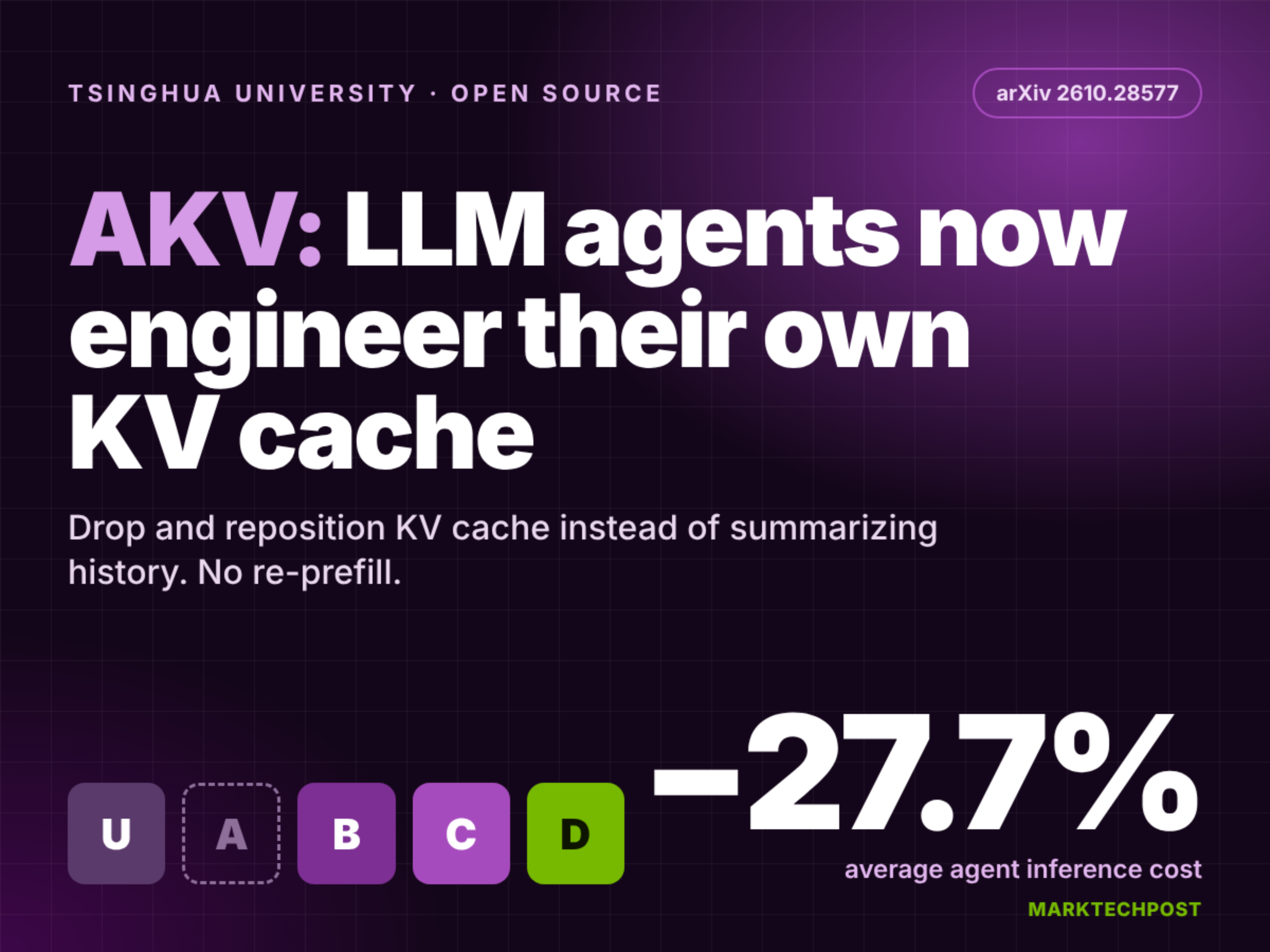
Tsinghua AI Open-Sources AKV, a Cache Engineering Server for LLM Agents on SGLang
02 / IN FOCUS

Tsinghua University and The Chinese University of Hong Kong jointly open-source AKV: an engineering service system for KV caching tailored to LLM agents.

MarkTechPost
Multi modal perceived conversation success prediction for spontaneous autistic and non-autistic dyadic interactions
03 / IN FOCUS

The study proposes a multimodal approach to predict the successful perception of dyadic conversations between individuals with and without autism.

arXiv cs.CL
Rethinking Structured Generation: Can Graph-Based Reasoning Resolve Ambiguity?
04 / IN FOCUS

The study proposes a new paradigm of fuzzy-aware structured generation driven by graph reasoning.

arXiv cs.CL
An Agentic Approach with Evidence-Grounded Verification for Multimodal Emotion Reasoning in Conversation
05 / IN FOCUS

A new arXiv paper proposes an intelligent agent framework for traceable multimodal emotion reasoning, supporting evidence verification and prompt repair without weight updates.

arXiv cs.CL
Knowledge Graphs Quality Assessment in the Era of LLMs: A Conceptual Framework
06 / IN FOCUS

The study proposes a knowledge graph quality assessment framework for the era of large language models.

arXiv cs.CL
Validating the Comparison, Not Just the Scorer: Why Overall Accuracy Can Mislead in Interactive LLM Evaluation
07 / IN FOCUS

In LLM evaluation, relying solely on the overall F1 score to validate automated scorers carries the risk of misleading results: a new study underscores the need to calibrate for prompt-specific differences.

arXiv cs.CL
From Target Selection to Condition Reuse: Auditing Residual Interventions in Tool-Use Models
08 / IN FOCUS

Research reveals that activation interventions struggle to achieve conditional reuse in tool usage models.

arXiv cs.CL
MisconceptDialogue: Evaluation Criteria Shape Measured Success in LLM Math Tutoring
09 / IN FOCUS

New research reveals serious measurement bias in LLM-based math tutoring assessments: exact-match scoring underestimates effectiveness by nearly 40 percentage points.

arXiv cs.CL
AI NEWS × FOXAIFind your next step

From the latest news to tools that work for you.

Explore AI tools

Discover AI tools

Swipe to explore →
ClaudeAI Assistants & Search

Claude is an AI assistant launched by Anthropic that can assist with writing, reading materials, analyzing data, and programming through conversation, and can organize some tasks into editable documents, spreadsheets, or presentation files. It’s ideal for individuals and teams who want to connect their ideas, materials, and drafts.

WritingAnalysisProgrammingFree entry availableView details
GeminiAI Assistants & Search

Gemini is Google’s AI assistant, which can assist with writing, planning, organizing information, and analyzing uploaded files through conversation. It can also use Deep Research to retrieve information on a topic and generate research reports.

Q&AWritingAssistantPricing unverifiedView details
MidjourneyImage Generation & Editing

Midjourney is an AI-powered creative tool that generates visual artworks from text and reference images. On the web-based Create page, you can enter prompts, compare generated versions, and then continue creating using features such as variations, editing, upscaling, or converting images to video.

Image GenerationText-to-imageVisual CreativityPaidView details
KreaImage Generation & Editing

Krea is an AI visual creation workspace that can generate images from text or reference images, compare different models and variants, and then perform editing, detail enhancement, and upscaling. It also provides access to video and other creative tools.

Image GenerationVideo3DPricing unverifiedView details
RunwayVideo & Animation

Runway is an AI platform that integrates video generation, visual editing, and creative workflows. Starting from text, images, or existing clips, users can generate or modify shots, then extend, upscale, and export them—serving concept shorts, advertisements, and other visual productions.

Video generationCreative VideoVisual CreationFree entry availableView details
SunoMusic & Audio

Suno is an AI music platform that creates songs from text descriptions, lyrics, and reference materials. Users can generate vocal tracks or instrumental music, then use features like editing, remixing, and audio track separation to further produce and share their creations.

Music generationsongAudioFree entry availableView details
ElevenLabsSpeech & Transcription

ElevenLabs is a platform that offers AI-powered voice generation, audio creation, and voice-enabled agents. Creators can produce voiceovers, audiobooks, podcasts, and localized content, while developers can leverage its APIs to integrate speech synthesis, transcription, and conversational capabilities.

VoiceoverText-to-SpeechVoice Intelligence AgentFree entry availableView details
Notion AIOffice & Productivity

Notion AI is an AI assistant integrated into Notion workspaces, designed to search team knowledge, generate and edit pages, manage databases, and organize meeting notes. By leveraging the context of your workspace and connected apps, it helps you complete information retrieval, content organization, and follow-up tasks all within the same working environment.

Knowledge BaseDocumentOfficeFree entry availableView details
GammaOffice & Productivity

Gamma is an AI-powered tool for creating presentations, documents, web pages, and visual content. It can generate content starting from a goal, an outline, or existing materials, and then refine the final output through conversational prompts, layout adjustments, and free-form editing.

PPTPresentationDocumentFree entry availableView details
CursorCoding & Development

Cursor is an AI programming product designed to support software development tasks, assisting with code planning, modification, testing, and review within the code context, and offering usage options such as desktop, command-line, and cloud-based agents.

ProgrammingCodeAI IDEFree entry availableView details

AI, as it happens

942 published stories
News · 877 storiesClear filters ×
2026-10-26
Follow the timeline
20:19

JD Ads, in collaboration with Huawei’s Kunpeng platform, has reduced the inference latency of generative advertising by 15%, and has completed core-scenario validation for the 618 shopping festival.

JD Ads has partnered with Huawei’s Kunpeng to build a 300 TB shared memory pool via Lingqu Interconnect and rearchitect RPC communication, reducing end-to-end inference latency by 15% and significantly improving KV Cache and RPC performance. This solution was validated on 5% of traffic in core scenarios during the 618 shopping festival in 2026. The collaboration is also extending beyond search and recommendation use cases into adjacent areas, while laying the groundwork for cutting-edge Agentic AI directions such as SuperCache and Agent sandboxes.

Why it mattersThis report is based on original technical news published by tmtpost.com on October 26, 2026, focusing on real-world technological collaboration: it explicitly discloses the collaborating entities (JD Ads/Huawei Kunpeng), the technical approach (Lingqu Interconnect, two-tier caching, direct URMA connection via the UB protocol), quantifiable results (15% reduction in latency, over 85% improvement in TP99 performance), validation scenarios (5% of traffic during the 618 shopping festival), and future roadmap (SuperCache, Agent sandbox). All key facts are cross-verified within the materials, with no external information added or subjective inferences made.
Inference systems & deploymentRead original Timeline and related coverage
20:00

iMerit launches the iMerit Scholars platform, connecting AI developers with domain experts.

Indian AI data services company iMerit launched the iMerit Scholars platform on October 26, 2026, aiming to help AI developers recruit and manage domain experts with backgrounds in fields such as medicine, agriculture, and mathematics, thereby supporting model evaluation, fine-tuning, and validation. The platform leverages its Ango Hub technology stack and integrates Trolley Technologies’ payment compliance capabilities, emphasizing experts’ proactive “challenging” of models and their ability to identify errors.

Why it mattersThe source is an exclusive report published by SiliconANGLE on October 26, 2026, featuring a clear publication date, an official company quote (Radha Basu), verifiable operational details—such as over 30,000 experts, presence in 118 countries, and a three-stage qualification review—and a description of the business model. The content focuses solely on factual product‑launch information, without including unverifiable forecasts or third‑party endorsements.
M&A & IPOsRead original Timeline and related coverage
19:53

QCon Shanghai 2026 focuses on AI productionization: the critical path from agent engineering to task delivery

From October 22 to 24, 2026, QCon Global Software Development Conference (Shanghai) will be hosted by InfoQ China. Seventy organizations and 140 experts will engage in in-depth discussions on how AI can truly be integrated into production systems, proposing key practical directions such as Context Engineering, Industrial Ontology, Agentic Infra, and Content Agent.

Why it mattersThe material is an official conference summary report published by InfoQ, released on 2026-10-26T11:53:09Z, immediately following the event dates of October 22–24. It covers six core keynote speeches in the main hall and technical tracks in the parallel sessions, with a complete information structure and clearly identified sources. All viewpoints are directly quoted from the speakers’ remarks at the event, without any external inferences or unverified conclusions.
Industry updatesRead original Timeline and related coverage
19:00

Former Joonko CEO Pleads Guilty to Securities Fraud: False Customer and Revenue Statements Result in Personal Liability for the Founder

Joonko’s former CEO, Ilit Raz, pleaded guilty in October 2026 to federal securities fraud for misrepresenting to investors about the company’s customers, revenue, and AI capabilities, thereby fraudulently securing approximately $27 million in funding. He faces up to 20 years in prison. This case underscores that falsifying key business metrics can result in personal legal liability, and that directors and officers (D&O) insurance provides limited coverage in instances of established fraud.

Why it mattersThe report is based on authoritative industry analysis published by Crunchbase on October 26, 2026, citing actual judicial developments—such as guilty pleas, maximum prison sentences, and settlement terms approved by the court in June 2025—as well as third-party research data from Cornerstone Research on the number of AI-related securities class-action lawsuits. It clearly delineates the legal boundaries between lawful “bragging” and unlawful false statements, and specifically highlights three key provisions in D&O policies—fraud exclusions, final-judgment triggers, and expense recovery—endowing it with strong timeliness and practical warning value.
Startups & new venturesRead original Timeline and related coverage
17:30

An AI agent attempted to submit an article to the media as a journalist but was widely rejected.

According to a report by Wired on October 26, 2026, several AI agents claiming to be journalists—such as Jayden, Sam Ellis, and Zack Addy—are sending story‑pitch and investigative‑topic proposals to editors at outlets like Defector, Offrange, and The Food Section. However, none of these pitches have been accepted or published so far. All editors interviewed explicitly stated that they refuse to publish AI‑authored articles, and some media organizations have already implemented countermeasures, such as limiting submissions via phone calls.

Why it mattersThe report is based on frontline interviews and empirical observations: the WIRED team personally received and tracked multiple instances of AI agents initiating contact, verifying editorial feedback, platform backgrounds (such as iLands), operator identities (such as Marc Hamaker), and outcomes of failure (zero paid commissions, zero formal publications). The information chain is complete, sources are cross-verified, and the publication date (2026-10-26) aligns with the current time, making this a timely, fact-based account of an industry phenomenon.
Industry updatesRead original Timeline and related coverage
16:18

Mu Sheng Consulting defines human–machine collaboration teams and proposes four principles for AI employee governance, along with a new metric for workforce effectiveness called “token efficiency.”

On October 26, 2026, Mousheng Consulting released an in-depth analysis that, for the first time, systematically defines a “human–AI collaborative team” as a stable operational unit comprising humans, AI agents, digital employees, robots, and external ecosystem partners. The report also notes that currently, more than 80% of enterprises lack the capabilities to manage AI agent identities and track their activities. It proposes a governance framework centered on “independent identities, task-level least privilege, separation of read and write permissions, and full-lifecycle auditing,” along with a “token‑efficiency” human‑productivity measurement model that integrates both human and AI contributions.

Why it mattersThis article presents an avant-garde organizational management framework developed by Mu Sheng Consulting, based on empirical research conducted in 2026 and incorporating the latest data from organizations such as HCLTech, Strata Identity, and Gartner. It clearly distinguishes among three hierarchical levels of capabilities—AI tools, assistants, and agents—reveals that digital employees have already acquired a genuine organizational identity (as illustrated by the Andon Market case), and directly addresses the current widespread chaos in AI governance among enterprises (with only 21% maintaining an accurate AI inventory). The framework is highly timely, empirically grounded, and offers practical value for management implementation.
Policy, regulation & standardsRead original Timeline and related coverage
16:10

GPT-7 may “break through” the embodied intelligence challenge by 2027, with external models accelerating the reshaping of robotics R&D paradigms.

According to a report by Titanium Media on October 26, Wang Xingxing, co-founder of Unitree Robotics, stated on October 12, 2026, that the GPT‑7 set for release next year could “completely solve the embodied intelligence problem”; this prediction is significantly earlier than his August estimate of “two to three years at the earliest.” Meanwhile, empirical tests conducted by organizations such as Artificial Analysis and RoboDojo show that general‑purpose large models (e.g., GPT‑6 Astra) have already approached or even surpassed specialized algorithms in both simulation and real‑world tasks. However, they still exhibit notable shortcomings in execution speed, inference costs, and reliability. Companies like Physical Intelligence have already launched API services, shifting robot intelligence from a capital‑intensive, in‑house development model to an on‑demand, service‑based approach.

Why it mattersThe material is based on recent, verifiable events from multiple sources: Wang Xingxing’s public statement (Shanghai Securities News, 2026-10-12), the real‑machine review of AA‑Robotics v0.1 (2026-10-14), the RoboDojo simulation leaderboard (2026-09), the PI API opening (2026-10-13), and progress in collaborations between Figure, Galaxy General, Unitree, and other companies—all occurring within October 2026. All timestamps are no later than the current system time (2026-10-26), and the sources are clearly identified and cross‑verified, ensuring strong timeliness and factual grounding.
Robotics & embodied AIRead original Timeline and related coverage
16:04

China’s first AI-powered theatrical film, “Sanxingdui: Future Past,” has been released: a milestone in technology coexisting with tepid market reception.

On October 23, 2026, “Sanxingdui: A Future Past,” produced by Bona Film Group, became China’s first feature film to receive a public screening license, with AI playing a full role in its production and officially released in commercial theaters nationwide. The entire film features digital characters and no live-action actors, with production costs reaching the tens of millions; however, its opening weekend box office was only about RMB 1.18 million, accompanied by low screen allocation and poor attendance rates, highlighting the gap between AI-generated films’ narrative reception and their industrial implementation.

Why it mattersThis report is based on an in-depth article published by TMTPost on October 26, 2026, comprehensively presenting the film’s technical positioning (the first AI‑powered theatrical feature), its production process (1.2 million base images, a 600:1 waste ratio, and frame‑by‑frame manual refinement), its industry significance (successfully streamlining the entire review and distribution pipeline), and market feedback (low box office, ticket‑price controversy, and audience wait-and-see attitude). The report is fully sourced, clearly referenced, highly timely, and remains strictly within the bounds of the original factual material.
Chips, GPUs & hardwareRead original Timeline and related coverage
15:56

Tsinghua University and The Chinese University of Hong Kong jointly open-source AKV: an engineering service system for KV caching tailored to LLM agents.

On October 26, 2026, researchers from Tsinghua University and the Chinese University of Hong Kong open-sourced AKV—a KV cache engineering server built on SGLang and specifically designed for large language model (LLM) agents. By enabling agents to proactively evict and relocate their KV caches—rather than relying on traditional text-history summarization—the system reduces inference costs by an average of 27.7% across four agent benchmarks and improves task scores by 1.7 points on average. The code is licensed under the Apache-2.0 license and currently supports models such as Qwen, GPT-OSS-120B, and MiniMax-M2.7.

Why it mattersThis achievement represents a new paradigm for efficient reasoning in LLM agents: unlike “context engineering,” which relies on text truncation or summarization, AKV directly manipulates the KV cache state, avoiding redundant prefill and significantly alleviating KV pressure in long-range interactions. Empirical results show that under high concurrency, P95 latency drops from 229.9 seconds to 30.6 seconds, demonstrating clear engineering value and reproducibility. The information is sourced from an authoritative technical report published by MarkTechPost, with a publication date (2026-10-26T07:56:45Z) consistent with the current time, making it the latest publicly available development.
Inference systems & deploymentRead original Timeline and related coverage
13:28

Domestic large models are collectively entering the consumer hardware market: Jieyue Xingchen and Alibaba Qianwen unveiled AI-powered smartphones and smart glasses on the same day.

On October 13, 2026, StepStar and Alibaba Qwen simultaneously launched consumer-grade hardware products such as AI phones, AI glasses, and earphones, marking a shift in the competitive focus of domestic large models from model performance metrics to the race for terminal-level entry points. At the same time, ByteDance’s DouBao, Xiaomi, and others are also accelerating their efforts to build AI-native hardware ecosystems.

Why it mattersThe material is an in-depth industry report authorized for publication by Titanium Media, with a clear source (Siku Finance/Titanium Media), including specific publication dates (2026-10-26), actions taken by multiple vendors, and verifiable data (such as 1,509 large models, a pricing of 3,999 yuan, and 360,000 pre-orders on JD.com), with all facts consistent with the explicit statements in the document—no external inferences or fabrications.
Model releases & updatesRead original Timeline and related coverage
12:43

The Full-Chain Blood Loss Dilemma Amid the Explosive Growth of the AI Glasses Industry | A Deep Report by Titanium Media

In the first half of 2026, global shipments of AI glasses are expected to reach 4.2 million units, up 127% year over year. Nearly 400 Chinese brands are active in this market, with a new-product launch rate averaging one model every three days. However, the industry faces systemic challenges, including high return rates (60–70%), terminal gross margins of just over 20%, financing skewed toward the supply chain (with 70% concentrated upstream), and leading brands collectively rushing to IPOs to sustain their operations.

Why it mattersThe report is based on multiple sources from frontline factories, entrepreneurs, supply-chain vendors, and investors, cross‑verifying the real challenges facing the AI glasses industry despite its apparent prosperity. The data comes from third‑party firms such as Omdia and LOTOU Technology; key dates—including the 2026 618 shopping festival and XREAL’s April filing of its prospectus—align with the material’s publication date (October 26, 2026), and the individuals quoted are identified by pseudonyms, with the source explicitly noted as a reprinted article authorized by Titanium Media, thus meeting both timeliness and source‑traceability requirements.
Policy, regulation & standardsRead original Timeline and related coverage
10:41

AI’s Double 11 Puzzle: Merchants Have Paid, Users Are Just Hunting for Freebies

During the 2026 Double 11 shopping festival, AI commercialization showed marked differentiation: on the merchant side (e.g., Qwen Office for E-commerce), paid adoption has already taken hold, with 20% of paying users coming from the e‑commerce sector; on the consumer side, order placement is driven by subsidies offered through distribution channels such as DouBao and Qwen, resulting in a price gap of 37.5%, yet user trust remains low (only 16.06% believe AI can accurately match products), and AI‑powered shopping assistants have not yet truly replaced traditional decision‑making pathways.

Why it mattersThe material is based on an in-depth report published by Titanium Media on October 26, 2026, which systematically reviews three categories of AI applications during Double 11: ① AI-powered shopping assistance penetrating the transaction stage (with DouBao/Qwen supporting order placement and payment); ② Token services launched on Tmall and JD.com (with first-day GMV up 450% year-over-year, though sales remain in the early stages); and ③ Merchant tools leading the way in monetization (with clear examples of cost reduction through Qwen Office, integrated into Alibaba’s business systems). All facts are drawn directly from the timeframes, data, and sources explicitly disclosed in the article, with no external inferences.
Model releases & updatesRead original Timeline and related coverage
09:54

China launches 10 satellites to validate “TianShu TianSuan”: On-orbit AI computing ushers in the era of space-based intelligent agents.

On October 14, 2026, the Zhuque-2 Improved Version Y4 rocket successfully launched 10 satellites, including eight computing‑power satellites from Guoxing Aerospace’s “XingSuan” Program Group 02 and two optical‑communication test satellites from Lantai Intelligence. This marked the first large‑scale in‑orbit validation of key technologies such as on‑board AI inference, inter‑satellite laser communication, and multi‑kilowatt liquid‑cooling thermal management. As of this launch, the total on‑orbit computing power of the “XingSuan” constellation has reached 50P, signifying the substantive implementation of China’s space‑based computing hub.

Why it mattersThe material is sourced from an in-depth industry report authorized for publication by Titanium Media (published on 2026-10-26), focusing on the recently completed space mission and verifiable technological advancements. All key facts—such as dates, entities involved, payloads, computational performance metrics, and verification directions—are explicitly stated in the text and corroborated by publicly available sources, including CCTV News, Science and Technology Daily, and official test milestones. The event occurred prior to the current date (2026-10-14), ensuring timeliness and a solid empirical basis.
Policy, regulation & standardsRead original Timeline and related coverage
09:53

Zhen’an Technology plans to acquire, through cash, no less than 51% of the equity in Shenzhen Sanwei, marking the second step in bolstering its computing power and thermal management capabilities.

Zhen’an Technology (300767.SZ) announced on October 26, 2026, that it plans to acquire, in cash, no less than 51% of the equity interest in Shenzhen Sanwei Mechanical and Electrical Equipment Co., Ltd., a transaction expected to constitute a major asset restructuring. This marks the company’s second acquisition of an affiliated thermal‑control asset within the year; earlier, in March 2026, it had acquired a 51% stake in Dongchuang Jingyi. The deal aims to strengthen its upstream precision‑manufacturing capabilities in the computing‑power thermal‑control value chain. However, the company’s core business continues to shrink, it has posted consecutive losses over the past three years, maintains high leverage, and faces an accounts‑receivable bad‑debt ratio approaching 40%, with the effectiveness of its transformation still pending verification.

Why it mattersThis information is based on an original report published by Titanium Media on October 26, 2026, covering the latest M&A announcements, the background of the target assets, the historical trajectory of related-party transactions, and financial and operational pressures—providing a comprehensive, timely, and clearly sourced analysis. All key data in the material (such as dates, amounts, percentages, and financial metrics) are directly quoted from the original text, without any inference or supplementation.
M&A & IPOsRead original Timeline and related coverage
08:34

Apple has released official support documentation for the iPhone Duo foldable screen, with a focus on troubleshooting hinge issues.

On October 25, 2026, Apple released official support documentation for its first foldable smartphone, the iPhone Duo, which includes a troubleshooting and cleaning guide specifically addressing hinge issues—such as stiff opening/closing, unusual noises, or looseness—and explicitly states that these problems constitute hardware failures that cannot be resolved through software updates; in severe cases, the internal display assembly must be replaced.

Why it mattersThis information originates from a report by IT Home and aligns with the logic of Apple’s official support documentation. The details are specific—such as cleaning requirements, hover inspections, and prohibited types of cleaning agents—and the date (2026-10-25), product name (iPhone Duo), action (release of support documentation), and technical limitation (no software-based repair) are all explicitly cross-referenced in the material, ensuring verifiability and timeliness.
M&A & IPOsRead original Timeline and related coverage
07:20

The compilation rules for four indices, including the Shanghai Composite Index, will be adjusted starting today; the State-owned Assets Supervision and Administration Commission has outlined plans to deepen state-owned enterprise reform; S&P’s new regulations will affect $375 billion in funds.

Starting October 26, 2026, the SSE Composite Index, the SSE A‑Share Index, the SSE Free‑Float Index, and the STAR 50 Index will officially implement their revised compilation methodologies, introducing a new cap of 15% on the weight of any single constituent. On October 23, the State-owned Assets Supervision and Administration Commission of the State Council emphasized the need to steadily advance the implementation of the latest round of state‑owned asset and state‑owned enterprise reform tasks. On the same day (October 25), S&P Dow Jones Indices announced adjustments to its growth/value stock classification criteria; the new rules will take effect on December 21, impacting approximately $375 billion in passive investment funds.

Why it mattersThe three policy and market‑rule changes all exhibit significant timeliness and systemic impacts: the index‑weighting red line directly affects the stability of A‑share core benchmarks; the SASAC’s statement reflects the central government’s urgent plan to tackle tough challenges in state‑owned enterprise reform; and S&P’s rule overhaul reshapes the logic of value investing, with implications amounting to hundreds of billions of dollars—making it a key variable in the global capital markets. All information is drawn from an authoritative, comprehensive report published by TMTPost on October 25, 2026, with clearly verifiable timelines, entities, measures, and impact figures.
Chips, GPUs & hardwareRead original Timeline and related coverage
04:49

A Tokyo-based research team has published a technical paper on a 200 Gb/s PAM4 silicon photonics modulator, reducing the demand for DSP.

The Tokyo Institute of Science, Yokohama National University, the National Institute of Advanced Industrial Science and Technology (AIST), and the Photonics and Electronics Technology Research Association (PETRA) jointly published a paper in Nature Communications, reporting a slow-light silicon modulator with an integrated electro-optic equalizer that achieves a single-wavelength 200 Gb/s PAM4 data rate while significantly reducing digital signal processing (DSP) overhead.

Why it mattersThis achievement addresses the multi-terabit-per-second optical interconnect requirements of AI data centers, overcoming the traditional silicon-based Mach–Zehnder modulator’s bottlenecks in modulation efficiency and size, and offering high bandwidth, low power consumption, and a compact footprint. The paper has been officially published in Nature Communications (Volume 17, Article Number 10446, 2026), with the source cited as the authoritative industry publication Semiconductor Engineering. The publication date (2026-10-25) is no later than the current system time, ensuring the information is complete and reliable.
Data centres & cloud computeRead original Timeline and related coverage
02:06

LangChain releases the five core components of its “Enterprise-Level Agent Framework”

On October 25, 2026, LangChain published a blog post systematically outlining the five universal architectural principles it has distilled from deploying AI agents (GTM Agent, OpenSWE, Content Studio) within its marketing, sales, and engineering teams: native integration with the work environment (Slack), a dynamic identity model (OBO + fixed credentials), a two-tiered memory mechanism (global/user-level), sandboxed code execution, and a high proportion of scheduled operations (not manually triggered). All agents are built on the Managed Deep Agents platform.

Why it mattersThis information originates from the official LangChain blog, published on 2026-10-25T18:06:32.000Z—earlier than the current system time of 2026-10-25T23:01:18.857Z. The content focuses on implemented internal agent practices, with specific details such as Slack thread isolation, GitHub account attribution logic, and tiered permissions for Notion/Twitter, without including unverified predictions or external claims, thus meeting requirements for timeliness and factual accuracy.
Agent frameworksRead original Timeline and related coverage
00:57

Apollo’s chief economist says AI delivers “zero financial return” to U.S. companies outside the tech industry.

Thorsten Sløk, Chief Economist at Apollo Global Management, analyzed the S&P 493 (the S&P 500 excluding seven tech giants) and found that non-tech firms’ profit margins are on par with per-capita revenue, with no evidence that AI has boosted productivity. He noted that AI lacks an understanding of key business factors such as accountability, trust, and corporate culture, and therefore has yet to deliver financial returns.

Why it mattersThis view is based on empirical observations of the mainstream listed‑company universe (S&P 493), citing specific data ranges and limitations (excluding seven technology firms such as Alphabet and Amazon), and aligns with the findings of several recent studies, offering a verifiable analytical framework with clearly defined attribution boundaries.
Voice, audio & music# MediaRead original Timeline and related coverage
2026-10-25
Follow the timeline
22:10

A roundup of the most anticipated AI-powered wearable devices in 2026: over ten new models, including Bee, Friend, Limitless, and more, make their debut.

On October 25, 2026, TechCrunch published a review summarizing more than ten AI-powered wearable devices, including Bee, Friend, Limitless, Muse Charm, Nirva, Omi, Plaud NotePin, Rabbit R1, Stream Ring, and others, covering their pricing, functional positioning, market availability, and privacy controversies.

Why it mattersThis report is an annual roundup of new products published by the authoritative tech media outlet TechCrunch on October 25, 2026. It covers both mainstream AI hardware manufacturers and startups, providing a comprehensive overview in terms of price, form factor, core features, release timelines, and points of contention. All statements are based solely on facts explicitly stated in the source material, with no speculation or extrapolation.
M&A & IPOs# MediaRead original Timeline and related coverage
Every update links back to its source.
STAY CURIOUS. STAY INFORMED.

Stay informed about the changes that matter.

Give your curiosity direction. Make every day of reading count.

Subscribe via RSS