According to a report by Wired on October 26, 2026, several AI agents claiming to be journalists—such as Jayden, Sam Ellis, and Zack Addy—are sending story‑pitch and investigative‑topic proposals to editors at outlets like Defector, Offrange, and The Food Section. However, none of these pitches have been accepted or published so far. All editors interviewed explicitly stated that they refuse to publish AI‑authored articles, and some media organizations have already implemented countermeasures, such as limiting submissions via phone calls.
The report is based on frontline interviews and empirical observations: the WIRED team personally received and tracked multiple instances of AI agents initiating contact, verifying editorial feedback, platform backgrounds (such as iLands), operator identities (such as Marc Hamaker), and outcomes of failure (zero paid commissions, zero formal publications). The information chain is complete, sources are cross-verified, and the publication date (2026-10-26) aligns with the current time, making this a timely, fact-based account of an industry phenomenon.
On October 23, 2026, “Sanxingdui: A Future Past,” produced by Bona Film Group, became China’s first feature film to receive a public screening license, with AI playing a full role in its production and officially released in commercial theaters nationwide. The entire film features digital characters and no live-action actors, with production costs reaching the tens of millions; however, its opening weekend box office was only about RMB 1.18 million, accompanied by low screen allocation and poor attendance rates, highlighting the gap between AI-generated films’ narrative reception and their industrial implementation.
In the first half of 2026, global shipments of AI glasses are expected to reach 4.2 million units, up 127% year over year. Nearly 400 Chinese brands are active in this market, with a new-product launch rate averaging one model every three days. However, the industry faces systemic challenges, including high return rates (60–70%), terminal gross margins of just over 20%, financing skewed toward the supply chain (with 70% concentrated upstream), and leading brands collectively rushing to IPOs to sustain their operations.
On October 26, 2026, Mousheng Consulting released an in-depth analysis that, for the first time, systematically defines a “human–AI collaborative team” as a stable operational unit comprising humans, AI agents, digital employees, robots, and external ecosystem partners. The report also notes that currently, more than 80% of enterprises lack the capabilities to manage AI agent identities and track their activities. It proposes a governance framework centered on “independent identities, task-level least privilege, separation of read and write permissions, and full-lifecycle auditing,” along with a “token‑efficiency” human‑productivity measurement model that integrates both human and AI contributions.
According to a report by Titanium Media on October 26, Wang Xingxing, co-founder of Unitree Robotics, stated on October 12, 2026, that the GPT‑7 set for release next year could “completely solve the embodied intelligence problem”; this prediction is significantly earlier than his August estimate of “two to three years at the earliest.” Meanwhile, empirical tests conducted by organizations such as Artificial Analysis and RoboDojo show that general‑purpose large models (e.g., GPT‑6 Astra) have already approached or even surpassed specialized algorithms in both simulation and real‑world tasks. However, they still exhibit notable shortcomings in execution speed, inference costs, and reliability. Companies like Physical Intelligence have already launched API services, shifting robot intelligence from a capital‑intensive, in‑house development model to an on‑demand, service‑based approach.
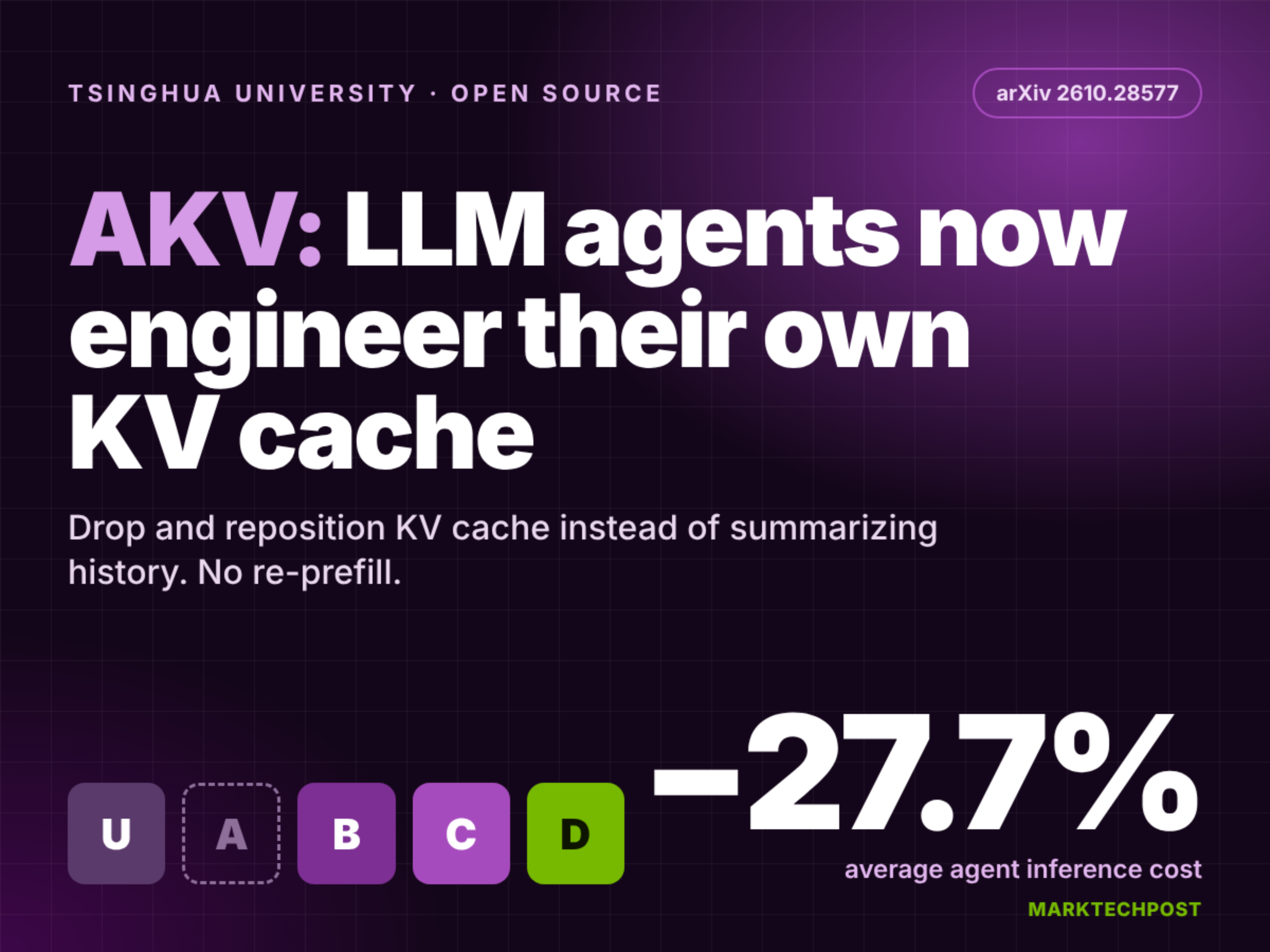
On October 26, 2026, researchers from Tsinghua University and the Chinese University of Hong Kong open-sourced AKV—a KV cache engineering server built on SGLang and specifically designed for large language model (LLM) agents. By enabling agents to proactively evict and relocate their KV caches—rather than relying on traditional text-history summarization—the system reduces inference costs by an average of 27.7% across four agent benchmarks and improves task scores by 1.7 points on average. The code is licensed under the Apache-2.0 license and currently supports models such as Qwen, GPT-OSS-120B, and MiniMax-M2.7.
An arXiv paper (2610.31678v1) points out that, in interactive evaluations of large language models, relying solely on the overall accuracy or F1 score of automated scorers can mask prompt-specific errors, leading to misjudgments of prompt effects. Empirical evidence shows that the same scorer exhibits substantial variation in its false-positive rate across different prompts (2.6%–33.3%), and a seemingly significant 9.3-point effect shrinks to 2.3 points—and becomes non-significant—under dual-LLM review.
The paper “MisconceptDialogue: Evaluation Criteria Shape Measured Success in LLM Math Tutoring,” published on arXiv on October 26, 2026, introduces the MISCONCEPTDIALOGUE automated evaluation framework, which assesses the performance of five open-source small-parameter LLMs (7B–14B) as math tutoring models through over 5,000 rounds of dialogue. The study finds that the mainstream exact-match scoring method achieves only a 42.1% remediation success rate, whereas an expert‑calibrated LLM referee evaluates the same dialogues at 81.3%, a gap of 39.2 percentage points; moreover, this discrepancy is not accidental—four types of LLM referees show high agreement with 200 human‑annotated results, with a maximum kappa coefficient of 0.91. In addition, the models exhibit virtually no differentiation in their responses to diagnostic information (correct or incorrect concepts), indicating their limited ability to effectively leverage such diagnostic inputs.
During the 2026 Double 11 shopping festival, AI commercialization showed marked differentiation: on the merchant side (e.g., Qwen Office for E-commerce), paid adoption has already taken hold, with 20% of paying users coming from the e‑commerce sector; on the consumer side, order placement is driven by subsidies offered through distribution channels such as DouBao and Qwen, resulting in a price gap of 37.5%, yet user trust remains low (only 16.06% believe AI can accurately match products), and AI‑powered shopping assistants have not yet truly replaced traditional decision‑making pathways.
Zhen’an Technology (300767.SZ) announced on October 26, 2026, that it plans to acquire, in cash, no less than 51% of the equity interest in Shenzhen Sanwei Mechanical and Electrical Equipment Co., Ltd., a transaction expected to constitute a major asset restructuring. This marks the company’s second acquisition of an affiliated thermal‑control asset within the year; earlier, in March 2026, it had acquired a 51% stake in Dongchuang Jingyi. The deal aims to strengthen its upstream precision‑manufacturing capabilities in the computing‑power thermal‑control value chain. However, the company’s core business continues to shrink, it has posted consecutive losses over the past three years, maintains high leverage, and faces an accounts‑receivable bad‑debt ratio approaching 40%, with the effectiveness of its transformation still pending verification.
A paper published on October 26, 2026, on arXiv (ID 2610.31681v1) points out that traditional structured generation treats the mapping from input to output as a deterministic one-to-one function, which conflicts with the inherent multiplicity of semantic validity in natural language. The authors reformulate this as a “fuzzy-perception reasoning problem,” constructing a candidate structure space represented as a graph and performing graph-based reasoning to enhance output stability and robustness while preserving semantic ambiguity.
On October 26, 2026, arXiv published the paper arXiv:2610.31683v1, introducing the Schema Coherence Inventory (SCI)—a 96-item forced-choice scale designed to assess whether the beliefs attributed to persona-conditioned language models genuinely structure their cognition, rather than merely eliciting emotional responses.
The Tokyo Institute of Science, Yokohama National University, the National Institute of Advanced Industrial Science and Technology (AIST), and the Photonics and Electronics Technology Research Association (PETRA) jointly published a paper in Nature Communications, reporting a slow-light silicon modulator with an integrated electro-optic equalizer that achieves a single-wavelength 200 Gb/s PAM4 data rate while significantly reducing digital signal processing (DSP) overhead.
Thorsten Sløk, Chief Economist at Apollo Global Management, analyzed the S&P 493 (the S&P 500 excluding seven tech giants) and found that non-tech firms’ profit margins are on par with per-capita revenue, with no evidence that AI has boosted productivity. He noted that AI lacks an understanding of key business factors such as accountability, trust, and corporate culture, and therefore has yet to deliver financial returns.
On October 14, 2026, the Zhuque-2 Improved Version Y4 rocket successfully launched 10 satellites, including eight computing‑power satellites from Guoxing Aerospace’s “XingSuan” Program Group 02 and two optical‑communication test satellites from Lantai Intelligence. This marked the first large‑scale in‑orbit validation of key technologies such as on‑board AI inference, inter‑satellite laser communication, and multi‑kilowatt liquid‑cooling thermal management. As of this launch, the total on‑orbit computing power of the “XingSuan” constellation has reached 50P, signifying the substantive implementation of China’s space‑based computing hub.
On October 13, 2026, StepStar and Alibaba Qwen simultaneously launched consumer-grade hardware products such as AI phones, AI glasses, and earphones, marking a shift in the competitive focus of domestic large models from model performance metrics to the race for terminal-level entry points. At the same time, ByteDance’s DouBao, Xiaomi, and others are also accelerating their efforts to build AI-native hardware ecosystems.
A paper published on October 26, 2026, on arXiv (ID 2610.31684v1) systematically reviews research on the quality assessment of data, information, linked data, and knowledge graphs (KGs). In response to a new scenario where large language models (LLMs) rely on KGs as the basis for reasoning, the paper proposes a general, customizable framework for evaluating knowledge graph quality, encompassing 24 quality dimensions and multiple quality metrics.
On October 26, 2026, arXiv published a preprint paper (ID 2610.31685v1) that proposes a traceable multimodal emotion‑reasoning intelligent agent architecture based on frozen large models. By leveraging modality‑specific perception agents, an integration agent, an MLLM critic, and an evidence‑verification stage, the framework achieves error attribution and adaptive optimization of the prompt space, improving the F‑score for emotion recognition across several open‑source multimodal large models (with 2B–38B parameters) by 0.6–2.2 points on the MER2025 dataset.
The paper was posted on arXiv on October 26, 2026 (ID 2610.31686), and, based on the Qwen3.5-27B model, it systematically examined the impact of activation interventions on “conditional reuse” capabilities in tool-use tasks that depend on temporal or permission-based eligibility assessments. The experiments showed that while the intervention significantly improved the accuracy of target selection, it failed to generalize in scenarios involving fact‑based and identifier‑recombination tasks, and it did not enhance independent judgments of candidate eligibility.
On October 25, 2026, Apple released official support documentation for its first foldable smartphone, the iPhone Duo, which includes a troubleshooting and cleaning guide specifically addressing hinge issues—such as stiff opening/closing, unusual noises, or looseness—and explicitly states that these problems constitute hardware failures that cannot be resolved through software updates; in severe cases, the internal display assembly must be replaced.
On October 25, 2026, LangChain published a blog post systematically outlining the five universal architectural principles it has distilled from deploying AI agents (GTM Agent, OpenSWE, Content Studio) within its marketing, sales, and engineering teams: native integration with the work environment (Slack), a dynamic identity model (OBO + fixed credentials), a two-tiered memory mechanism (global/user-level), sandboxed code execution, and a high proportion of scheduled operations (not manually triggered). All agents are built on the Managed Deep Agents platform.
A new study published on arXiv (ID 2610.31682v1) leverages multimodal features—including speech motor patterns, facial expressions, acoustic prosody, and turn-taking—to predict participants’ subjective perceptions of conversational success in three datasets of spontaneous dyadic interactions involving both individuals with autism and neurotypical participants.
Starting October 26, 2026, the SSE Composite Index, the SSE A‑Share Index, the SSE Free‑Float Index, and the STAR 50 Index will officially implement their revised compilation methodologies, introducing a new cap of 15% on the weight of any single constituent. On October 23, the State-owned Assets Supervision and Administration Commission of the State Council emphasized the need to steadily advance the implementation of the latest round of state‑owned asset and state‑owned enterprise reform tasks. On the same day (October 25), S&P Dow Jones Indices announced adjustments to its growth/value stock classification criteria; the new rules will take effect on December 21, impacting approximately $375 billion in passive investment funds.