








THE NEXT THING, IN PERSPECTIVEIndependent AI news

The latest AI news, in focus.

Official announcements and industry reporting. Follow the timeline of AI.

Today's news

News feed
When Traction Becomes Personal Exposure: What The Joonko Guilty Plea Means For Founders
01 / IN FOCUS

Former Joonko CEO Pleads Guilty to Securities Fraud: False Customer and Revenue Statements Result in Personal Liability for the Founder

Crunchbase AI
Tsinghua AI Open-Sources AKV, a Cache Engineering Server for LLM Agents on SGLang
02 / IN FOCUS

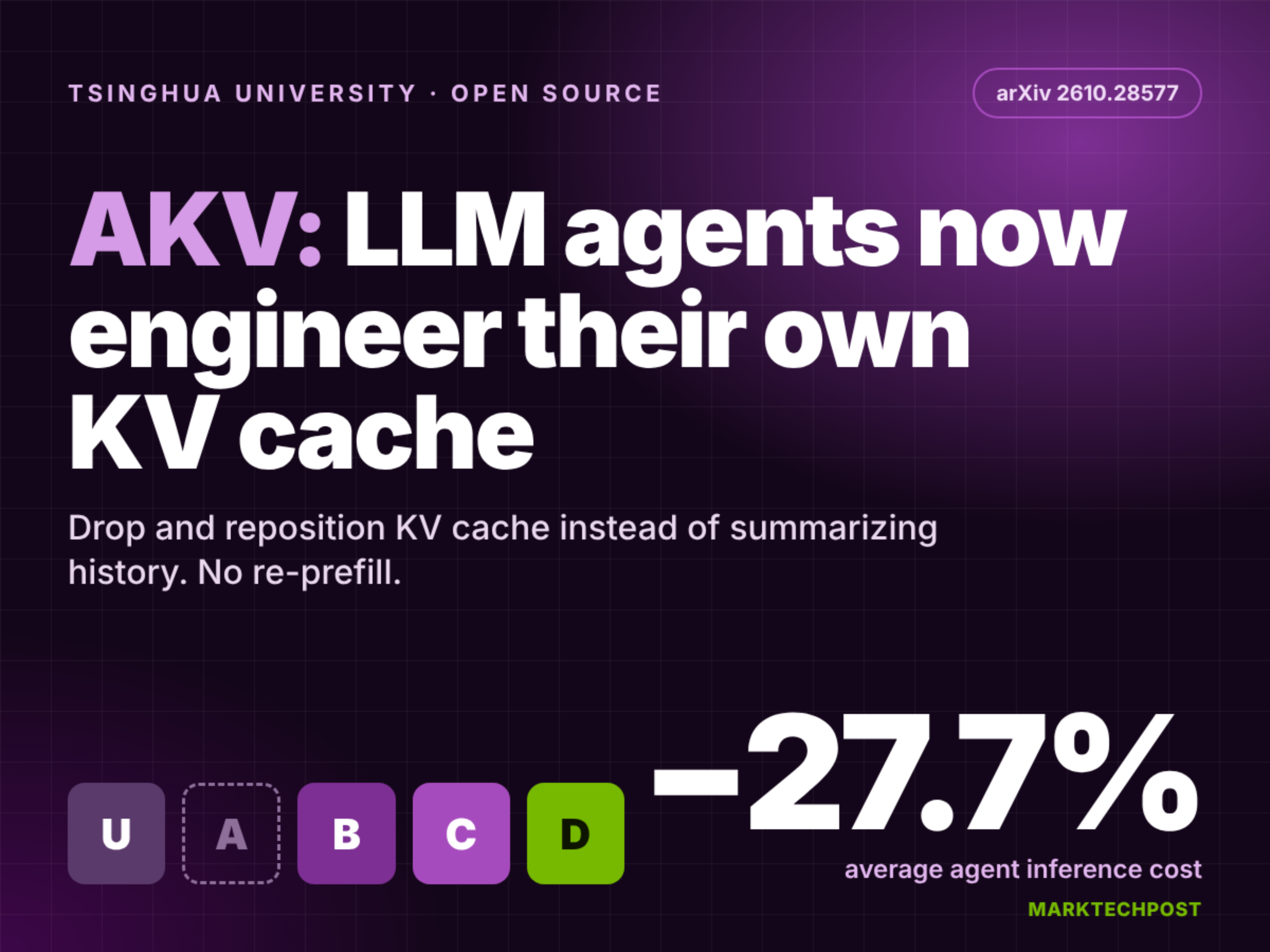
Tsinghua University and The Chinese University of Hong Kong jointly open-source AKV: an engineering service system for KV caching tailored to LLM agents.

MarkTechPost
Multi modal perceived conversation success prediction for spontaneous autistic and non-autistic dyadic interactions
03 / IN FOCUS

The study proposes a multimodal approach to predict the successful perception of dyadic conversations between individuals with and without autism.

arXiv cs.CL
Rethinking Structured Generation: Can Graph-Based Reasoning Resolve Ambiguity?
04 / IN FOCUS

The study proposes a new paradigm of fuzzy-aware structured generation driven by graph reasoning.

arXiv cs.CL
An Agentic Approach with Evidence-Grounded Verification for Multimodal Emotion Reasoning in Conversation
05 / IN FOCUS

A new arXiv paper proposes an intelligent agent framework for traceable multimodal emotion reasoning, supporting evidence verification and prompt repair without weight updates.

arXiv cs.CL
Knowledge Graphs Quality Assessment in the Era of LLMs: A Conceptual Framework
06 / IN FOCUS

The study proposes a knowledge graph quality assessment framework for the era of large language models.

arXiv cs.CL
Validating the Comparison, Not Just the Scorer: Why Overall Accuracy Can Mislead in Interactive LLM Evaluation
07 / IN FOCUS

In LLM evaluation, relying solely on the overall F1 score to validate automated scorers carries the risk of misleading results: a new study underscores the need to calibrate for prompt-specific differences.

arXiv cs.CL
From Target Selection to Condition Reuse: Auditing Residual Interventions in Tool-Use Models
08 / IN FOCUS

Research reveals that activation interventions struggle to achieve conditional reuse in tool usage models.

arXiv cs.CL
MisconceptDialogue: Evaluation Criteria Shape Measured Success in LLM Math Tutoring
09 / IN FOCUS

New research reveals serious measurement bias in LLM-based math tutoring assessments: exact-match scoring underestimates effectiveness by nearly 40 percentage points.

arXiv cs.CL
AI NEWS × FOXAIFind your next step

From the latest news to tools that work for you.

Explore AI tools

Discover AI tools

Swipe to explore →
ClaudeAI Assistants & Search

Claude is an AI assistant launched by Anthropic that can assist with writing, reading materials, analyzing data, and programming through conversation, and can organize some tasks into editable documents, spreadsheets, or presentation files. It’s ideal for individuals and teams who want to connect their ideas, materials, and drafts.

WritingAnalysisProgrammingFree entry availableView details
GeminiAI Assistants & Search

Gemini is Google’s AI assistant, which can assist with writing, planning, organizing information, and analyzing uploaded files through conversation. It can also use Deep Research to retrieve information on a topic and generate research reports.

Q&AWritingAssistantPricing unverifiedView details
MidjourneyImage Generation & Editing

Midjourney is an AI-powered creative tool that generates visual artworks from text and reference images. On the web-based Create page, you can enter prompts, compare generated versions, and then continue creating using features such as variations, editing, upscaling, or converting images to video.

Image GenerationText-to-imageVisual CreativityPaidView details
KreaImage Generation & Editing

Krea is an AI visual creation workspace that can generate images from text or reference images, compare different models and variants, and then perform editing, detail enhancement, and upscaling. It also provides access to video and other creative tools.

Image GenerationVideo3DPricing unverifiedView details
RunwayVideo & Animation

Runway is an AI platform that integrates video generation, visual editing, and creative workflows. Starting from text, images, or existing clips, users can generate or modify shots, then extend, upscale, and export them—serving concept shorts, advertisements, and other visual productions.

Video generationCreative VideoVisual CreationFree entry availableView details
SunoMusic & Audio

Suno is an AI music platform that creates songs from text descriptions, lyrics, and reference materials. Users can generate vocal tracks or instrumental music, then use features like editing, remixing, and audio track separation to further produce and share their creations.

Music generationsongAudioFree entry availableView details
ElevenLabsSpeech & Transcription

ElevenLabs is a platform that offers AI-powered voice generation, audio creation, and voice-enabled agents. Creators can produce voiceovers, audiobooks, podcasts, and localized content, while developers can leverage its APIs to integrate speech synthesis, transcription, and conversational capabilities.

VoiceoverText-to-SpeechVoice Intelligence AgentFree entry availableView details
Notion AIOffice & Productivity

Notion AI is an AI assistant integrated into Notion workspaces, designed to search team knowledge, generate and edit pages, manage databases, and organize meeting notes. By leveraging the context of your workspace and connected apps, it helps you complete information retrieval, content organization, and follow-up tasks all within the same working environment.

Knowledge BaseDocumentOfficeFree entry availableView details
GammaOffice & Productivity

Gamma is an AI-powered tool for creating presentations, documents, web pages, and visual content. It can generate content starting from a goal, an outline, or existing materials, and then refine the final output through conversational prompts, layout adjustments, and free-form editing.

PPTPresentationDocumentFree entry availableView details
CursorCoding & Development

Cursor is an AI programming product designed to support software development tasks, assisting with code planning, modification, testing, and review within the code context, and offering usage options such as desktop, command-line, and cloud-based agents.

ProgrammingCodeAI IDEFree entry availableView details

AI, as it happens

940 published stories
Inference systems & deployment · 16 storiesClear filters ×
2026-10-26
Follow the timeline
15:56

Tsinghua University and The Chinese University of Hong Kong jointly open-source AKV: an engineering service system for KV caching tailored to LLM agents.

On October 26, 2026, researchers from Tsinghua University and the Chinese University of Hong Kong open-sourced AKV—a KV cache engineering server built on SGLang and specifically designed for large language model (LLM) agents. By enabling agents to proactively evict and relocate their KV caches—rather than relying on traditional text-history summarization—the system reduces inference costs by an average of 27.7% across four agent benchmarks and improves task scores by 1.7 points on average. The code is licensed under the Apache-2.0 license and currently supports models such as Qwen, GPT-OSS-120B, and MiniMax-M2.7.

Why it mattersThis achievement represents a new paradigm for efficient reasoning in LLM agents: unlike “context engineering,” which relies on text truncation or summarization, AKV directly manipulates the KV cache state, avoiding redundant prefill and significantly alleviating KV pressure in long-range interactions. Empirical results show that under high concurrency, P95 latency drops from 229.9 seconds to 30.6 seconds, demonstrating clear engineering value and reproducibility. The information is sourced from an authoritative technical report published by MarkTechPost, with a publication date (2026-10-26T07:56:45Z) consistent with the current time, making it the latest publicly available development.
Inference systems & deploymentRead original Timeline and related coverage
2026-10-25
Follow the timeline
14:28

llama.cpp releases version b11871: adds a limit on JSON nesting depth to prevent service crashes

llama.cpp introduced a critical security fix in version b11871, imposing a hard limit of 128 nested JSON levels on requests to prevent HTTP thread stack overflows and service crashes caused by deep recursive parsing (triggering SIGBUS on macOS and SIGSEGV on Linux). This policy covers multiple input scenarios for the chat interface and uniformly returns an HTTP 400 error.

Inference systems & deploymentRead original Timeline and related coverage
10:30

Underdog Saluki 27B: Technical Analysis of the 2-bit Qwen3.8-27B Tool-Calling Model Based on GSQ-RCO

This article introduces Saluki 27B, a model released by Underdog—a 7.9 GB, 2-bit quantized variant of Qwen3.8-27B—built using the GSQ-RCO method from ISTA-DASLab. It claims to outperform the original 54 GB full-precision model on the BFCL v4 benchmark across 120 tasks; however, all performance conclusions are based solely on the developers’ assertions and have not been independently verified.

Inference systems & deploymentRead original Timeline and related coverage
10:15

llama.cpp has released version b11870, officially supporting the DeepSeek-V4.1-Flash model.

llama.cpp has added support for the DeepSeek-V4.1-Flash (deepseek41) model in version b11870, and implemented several low-level optimizations tailored to its Engram architecture, including simplification of KV cache computation, replacement of MXFP8 with BF16 precision, and in-graph row gather operations; it also provides multi-platform binary builds covering macOS, Linux, Windows, Android, iOS, and openEuler.

Inference systems & deploymentRead original Timeline and related coverage
05:18

llama.cpp releases version b11869: fixes Jinja template function argument handling and adds multi-platform binary support.

The llama.cpp project has released build version b11869, which primarily fixes the parameter-parsing logic for the select and selectattr functions in Jinja templates and provides precompiled binaries that support dozens of hardware–backend combinations across macOS, Linux, Windows, Android, iOS, and openEuler.

Inference systems & deploymentRead original Timeline and related coverage
04:23

llama.cpp releases version b11868: enhanced Hexagon NPU multi-core Flash Attention support, with cross-platform compilation and build capabilities.

llama.cpp v2.45.0 (tag b11868) has been officially released, with the core update being the introduction of a KV-head splitting mechanism in the Hexagon backend to optimize multi-core HMX Flash Attention performance and unify the FA splitting control flag. Binary packages are simultaneously available for all major platforms, including macOS, Linux, Windows, Android, iOS, and openEuler, supporting multiple backends such as CUDA 12/13, Vulkan, ROCm, OpenVINO, SYCL, and Snapdragon (Adreno + Hexagon).

Inference systems & deploymentRead original Timeline and related coverage
04:11

llama.cpp releases version b11867: server-side entry point refactored, with full support for multiple platforms and heterogeneous acceleration backends.

llama.cpp has officially released version b11867 on GitHub. Key changes include a refactored server entry point (PR #31113) and the addition of the server_role mechanism. Additionally, more than 40 precompiled binaries are now available, covering macOS, Linux, Windows, Android, iOS, and openEuler, with support for diverse hardware backends such as CPU, CUDA (12.4/12.8/13.4), Vulkan, ROCm 10.0, OpenVINO, SYCL (FP16/FP32), and Snapdragon (Adreno + Hexagon).

Inference systems & deploymentRead original Timeline and related coverage
03:51

llama.cpp releases version b11866: removes redundant AMAX scaling logic from the Metal backend and streamlines the MoE computation path.

llama.cpp v.b11866 has removed the outdated src1 power-of-two AMAX scaling mechanism from the Metal backend, instead relying on a more granular per-expert-token amax scaling within the computation graph, ensuring that MoE projection activation values remain within the f16 representation range; concurrently, it also deleted the associated two-stage reduction kernels, F32-precision scheduling, and out-of-bounds test cases.

Inference systems & deploymentRead original Timeline and related coverage
03:30

llama.cpp releases version b11865: adds RDMA receive boundary checking and supports multiple platform backends, including CUDA 13.4, ROCm 10.0, and Snapdragon NPU.

The llama.cpp project has released build version b11865, with core changes including the addition of memory-boundary checks in the RDMA receive logic (PR #30399) and a significant expansion of hardware-acceleration support, covering CUDA 13.4, ROCm 10.0, Vulkan, OpenVINO, SYCL, and Qualcomm Snapdragon—providing full-stack heterogeneous computing backends for CPU, Adreno, and Hexagon. macOS KleidiAI support and openEuler builds have been explicitly marked as DISABLED.

Inference systems & deploymentRead original Timeline and related coverage
03:13

llama.cpp releases version b11861: fixes an inference exception caused by the minimax-m3 model’s quantized scaling tensor not being propagated.

llama.cpp v.b11861 fixes the weight distortion issue in the minimax-m3 model that occurred under NVFP4/MXFP8 quantization due to the scale tensor not being injected into the computation graph, thereby preventing “token soup” and residual vanishing; it also provides multi-platform binary builds covering macOS, Linux, Windows, Android, iOS, and openEuler.

Inference systems & deploymentRead original Timeline and related coverage
2026-10-20
Follow the timeline
10-20

AnyLanguageModel 1.0 released: a unified Swift interface supporting both local and hosted models, compatible with the entire Apple platform family of operating systems 27

Hugging Face has officially released AnyLanguageModel 1.0, an open-source Swift framework fully compatible with the Apple Foundation Models API. It supports seamless switching between local models (MLX, llama.cpp, Core ML) and hosted models (OpenAI, Anthropic, Gemini, Hugging Face Inference Providers, etc.), and introduces new features such as image input, tool invocation, guided generation, and automatic adaptation of inference chunks.

Inference systems & deploymentRead original Timeline and related coverage
2026-09-22
Follow the timeline
2026-08-25
Follow the timeline
2026-07-08
Follow the timeline
2026-06-26
Follow the timeline
2026-01-22
Follow the timeline
Every update links back to its source.
STAY CURIOUS. STAY INFORMED.

Stay informed about the changes that matter.

Give your curiosity direction. Make every day of reading count.

Subscribe via RSS