








THE NEXT THING, IN PERSPECTIVEIndependent AI news

The latest AI news, in focus.

Official announcements and industry reporting. Follow the timeline of AI.

Today's news

News feed
When Traction Becomes Personal Exposure: What The Joonko Guilty Plea Means For Founders
01 / IN FOCUS

Former Joonko CEO Pleads Guilty to Securities Fraud: False Customer and Revenue Statements Result in Personal Liability for the Founder

Crunchbase AI
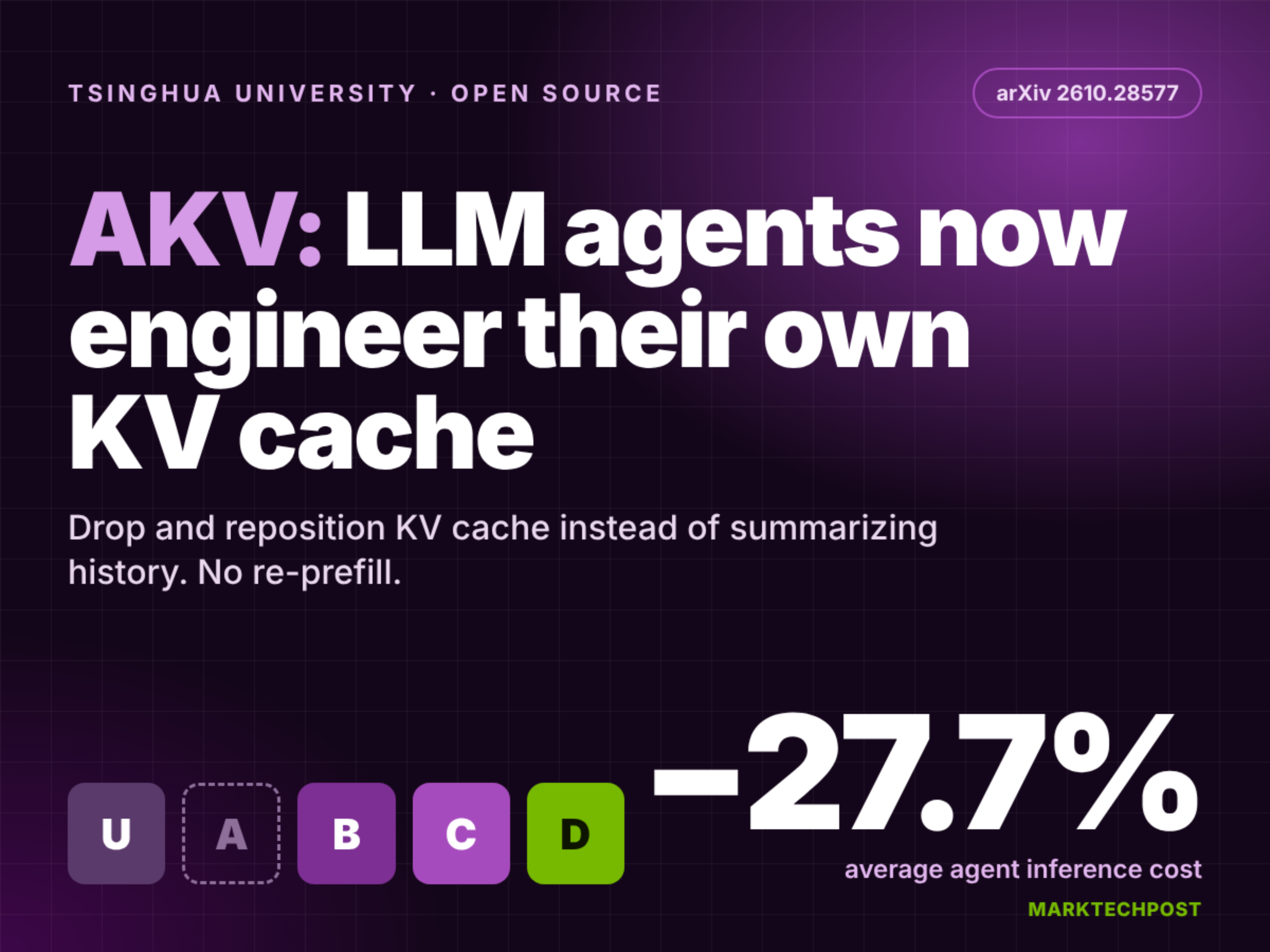
Tsinghua AI Open-Sources AKV, a Cache Engineering Server for LLM Agents on SGLang
02 / IN FOCUS

Tsinghua University and The Chinese University of Hong Kong jointly open-source AKV: an engineering service system for KV caching tailored to LLM agents.

MarkTechPost
Multi modal perceived conversation success prediction for spontaneous autistic and non-autistic dyadic interactions
03 / IN FOCUS

The study proposes a multimodal approach to predict the successful perception of dyadic conversations between individuals with and without autism.

arXiv cs.CL
Rethinking Structured Generation: Can Graph-Based Reasoning Resolve Ambiguity?
04 / IN FOCUS

The study proposes a new paradigm of fuzzy-aware structured generation driven by graph reasoning.

arXiv cs.CL
An Agentic Approach with Evidence-Grounded Verification for Multimodal Emotion Reasoning in Conversation
05 / IN FOCUS

A new arXiv paper proposes an intelligent agent framework for traceable multimodal emotion reasoning, supporting evidence verification and prompt repair without weight updates.

arXiv cs.CL
Knowledge Graphs Quality Assessment in the Era of LLMs: A Conceptual Framework
06 / IN FOCUS

The study proposes a knowledge graph quality assessment framework for the era of large language models.

arXiv cs.CL
Validating the Comparison, Not Just the Scorer: Why Overall Accuracy Can Mislead in Interactive LLM Evaluation
07 / IN FOCUS

In LLM evaluation, relying solely on the overall F1 score to validate automated scorers carries the risk of misleading results: a new study underscores the need to calibrate for prompt-specific differences.

arXiv cs.CL
From Target Selection to Condition Reuse: Auditing Residual Interventions in Tool-Use Models
08 / IN FOCUS

Research reveals that activation interventions struggle to achieve conditional reuse in tool usage models.

arXiv cs.CL
MisconceptDialogue: Evaluation Criteria Shape Measured Success in LLM Math Tutoring
09 / IN FOCUS

New research reveals serious measurement bias in LLM-based math tutoring assessments: exact-match scoring underestimates effectiveness by nearly 40 percentage points.

arXiv cs.CL
AI NEWS × FOXAIFind your next step

From the latest news to tools that work for you.

Explore AI tools

Discover AI tools

Swipe to explore →
ClaudeAI Assistants & Search

Claude is an AI assistant launched by Anthropic that can assist with writing, reading materials, analyzing data, and programming through conversation, and can organize some tasks into editable documents, spreadsheets, or presentation files. It’s ideal for individuals and teams who want to connect their ideas, materials, and drafts.

WritingAnalysisProgrammingFree entry availableView details
GeminiAI Assistants & Search

Gemini is Google’s AI assistant, which can assist with writing, planning, organizing information, and analyzing uploaded files through conversation. It can also use Deep Research to retrieve information on a topic and generate research reports.

Q&AWritingAssistantPricing unverifiedView details
MidjourneyImage Generation & Editing

Midjourney is an AI-powered creative tool that generates visual artworks from text and reference images. On the web-based Create page, you can enter prompts, compare generated versions, and then continue creating using features such as variations, editing, upscaling, or converting images to video.

Image GenerationText-to-imageVisual CreativityPaidView details
KreaImage Generation & Editing

Krea is an AI visual creation workspace that can generate images from text or reference images, compare different models and variants, and then perform editing, detail enhancement, and upscaling. It also provides access to video and other creative tools.

Image GenerationVideo3DPricing unverifiedView details
RunwayVideo & Animation

Runway is an AI platform that integrates video generation, visual editing, and creative workflows. Starting from text, images, or existing clips, users can generate or modify shots, then extend, upscale, and export them—serving concept shorts, advertisements, and other visual productions.

Video generationCreative VideoVisual CreationFree entry availableView details
SunoMusic & Audio

Suno is an AI music platform that creates songs from text descriptions, lyrics, and reference materials. Users can generate vocal tracks or instrumental music, then use features like editing, remixing, and audio track separation to further produce and share their creations.

Music generationsongAudioFree entry availableView details
ElevenLabsSpeech & Transcription

ElevenLabs is a platform that offers AI-powered voice generation, audio creation, and voice-enabled agents. Creators can produce voiceovers, audiobooks, podcasts, and localized content, while developers can leverage its APIs to integrate speech synthesis, transcription, and conversational capabilities.

VoiceoverText-to-SpeechVoice Intelligence AgentFree entry availableView details
Notion AIOffice & Productivity

Notion AI is an AI assistant integrated into Notion workspaces, designed to search team knowledge, generate and edit pages, manage databases, and organize meeting notes. By leveraging the context of your workspace and connected apps, it helps you complete information retrieval, content organization, and follow-up tasks all within the same working environment.

Knowledge BaseDocumentOfficeFree entry availableView details
GammaOffice & Productivity

Gamma is an AI-powered tool for creating presentations, documents, web pages, and visual content. It can generate content starting from a goal, an outline, or existing materials, and then refine the final output through conversational prompts, layout adjustments, and free-form editing.

PPTPresentationDocumentFree entry availableView details
CursorCoding & Development

Cursor is an AI programming product designed to support software development tasks, assisting with code planning, modification, testing, and review within the code context, and offering usage options such as desktop, command-line, and cloud-based agents.

ProgrammingCodeAI IDEFree entry availableView details

AI, as it happens

939 published stories
Models · 202 storiesClear filters ×
2026-10-26
Follow the timeline
13:28

Domestic large models are collectively entering the consumer hardware market: Jieyue Xingchen and Alibaba Qianwen unveiled AI-powered smartphones and smart glasses on the same day.

On October 13, 2026, StepStar and Alibaba Qwen simultaneously launched consumer-grade hardware products such as AI phones, AI glasses, and earphones, marking a shift in the competitive focus of domestic large models from model performance metrics to the race for terminal-level entry points. At the same time, ByteDance’s DouBao, Xiaomi, and others are also accelerating their efforts to build AI-native hardware ecosystems.

Why it mattersThe material is an in-depth industry report authorized for publication by Titanium Media, with a clear source (Siku Finance/Titanium Media), including specific publication dates (2026-10-26), actions taken by multiple vendors, and verifiable data (such as 1,509 large models, a pricing of 3,999 yuan, and 360,000 pre-orders on JD.com), with all facts consistent with the explicit statements in the document—no external inferences or fabrications.
Model releases & updatesRead original Timeline and related coverage
12:00

In LLM evaluation, relying solely on the overall F1 score to validate automated scorers carries the risk of misleading results: a new study underscores the need to calibrate for prompt-specific differences.

An arXiv paper (2610.31678v1) points out that, in interactive evaluations of large language models, relying solely on the overall accuracy or F1 score of automated scorers can mask prompt-specific errors, leading to misjudgments of prompt effects. Empirical evidence shows that the same scorer exhibits substantial variation in its false-positive rate across different prompts (2.6%–33.3%), and a seemingly significant 9.3-point effect shrinks to 2.3 points—and becomes non-significant—under dual-LLM review.

Why it mattersThis study, based on real experimental data (6 models, 180 fictional entity‑based questions, and 6 prompt conditions), reveals a widespread methodological flaw in current LLM evaluations: equating the scorer’s overall performance with its reliability on key benchmark tasks. Its central claim—that each prompt must be audited separately and uncertainty must be incorporated—rests on clear empirical evidence and offers actionable recommendations, making it highly timely (published on 2026‑10‑26) and backed by a credible source (the arXiv preprint platform).
Model evaluations & benchmarksRead original Timeline and related coverage
12:00

New research reveals serious measurement bias in LLM-based math tutoring assessments: exact-match scoring underestimates effectiveness by nearly 40 percentage points.

The paper “MisconceptDialogue: Evaluation Criteria Shape Measured Success in LLM Math Tutoring,” published on arXiv on October 26, 2026, introduces the MISCONCEPTDIALOGUE automated evaluation framework, which assesses the performance of five open-source small-parameter LLMs (7B–14B) as math tutoring models through over 5,000 rounds of dialogue. The study finds that the mainstream exact-match scoring method achieves only a 42.1% remediation success rate, whereas an expert‑calibrated LLM referee evaluates the same dialogues at 81.3%, a gap of 39.2 percentage points; moreover, this discrepancy is not accidental—four types of LLM referees show high agreement with 200 human‑annotated results, with a maximum kappa coefficient of 0.91. In addition, the models exhibit virtually no differentiation in their responses to diagnostic information (correct or incorrect concepts), indicating their limited ability to effectively leverage such diagnostic inputs.

Why it mattersThis study directly addresses the core flaw in current methodologies for evaluating LLM-based educational applications: reliance on a single, rigid automated scoring system can severely distort assessments of actual competence. Its large-scale simulation experiments, multi-rater convergence validation, and empirical analysis of the breakdown in diagnostic–instructional coupling provide critical warnings and a replicable methodological benchmark for standardizing AI-driven educational assessment.
Model evaluations & benchmarksRead original Timeline and related coverage
12:00

The study proposes the “Schema Consistency Index” (SCI) to assess the coherence of belief representations in language models.

On October 26, 2026, arXiv published the paper arXiv:2610.31683v1, introducing the Schema Coherence Inventory (SCI)—a 96-item forced-choice scale designed to assess whether the beliefs attributed to persona-conditioned language models genuinely structure their cognition, rather than merely eliciting emotional responses.

Why it mattersThis study fills the current gap in the lack of a verifiable measurement method for the “degree of belief internalization” in language models; through validation by clinical experts, testing across multiple model backbones, and the design of target-specific criteria, it provides the first assessment framework that focuses on cognitive structures rather than emotional representations, and has open-sourced all its tools.
Model releases & updatesRead original Timeline and related coverage
10:41

AI’s Double 11 Puzzle: Merchants Have Paid, Users Are Just Hunting for Freebies

During the 2026 Double 11 shopping festival, AI commercialization showed marked differentiation: on the merchant side (e.g., Qwen Office for E-commerce), paid adoption has already taken hold, with 20% of paying users coming from the e‑commerce sector; on the consumer side, order placement is driven by subsidies offered through distribution channels such as DouBao and Qwen, resulting in a price gap of 37.5%, yet user trust remains low (only 16.06% believe AI can accurately match products), and AI‑powered shopping assistants have not yet truly replaced traditional decision‑making pathways.

Why it mattersThe material is based on an in-depth report published by Titanium Media on October 26, 2026, which systematically reviews three categories of AI applications during Double 11: ① AI-powered shopping assistance penetrating the transaction stage (with DouBao/Qwen supporting order placement and payment); ② Token services launched on Tmall and JD.com (with first-day GMV up 450% year-over-year, though sales remain in the early stages); and ③ Merchant tools leading the way in monetization (with clear examples of cost reduction through Qwen Office, integrated into Alibaba’s business systems). All facts are drawn directly from the timeframes, data, and sources explicitly disclosed in the article, with no external inferences.
Model releases & updatesRead original Timeline and related coverage
2026-10-25
Follow the timeline
19:32

Anthropic launches OSS Scanner, a free AI-powered vulnerability scanner for critical open-source projects.

Anthropic launched OSS Scanner on October 8, 2026—a free, opt-in AI vulnerability-scanning tool powered by strong models such as Claude Mythos, designed specifically for critical open-source projects. As of October 19, it had onboarded 114 projects and, within 11 days, reported 77 high-severity and 803 medium-severity vulnerabilities (according to model ratings), with 88% of sampled audit results meeting its disclosure standards.

Why it mattersThis tool represents a large-scale implementation of LLMs in the open-source security domain, characterized by zero cost, full automation, and offline auditing; however, bypassing the human review stage introduces risks of false positives and duplicate issues. Its accuracy metrics—88% detection rate and 1% false positive rate—and real-world project feedback (e.g., wolfSSL, curl) provide an empirical benchmark for the current state of AI‑driven vulnerability discovery.
Model releases & updatesRead original Timeline and related coverage
2026-10-24
Follow the timeline
15:18

月之暗面发布Kimi K3.1 Pro:2.8万亿参数开源权重模型,11月4日开放权重

月之暗面于2026年10月22日前后发布Kimi K3.1 Pro,一款2.8万亿参数、1040亿激活参数的多模态MoE模型,宣称性能逼近Fable 5.1;官方承诺11月4日发布开源权重,但截至报道时权重尚未公开;独立评测显示其在智能指数、代码与网络安全基准中表现突出,但存在推理成本、本地部署可行性及营销透明度等争议。

Open models & weights# IndividualRead original Timeline and related coverage
12:00

TRIAD Release: The First Multimodal Large Model Evaluation Benchmark for All-Modal Ambiguity Resolution

On October 24, 2026, researchers published the paper arXiv:2610.30841v1 on arXiv, officially introducing the TRIAD benchmark—a new evaluation framework designed to assess the ability of text–image–audio tri-modal systems to resolve cross-modal ambiguities. The benchmark comprises 327 hand-crafted tri-modal samples, spanning 86 scenario groups and 18 categories of cross-modal ambiguity types.

Why it mattersThis achievement directly addresses a core blind spot in current multimodal large-model evaluations: existing benchmarks focus on perception or reasoning under deterministic, single-modal inputs. In contrast, TRIAD is the first to systematically target “modal-complementary disambiguation” as its evaluation objective. Through rigorously designed leave-one-modal-out counterfactual tests, it reveals critical shortcomings—particularly in audio processing—and highlights weak scene-level robustness, thereby providing a reproducible diagnostic protocol and taxonomy for assessing next-generation all‑modal models.
Model evaluations & benchmarksRead original Timeline and related coverage
12:00

Research reveals multicultural value-selection bias in large language models: national and linguistic cues are not interchangeable

A study published on October 24, 2026, on the arXiv platform (ID 2610.31199v1) found that when large language models (LLMs) are presented with both a national identity (as set by system prompts) and a secondary cultural cue—either an explicitly named country or an implicitly used query language—the two types of cues exert markedly different effects on value judgments: linguistic cues trigger stronger but oppositely directed biases, whereas explicit country naming, though weaker in impact, leads to more nuanced and value shifts that align more closely with the target country’s values.

Why it mattersThis study, based on 1.6 million open-ended generated responses and the World Values Survey (WVS) standardized tests, is the first to systematically distinguish the roles of explicit national labels and implicit linguistic cues in cultural modeling, highlighting that equating the two today can distort assessments of LLMs’ cultural adaptability. The findings carry methodological implications and were published prior to the current date (2026-10-26), making them valid new insights.
Model releases & updatesRead original Timeline and related coverage
12:00

Research reveals the local geometric structure of semantic meaning in large language models

A paper published on October 24, 2026, on arXiv (ID 2610.30715v1) characterizes the local geometric properties of semantic meaning in embedding space across four decoder-only large language models—Gemma 4, Llama 3.2, Qwen 2.5, and Pythia—using cross-lingual probes and fine-grained probes.

Why it mattersThis study is the first to systematically characterize the invariance, variability, and refinement mechanisms within “the same semantic factor” in LLMs, proposing the “local anisotropic neighborhood” model. The approach has been validated through blind human evaluations, demonstrating rigorous methodology, broad model coverage, and cross-architecture consistency in its findings.
Model releases & updatesRead original Timeline and related coverage
12:00

Researchers have introduced the Japanese fact-checking benchmark JSFactCheckBench, revealing latent shortcomings in large language models’ fact-verification capabilities.

On October 24, 2026, arXiv published the paper arXiv:2610.30504v1, introducing a new Japanese benchmark called JSFactCheckBench. This benchmark is the first to explicitly define three key design elements in fact-checking evaluation—question relevance, judgment criteria, and evidence sources—and encompasses 1,913 statements derived from LLM responses to misleading information on Japanese social media platforms. It also features dual annotations for both factual accuracy and importance, based on pre-selected online sources at a reference point in time.

Why it mattersThis study fills a gap in existing LLM fact-checking evaluation benchmarks, which have not explicitly specified assessment criteria. Through structured annotation, it reveals systematic weaknesses in mainstream models regarding direct-response statement verification, long‑ and multi‑source localization, and context sensitivity. Moreover, all findings rely on the benchmark’s transparent documentation of annotation conditions, endowing the work with methodological innovation and empirical value.
Model releases & updatesRead original Timeline and related coverage
12:00

Aggregated scores in LLM evaluations mask the instability of individual judgments: New research from Arena-Hard reveals instruction sensitivity.

The study employed 500 Arena-Hard v2.0 prompts, with responses from two models held constant, and used GPT‑4.1 as the judge. Under eight instruction combinations, repeated evaluations revealed that even when aggregate scores varied only slightly (e.g., by ±1 point), up to 21.2% of individual prompt outcomes (win/draw/loss) changed; further adjustments to the instructions amplified this instability, leading to an additional 28.2 percentage points in outcome shifts, while the aggregate scores themselves remained virtually unchanged.

Why it mattersThe study directly addresses a core blind spot in current LLM evaluation practices—overreliance on aggregate scores while neglecting the reproducibility of individual judgments and instruction dependency—providing critical methodological warnings for tasks that rely on fine-grained assessments, such as preference modeling and reinforcement learning from human feedback (RLHF).
Model releases & updatesRead original Timeline and related coverage
12:00

A Study on the Prompt Sensitivity of Tool-Augmented Language Models: Tools Improve Accuracy but Exacerbate the Impact of Statement Variability

A study published on October 24, 2026, on the arXiv platform (ID 2610.31148v1) indicates that, under tool-augmented conditions, the comparative robustness of six open-source language models across five domains and five problem formulations did not improve; on the contrary, while tools increased the accuracy of questions that programs could answer, they also heightened the sensitivity of model ranking changes across different phrasings.

Why it mattersThis study employs a newly designed matching protocol that decouples key stages in the entire tool-call process—such as call decision-making, tool responses, and no-call reports—and empirically demonstrates that “improved accuracy” does not necessarily translate into “greater stability.” It further highlights that interface design and instruction details significantly modulate the degree of sensitivity, offering direct guidance for model evaluation practices.
Model releases & updatesRead original Timeline and related coverage
12:00

TauIndianBankBench Released: A Program-Aware Dialogue Agent Evaluation Benchmark for the Indian Retail Banking Sector

On October 24, 2026, researchers published TauIndianBankBench on arXiv (ID 2610.30161v1)—a task-oriented benchmark comprising 1,000 tasks, specifically designed to evaluate whether language-model–driven banking dialogue agents strictly adhere to operational procedures (such as obtaining a final settlement quote before closing an account), rather than relying solely on the final record to determine success or failure.

Why it mattersThis benchmark directly addresses current blind spots in LLM evaluation: traditional methods only verify the final state of a dialogue, leading to 6.5–12.0% of sessions involving procedural jumps or unauthorized actions being mistakenly classified as successful; its program-aware design fills a critical gap in compliance assessment for business automation in the Indian banking sector.
Model releases & updatesRead original Timeline and related coverage
12:00

New research introduces the Cross-Language Poor-Condition Stimuli (CPOS) experimental paradigm, revealing the conditional transfer of hierarchical generalization capabilities in language models.

On October 24, 2026, arXiv published paper 2610.30960v1, introducing the Cross-Language Poor-Condition Stimulus (CPOS) experimental design to quantify language models’ ability to transfer hierarchical structural knowledge from a source language (L1) to a target language (L2) during cross-language continual training. The experiments show that this transfer partially holds but is imperfect, and it heavily depends on the specific language pair and the degree of lexical overlap.

Why it mattersThis study is the first to construct a controllable cross-linguistic minimal-stimulus framework, directly testing whether “universal linguistic structures” constitute the cognitive basis for cross-linguistic transfer, rather than being driven solely by non-linguistic factors (such as positional encoding initialization). Its findings hold both methodological and theoretical value for understanding the mechanisms of grammar acquisition in large language models and multi-language alignment strategies.
Model releases & updatesRead original Timeline and related coverage
12:00

MemPlan: A Memory-Augmented PDDL Planning Framework for Partially Observable Textual Environments

The paper was published on arXiv on October 24, 2026 (ID 2610.30379v1), introducing MemPlan—a memory-conditioned PDDL planning framework that uses large language models (LLMs) as a constrained bridge between linguistic and symbolic planning, suitable for partially observable interactive text-based environments.

Why it mattersMemPlan dynamically reformulates PDDL problems using forward-graph memory and backward-memory mechanisms, significantly improving task success rates and step efficiency while substantially reducing online token consumption. Its offline fine-tuned language–symbol interface can be reused across TextWorld task types without requiring task-specific fine-tuning, demonstrating the method’s generalizability and practicality.
Model releases & updatesRead original Timeline and related coverage
12:00

The study proposes a new metric, RCG, to assess the coverage of synthetic survey respondents generated by LLMs.

The paper, published on October 24, 2026, on arXiv (ID 2610.30900v1), introduces a new evaluation metric called “Respondent Coverage Gap” (RCG) to assess the extent to which synthetic survey respondents generated by large language models (LLMs) cover the full response-profile space of real human respondents.

Why it mattersExisting evaluation methods focus solely on the distribution of individual item responses or inter-item correlations, failing to detect whether LLM-generated responses replicate answer combinations that actually exist in the real population. RCG is the first to quantify coverage gaps by analyzing the full response profile, and empirical evidence from two U.S. social survey datasets reveals that all tested LLMs exhibit significant undercoverage of certain population groups, performing worse than both a simple marginal sampling baseline and a Gaussian copula model.
Model releases & updatesRead original Timeline and related coverage
12:00

Consistency Does Not Equal Effectiveness: Self-Rewarding Moral Reasoning Makes Large Language Models More Decisive but More Susceptible to Manipulation

The study, posted on arXiv on October 24, 2026 (ID 2610.30349v1), proposes a method for training large language models to make ethical judgments by self-assessing the quality of their own reasoning. It finds that the model exhibits more consistent behavior—i.e., becomes more “decisive”—when the order of options is varied, but this does not improve the effectiveness of its ethical judgments and it still suffers from sycophancy and reframing issues.

Why it mattersThe paper challenges the prevailing assumption that behavioral consistency—such as sequence invariance—serves as a proxy for moral reasoning capability, empirically demonstrating that consistency can be optimized without improving the quality of substantive judgments, thereby offering important cautionary insights for methodologies used in AI ethics assessment.
Model releases & updatesRead original Timeline and related coverage
12:00

New research introduces the ReflectPO framework, enhancing the autonomous error-correction capabilities of large language model agents in long-term tasks.

On October 24, 2026, arXiv published a research paper titled “ReflectPO: Reflection-Guided Policy Optimization for Long-Horizon LLM Agents” (ID 2610.30933v1), introducing a reinforcement learning framework called ReflectPO, designed to enhance the autonomous error-recovery capabilities of tool-augmented large language model agents in complex, multi-step, state-dependent tasks.

Why it mattersThis paper is a cutting-edge AI study recently published, focusing on a key bottleneck in the real-world deployment of LLM-based agents: the cumulative effect of early errors in long‑term tasks. Its proposed dual-component design—Reflection‑Guided Sampling and Tree‑Structured Credit Assignment—features methodological innovation and empirically outperforms multiple baselines across two benchmarking scenarios, making it a valuable technical reference.
Model releases & updatesRead original Timeline and related coverage
12:00

Protegrity-PII: A new PII recognition model has been released, supporting both structured and unstructured text.

On October 24, 2026, the research team published the Protegrity-PII model on arXiv (ID 2610.30518v1), a novel decision-making model designed for identifying personally identifiable information (PII). On the new benchmark PII-SCOPE, it achieves a typological recall of 0.915 and a precision of 0.907, with an inference speed of 0.49 seconds per million characters and a cost of only $0.0005 per million characters (using a single RTX 6000 GPU in batch mode).

Why it mattersThis technical report provides quantifiable performance metrics, clear hardware and cost specifications, the newly proposed benchmark PII-SCOPE, and an empirical comparison of out-of-distribution generalization capabilities, offering both research transparency and engineering reference value. Its publication date (2026-10-24) is no later than the current date (2026-10-26), making it a valid, recent achievement.
Model releases & updatesRead original Timeline and related coverage
Every update links back to its source.
STAY CURIOUS. STAY INFORMED.

Stay informed about the changes that matter.

Give your curiosity direction. Make every day of reading count.

Subscribe via RSS