
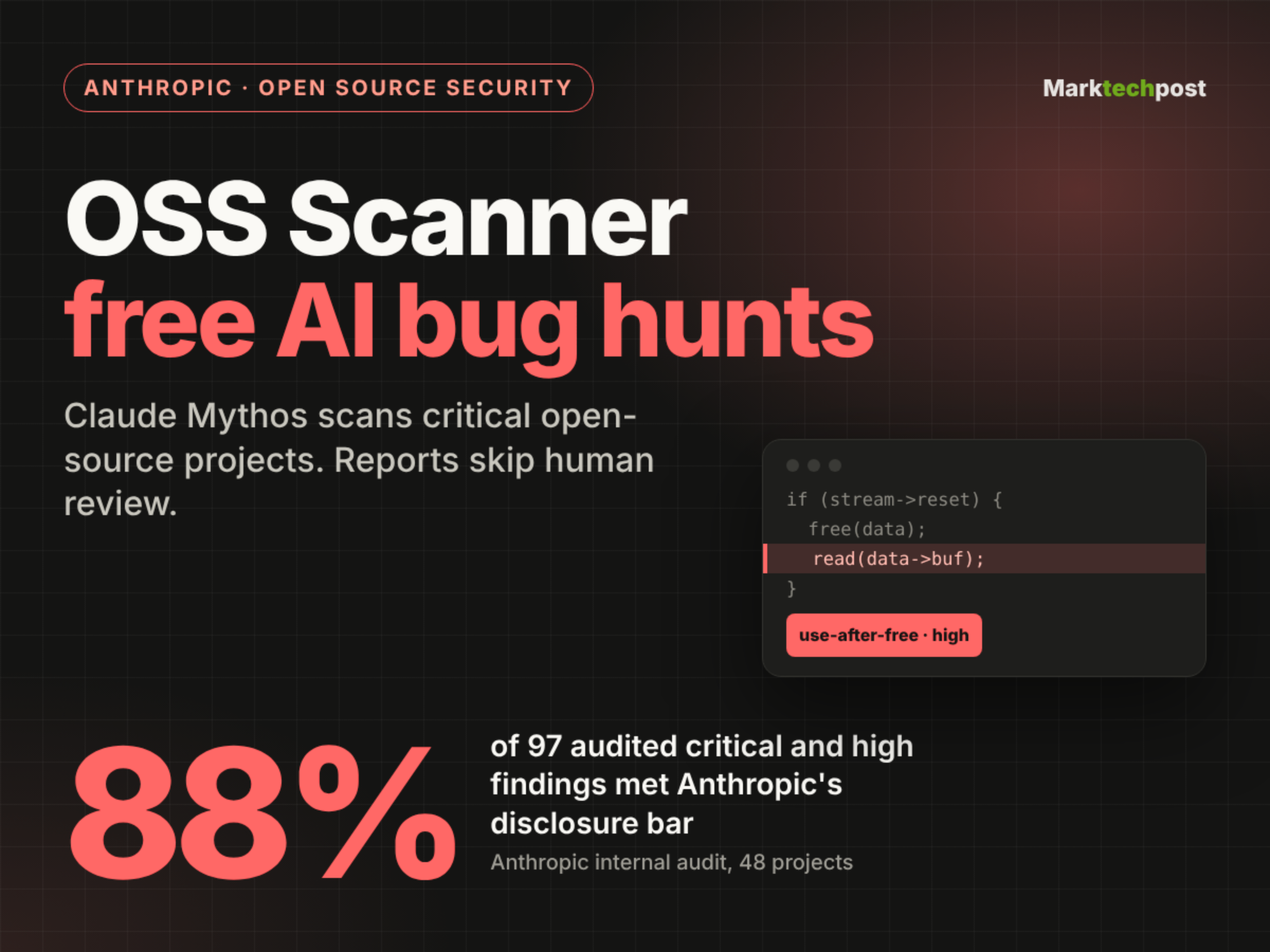
On October 8, 2026, Anthropic officially launched OSS Scanner—a free, opt-in AI vulnerability-scanning tool designed for critical open-source projects. The service is jointly operated by Anthropic’s Frontier Red Team and the Safeguards Research team, with the primary goal of alleviating the human-review bottlenecks currently plaguing AI-driven security audits. As of October 19, 114 projects have been approved to access the service from approximately 650 applications.
OSS Scanner runs on Anthropic’s proprietary infrastructure and is completely free. Project maintainers must register by submitting a Pull Request to the anthropic/oss-scanner repository, providing a project.yaml configuration file that includes the code repository URL, the primary contact, and the Dockerfile path. The audit is performed in an isolated virtual machine: the Dockerfile is used to build the project (with network access enabled), after which the environment is switched to an air-gapped setup to run the LLM-based analysis. Each report includes a minimal reproducible example of the vulnerability, an explanation of its root cause, a bisection-based identification of the commit that introduced the issue, and, optionally, a candidate patch.
Within 11 days of launch (as of October 19), OSS Scanner identified a total of 77 “critical” and 803 “high‑severity” model‑rating vulnerabilities. The Anthropic team conducted a sample review of 97 critical or high‑severity findings, with the results showing that 85 (88%) met their coordinated vulnerability disclosure (CVD) criteria; 11 were genuine vulnerabilities but represented duplicate reports of known issues; and only 1 was determined to be a false positive. The wolfSSL project reported that, out of 74 submitted reports, 72 were valid, with 5 already assigned CVE numbers. In response, the curl project addressed CVE‑2026‑92392—a use‑after‑free vulnerability in HTTP/2 uploads—affected versions 8.12.0 through 8.22.0, with the patched version 8.23.0 released on October 14.
The tool explicitly forgoes the human review stage in exchange for faster response times, with all reports delivered directly to maintainers, and triage (classification, verification, and prioritization) responsibilities fully shifted to the project teams. Anthropic has not set a disclosure deadline for reports that have not undergone human review (such as OSS-Fuzz’s 90-day rule), nor does it provide a severity calibration mechanism—if a project fails to submit a custom threat_model.md file, the model will independently infer threat scenarios and severity levels, a practice that some maintainers have reported leads to severe overestimation. Compared with similar projects like Google OSS-Fuzz, OpenAI Codex Security, and DeepMind CodeMender, OSS Scanner is currently the only open-source security scanning service entirely driven by an AI agent, delivering results with zero human intervention.