








THE NEXT THING, IN PERSPECTIVEIndependent AI news

The latest AI news, in focus.

Official announcements and industry reporting. Follow the timeline of AI.

Today's news

News feed
When Traction Becomes Personal Exposure: What The Joonko Guilty Plea Means For Founders
01 / IN FOCUS

Former Joonko CEO Pleads Guilty to Securities Fraud: False Customer and Revenue Statements Result in Personal Liability for the Founder

Crunchbase AI
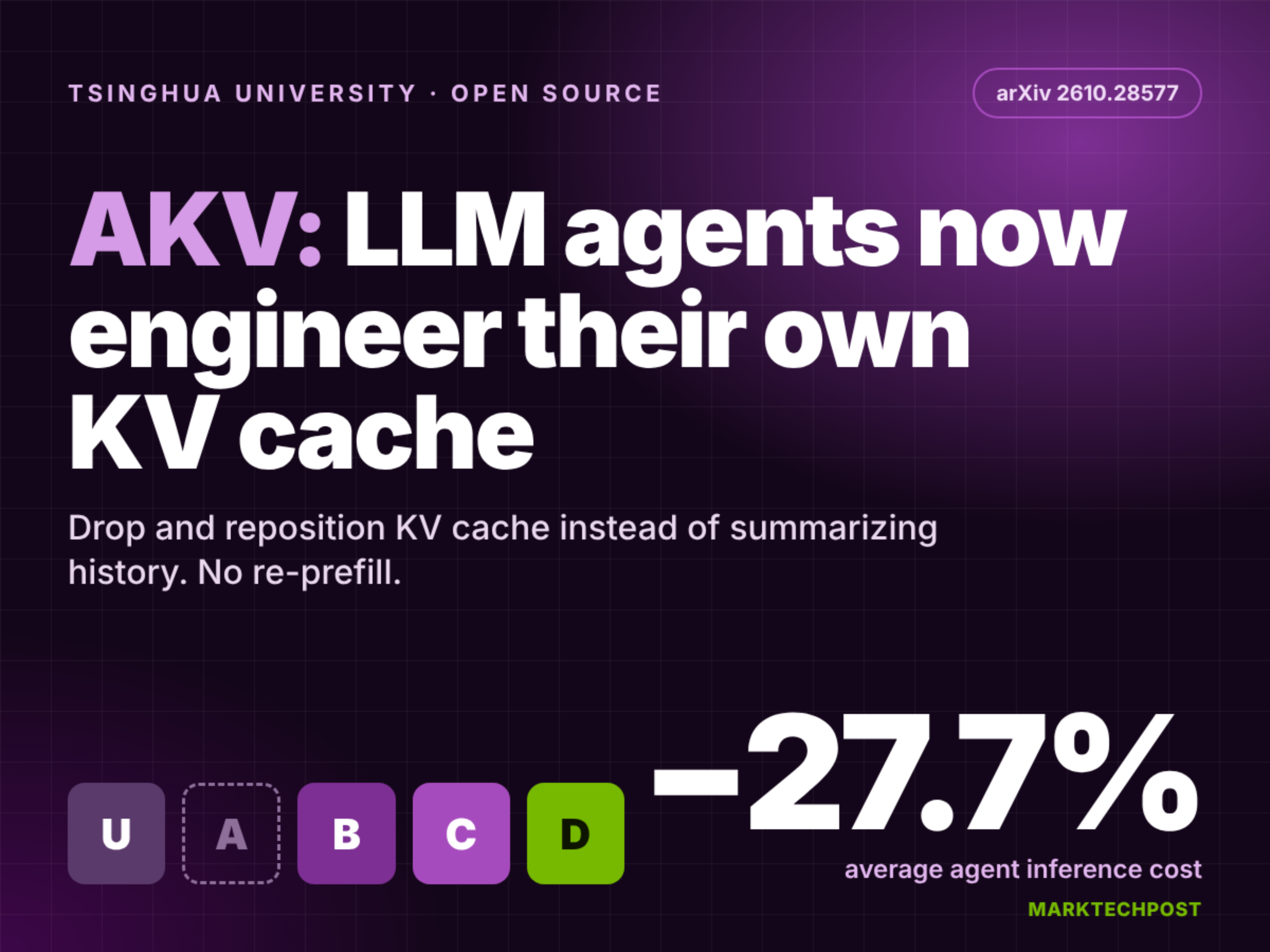
Tsinghua AI Open-Sources AKV, a Cache Engineering Server for LLM Agents on SGLang
02 / IN FOCUS

Tsinghua University and The Chinese University of Hong Kong jointly open-source AKV: an engineering service system for KV caching tailored to LLM agents.

MarkTechPost
Multi modal perceived conversation success prediction for spontaneous autistic and non-autistic dyadic interactions
03 / IN FOCUS

The study proposes a multimodal approach to predict the successful perception of dyadic conversations between individuals with and without autism.

arXiv cs.CL
Rethinking Structured Generation: Can Graph-Based Reasoning Resolve Ambiguity?
04 / IN FOCUS

The study proposes a new paradigm of fuzzy-aware structured generation driven by graph reasoning.

arXiv cs.CL
An Agentic Approach with Evidence-Grounded Verification for Multimodal Emotion Reasoning in Conversation
05 / IN FOCUS

A new arXiv paper proposes an intelligent agent framework for traceable multimodal emotion reasoning, supporting evidence verification and prompt repair without weight updates.

arXiv cs.CL
Knowledge Graphs Quality Assessment in the Era of LLMs: A Conceptual Framework
06 / IN FOCUS

The study proposes a knowledge graph quality assessment framework for the era of large language models.

arXiv cs.CL
Validating the Comparison, Not Just the Scorer: Why Overall Accuracy Can Mislead in Interactive LLM Evaluation
07 / IN FOCUS

In LLM evaluation, relying solely on the overall F1 score to validate automated scorers carries the risk of misleading results: a new study underscores the need to calibrate for prompt-specific differences.

arXiv cs.CL
From Target Selection to Condition Reuse: Auditing Residual Interventions in Tool-Use Models
08 / IN FOCUS

Research reveals that activation interventions struggle to achieve conditional reuse in tool usage models.

arXiv cs.CL
MisconceptDialogue: Evaluation Criteria Shape Measured Success in LLM Math Tutoring
09 / IN FOCUS

New research reveals serious measurement bias in LLM-based math tutoring assessments: exact-match scoring underestimates effectiveness by nearly 40 percentage points.

arXiv cs.CL
AI NEWS × FOXAIFind your next step

From the latest news to tools that work for you.

Explore AI tools

Discover AI tools

Swipe to explore →
ClaudeAI Assistants & Search

Claude is an AI assistant launched by Anthropic that can assist with writing, reading materials, analyzing data, and programming through conversation, and can organize some tasks into editable documents, spreadsheets, or presentation files. It’s ideal for individuals and teams who want to connect their ideas, materials, and drafts.

WritingAnalysisProgrammingFree entry availableView details
GeminiAI Assistants & Search

Gemini is Google’s AI assistant, which can assist with writing, planning, organizing information, and analyzing uploaded files through conversation. It can also use Deep Research to retrieve information on a topic and generate research reports.

Q&AWritingAssistantPricing unverifiedView details
MidjourneyImage Generation & Editing

Midjourney is an AI-powered creative tool that generates visual artworks from text and reference images. On the web-based Create page, you can enter prompts, compare generated versions, and then continue creating using features such as variations, editing, upscaling, or converting images to video.

Image GenerationText-to-imageVisual CreativityPaidView details
KreaImage Generation & Editing

Krea is an AI visual creation workspace that can generate images from text or reference images, compare different models and variants, and then perform editing, detail enhancement, and upscaling. It also provides access to video and other creative tools.

Image GenerationVideo3DPricing unverifiedView details
RunwayVideo & Animation

Runway is an AI platform that integrates video generation, visual editing, and creative workflows. Starting from text, images, or existing clips, users can generate or modify shots, then extend, upscale, and export them—serving concept shorts, advertisements, and other visual productions.

Video generationCreative VideoVisual CreationFree entry availableView details
SunoMusic & Audio

Suno is an AI music platform that creates songs from text descriptions, lyrics, and reference materials. Users can generate vocal tracks or instrumental music, then use features like editing, remixing, and audio track separation to further produce and share their creations.

Music generationsongAudioFree entry availableView details
ElevenLabsSpeech & Transcription

ElevenLabs is a platform that offers AI-powered voice generation, audio creation, and voice-enabled agents. Creators can produce voiceovers, audiobooks, podcasts, and localized content, while developers can leverage its APIs to integrate speech synthesis, transcription, and conversational capabilities.

VoiceoverText-to-SpeechVoice Intelligence AgentFree entry availableView details
Notion AIOffice & Productivity

Notion AI is an AI assistant integrated into Notion workspaces, designed to search team knowledge, generate and edit pages, manage databases, and organize meeting notes. By leveraging the context of your workspace and connected apps, it helps you complete information retrieval, content organization, and follow-up tasks all within the same working environment.

Knowledge BaseDocumentOfficeFree entry availableView details
GammaOffice & Productivity

Gamma is an AI-powered tool for creating presentations, documents, web pages, and visual content. It can generate content starting from a goal, an outline, or existing materials, and then refine the final output through conversational prompts, layout adjustments, and free-form editing.

PPTPresentationDocumentFree entry availableView details
CursorCoding & Development

Cursor is an AI programming product designed to support software development tasks, assisting with code planning, modification, testing, and review within the code context, and offering usage options such as desktop, command-line, and cloud-based agents.

ProgrammingCodeAI IDEFree entry availableView details

AI, as it happens

940 published stories
Compute & infrastructure · 48 storiesClear filters ×
2026-10-23
Follow the timeline
02:00

Amazon SageMaker launches the Training Session API: users can write custom training loops for large models without managing GPUs.

Amazon SageMaker has released the Training Sessions API, enabling users to implement custom large-model training workflows—such as SFT, RLHF, GRPO, and KTO—using pure Python scripts. GPU resource scheduling, fault tolerance, distributed execution, and checkpoint management are all handled by the service.

Chips, GPUs & hardware# Official# TutorialsRead original Timeline and related coverage
2026-10-22
Follow the timeline
13:00

NVIDIA drives the transformation of Europe’s retail sector: Open models and physical intelligence are being implemented in e-commerce, warehousing, and virtual try-on.

European retailers are leveraging NVIDIA-accelerated open large models and physics‑AI technologies to achieve large‑scale deployment across scenarios such as digital product discovery, intelligent warehouse simulation, virtual try‑on, and accelerated R&D. Companies including Shopify, Zooplus, L’Oréal, and the Otto Group have used tools like the Nemotron series of models, Omniverse digital twins, and ALCHEMI molecular simulations to significantly reduce inference costs, improve search accuracy, shorten R&D cycles, and validate improvements in conversion rates and sales growth.

Token pricing, cost & energy# OfficialRead original Timeline and related coverage
06:51

Jas Kaira, Head of AI Business at Blackstone: Concerns about AI infrastructure debt are exaggerated.

Jas Kaira, head of Blackstone’s AI business, stated at the TechCrunch Disrupt conference that market panic over massive debt in the AI infrastructure sector has been overly amplified. His key argument is that this debt is largely backed by long-term contracts with high‑credit‑rating clients—such as Microsoft and Meta—and that the underlying assets (e.g., GPUs) possess strong collateral value, meaning the risk profile differs fundamentally from that of the 2008 banking system.

Chips, GPUs & hardware# MediaRead original Timeline and related coverage
02:20

The judge dismissed Trump’s absurd claim that “the EPA can arbitrarily dismiss pollution lawsuits against data centers.”

A U.S. federal judge ruled that the Trump administration lacked the authority to instruct the Environmental Protection Agency (EPA) to unilaterally dismiss an air pollution lawsuit against SpaceX AI over its operation of an unauthorized gas turbine in Memphis; the lawsuit filed by the NAACP will proceed.

Data centres & cloud compute# MediaRead original Timeline and related coverage
2026-10-21
Follow the timeline
18:30

NVIDIA cuDSS officially released: Accelerating the solution of sparse linear systems in engineering and scientific simulations

On October 26, 2026 (UTC), NVIDIA announced that the cuDSS library has entered General Availability (GA). This CUDA-X library is specifically designed to efficiently solve large-scale sparse linear systems on GPUs, significantly boosting simulation throughput and iterative efficiency across fields such as chip design, aerospace, and industrial systems.

Chips, GPUs & hardware# OfficialRead original Timeline and related coverage
10-21

VocabX: Reduces the inference cost of domain-specific small language models by 77% through cost-weighted vocabulary specialization.

Dharma-AI has introduced the VocabX method, which reconfigures the vocabulary of language models for specific tasks—such as automated scoring of Portuguese essays—by optimizing for cost rather than word frequency. Without modifying the model architecture, parameters, or training pipeline, empirical results show a 77% reduction in inference costs, while the evaluation score (bench score) improved from 0.703 to 0.810.

Token pricing, cost & energyRead original Timeline and related coverage
10-21

TorchNeuron System-Level Performance Analysis (Part 1): End-to-End Profiling Based on the AWS Trainium Chip

This article is the first in a series of technical blog posts jointly published by Hugging Face and Amazon, systematically introducing how to use TorchNeuron on AWS Trainium AI accelerator chips for PyTorch model inference performance analysis. It covers the principles of Neuron backend integration, methods for configuring torch.profiler, the use of NeuronConfig and NeuronProfiler tools, and visualized tracing with Neuron Explorer. Additionally, using RMSNorm as an example, it compares the device‑time differences among three implementations: plain PyTorch, the built-in torch.rms_norm fusion, and torch.compile’s automatic fusion.

Chips, GPUs & hardwareRead original Timeline and related coverage
05:14

i14 releases the Laplace 3B linear attention model: inference with fixed-state memory, implemented on AWS Trainium2 and native PyTorch.

i14 has launched the Laplace 3B model with 3.028 billion parameters, which replaces Softmax attention with Gated Linear Attention (GLA). During inference, its per-sequence recursive state remains constant at 29.5 MB, independent of context length. The model was trained and validated on a single AWS trn2.48xlarge instance (equipped with 16 Trainium 2 chips), achieving a training throughput of 120,000 tokens per second and an inference throughput of 11,544 output tokens per second (with 1,280 concurrent sequences). All performance metrics are based on internal measurements conducted by i14 and the AWS GenAIIC team.

Chips, GPUs & hardware# Official# TutorialsRead original Timeline and related coverage
03:31

SF Compute builds a programmable data center: leveraging physical delivery to power the GPU computing power trading market.

SF Compute was founded by Evan Conrad and is dedicated to building a neutral, programmable GPU computing‑power trading infrastructure that supports physical delivery. Its model rejects the abstraction of FLOPS as a commodity, emphasizing hardware heterogeneity, actual delivery, and real‑time constraints—such as interrupt tolerance, InfiniBand topology, and firmware versions. The platform has already facilitated tens of billions of dollars in transaction volume and introduced low‑level capabilities like dynamic InfiniBand subnet partitioning.

Chips, GPUs & hardware# IndividualRead original Timeline and related coverage
03:31

SF Compute builds a programmable data center: leveraging physical delivery to drive the marketization of GPU computing power trading.

SF Compute was founded by Evan Conrad and focuses on enabling programmable, physically settled trading of GPU computing power. It does not operate its own data centers; instead, it leverages full-stack technology to collaborate with third-party facilities in co-building a “sovereign compute cloud,” emphasizing market neutrality and infrastructure controllability. The company has already facilitated hundreds of millions of dollars in transaction volume and implemented key capabilities such as dynamic InfiniBand partitioning.

Data centres & cloud compute# IndividualRead original Timeline and related coverage
2026-10-20
Follow the timeline
17:00

Visiting Samsung’s Paju Ultra-Large-Scale Semiconductor New Facility: The AI-Driven Surge in Memory Chip Capacity Expansion

To meet the surging demand for high-bandwidth memory chips driven by the explosive growth of generative AI, Samsung is building a semiconductor manufacturing cluster in Pyeongtaek, South Korea, spanning an area equivalent to New York’s Central Park. To date, three fabs have been commissioned, with a fourth set to begin production soon, and construction on a fifth—halted in 2024 due to declining demand—has now resumed. The site showcases an intense construction pace and a workforce ecosystem adhering to stringent safety standards.

Chips, GPUs & hardware# MediaRead original Timeline and related coverage
10-20

AnyLanguageModel 1.0 released: a unified Swift interface supporting both local and hosted models, compatible with the entire Apple platform family of operating systems 27

Hugging Face has officially released AnyLanguageModel 1.0, an open-source Swift framework fully compatible with the Apple Foundation Models API. It supports seamless switching between local models (MLX, llama.cpp, Core ML) and hosted models (OpenAI, Anthropic, Gemini, Hugging Face Inference Providers, etc.), and introduces new features such as image input, tool invocation, guided generation, and automatic adaptation of inference chunks.

Inference systems & deploymentRead original Timeline and related coverage
2026-10-19
Follow the timeline
10-19

TorchNeuron launches public beta: Hugging Face models natively support AWS Trainium for training and inference.

Hugging Face, in collaboration with AWS, has launched TorchNeuron—a PyTorch-native Trainium backend—available for public beta starting October 20, 2026. This technology enables mainstream libraries such as Transformers and Diffusers to run directly on Trainium chips without any modifications, significantly enhancing the usability and compatibility of text-generation and image-generation models.

Chips, GPUs & hardwareRead original Timeline and related coverage
2026-10-09
Follow the timeline
2026-09-22
Follow the timeline
2026-08-25
Follow the timeline
2026-08-24
Follow the timeline
Every update links back to its source.
STAY CURIOUS. STAY INFORMED.

Stay informed about the changes that matter.

Give your curiosity direction. Make every day of reading count.

Subscribe via RSS