Skip to content
AI NEWS JOURNAL
AI, IN PERSPECTIVE

Search AI news

Search headlines, summaries and articles to connect the dots.

Newest first

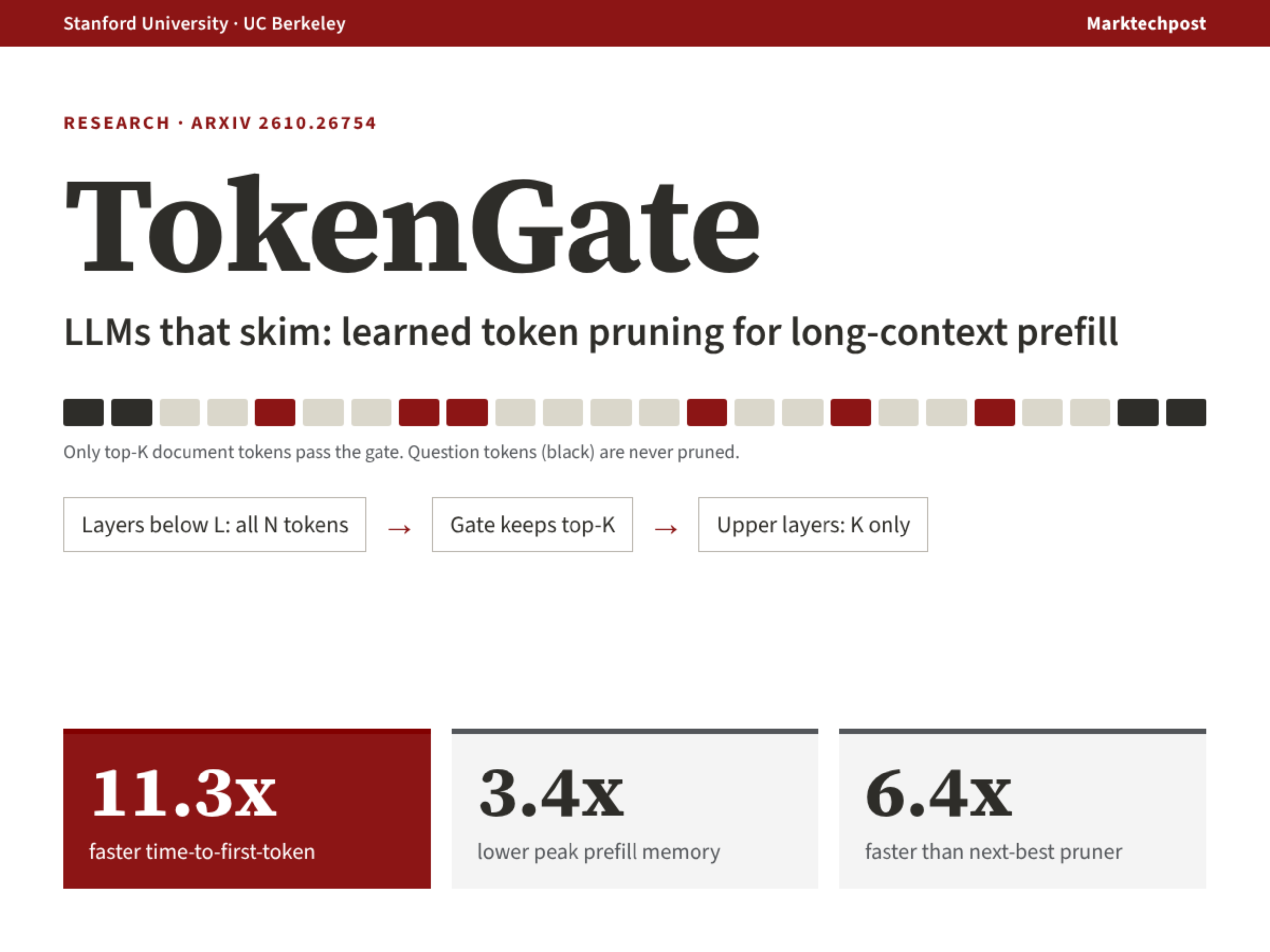
Researchers from Stanford and UC Berkeley Introduce TokenGate: Token-Gated Attention Makes Long-Context Prefill Up to 11.3x Faster

Researchers from Stanford University and the University of California, Berkeley have introduced TokenGate—a plug-and-play, learnable token-pruning module designed for existing large language models (LLMs). This approach accelerates the first-token generation time (TTFT) for long-context prefill by 1.4 to 11.3 times without sacrificing accuracy, while reducing peak memory usage by 1.5 to 3.4 times. The associated code and checkpoints have been made open source.

Researchers from Stanford and UC Berkeley Introduce TokenGate: Token-Gated Attention Makes Long-Context Prefill Up to 11.3x Faster
Timeline and related coverage

Kimi releases K3.1 Pro: Terminal task capabilities top the charts, with simulation debugging and multimodal programming showcasing the nascent form of embodied intelligence.

On October 25, 2026, Kimi released the K3.1 Pro model, which ranked first in the Terminal-Bench 4.0 terminal task benchmark with a 67.2% success rate. Its capabilities—including autonomously fixing emulator errors, performing physics simulations, conducting audio analysis, constructing 3D scenes, and editing videos—point toward exploring pathways in embodied intelligence technology.

根据报道中的虚拟人行走训练和模拟器调试制作的编辑示意,非软件实拍截图

Why it matters:The material is based on a hands-on test report published with authorization from Titanium Media, covering authoritative third-party benchmark data (such as Artificial Analysis and Terminal-Bench 4.0), official self-test results, and the author’s multi-scenario functional validation. It highlights the K3.1 Pro’s substantial advancements in execution performance, simulation closed-loop capabilities, and multimodal programming, while clearly noting performance limitations and undisclosed information (e.g., Flash/Ultra has not yet been released), in compliance with fact-checking and source attribution requirements.

Timeline and related coverage

A quarter of PRs are “AI garbage”! The Linux Foundation has released a new report: AI writes code 52% faster, yet open-source maintainers are even more exhausted.

On October 20, the Linux Foundation released a report indicating that generative AI reduces the time required for code writing by an average of 52%; however, open-source project maintainers estimate that roughly 25% of pull requests are low-quality “AI slop,” with this figure rising to 31% in large-scale projects. The report highlights that the efficiency gains have not been matched by corresponding reductions in review and governance costs, as only 35% of projects have established formal AI contribution policies, underscoring growing developer burnout and a trust deficit.

Timeline and related coverage

Taking on NVIDIA head-on to challenge Apple—Microsoft’s high-end AI PC gamble

Microsoft is courting local AI developers and high-end creators with the Surface Laptop Ultra, which features NVIDIA RTX Spark. The hardware brings large-capacity unified memory, CUDA, and RTX graphics capabilities to a portable device, but whether it can sustain competition against Macs will still depend on app optimization, agent-based experiences, and real-world workflows.

Why it matters:Ultimately, this competition comes down to whether on-device AI can genuinely boost creativity and development efficiency, and whether the associated costs—hardware, software, and migration—are justified. Hardware opens up new possibilities, but the ecosystem and real-world user experience determine how many users those possibilities can reach.

Timeline and related coverage

llama.cpp 发布 b11868 版本:增强 Hexagon NPU 多核 Flash Attention 支持,覆盖全平台编译构建

llama.cpp v2.45.0(标签 b11868)正式发布,核心更新为 Hexagon 后端引入 KV-head 团队拆分机制以优化多核 HMX Flash Attention 性能,并统一 FA 拆分控制标志;同步提供 macOS、Linux、Windows、Android、iOS 及 openEuler 等全平台二进制包,含 CUDA 12/13、Vulkan、ROCm、OpenVINO、SYCL、Snapdragon(Adreno+Hexagon)等多后端支持。

Why it matters:按信源设置仅收录,不参与自动精选

Timeline and related coverage

llama.cpp 发布 b11865 版本:新增 RDMA 接收边界检查,支持 CUDA 13.4、ROCm 10.0、Snapdragon NPU 等多平台后端

llama.cpp 项目发布构建版本 b11865,核心变更包括在 RDMA 接收逻辑中增加内存边界检查(PR #30399),并显著扩展硬件加速支持,覆盖 CUDA 13.4、ROCm 10.0、Vulkan、OpenVINO、SYCL 及高通 Snapdragon(CPU+Adreno+Hexagon)全栈异构计算后端;macOS KleidiAI 支持与 openEuler 构建被明确标记为 DISABLED。

Why it matters:按信源设置仅收录,不参与自动精选

Timeline and related coverage

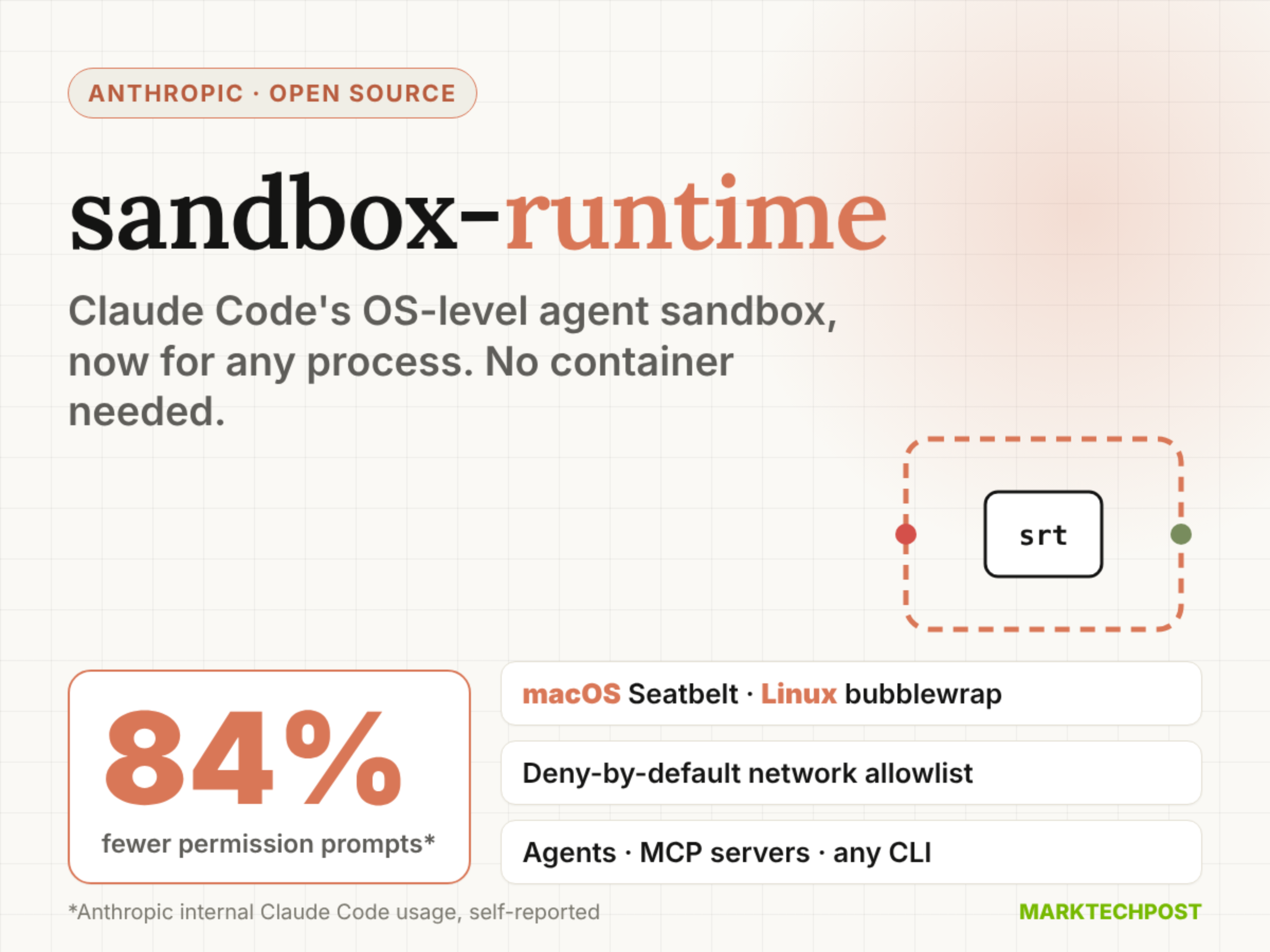
Anthropic open-sources the OS-level sandbox sandbox-runtime: providing container-free file and network isolation for AI agents.

On October 24, 2026, Anthropic open-sourced sandbox-runtime (srt), an OS-level sandboxing tool that operates without containers, designed to restrict file read/write and network access permissions for AI agents, MCP servers, and CLI tools. It supports macOS (Seatbelt), Linux (bubblewrap), and Windows (alpha), with npm package version 0.0.81 under the Apache-2.0 license.

Meet Anthropic’s sandbox-runtime: OS-Level Sandboxing for AI Agents, No Containers

Why it matters:This tool represents a significant advancement in AI security infrastructure—achieving fine-grained, full-process-tree coverage through the operating system’s native isolation mechanisms, directly addressing the risks of prompt injection and privilege escalation, and has already been deployed for internal validation within Claude Code.

Timeline and related coverage

ULME Framework Achieves True Unification of Text Embedding and Language Modeling: A New Paper on arXiv Proposes a Predictive Coupling Mechanism

On October 24, 2026, arXiv published the paper arXiv:2610.30705v1, introducing ULME—a post-training framework for causal-decoder–based large language models that, through a predictive coupling mechanism, achieves, for the first time, a mutually reinforcing unification of text embedding and language-generation capabilities. This approach was validated on the Qwen2.5/Qwen3 series (with 0.5B–8B parameters), yielding MTEB improvements of 3.3–4.1 points while maintaining performance on generation tasks such as MMLU.

ULME: Predictive Coupling for Mutually Reinforcing Embedding and Language Modeling

Why it matters:This paper directly addresses the core issue of fragmented multimodal LLM capabilities: embeddings and generation have long been handled either by separate models or by “pseudo-unified” models that rely solely on parameter sharing. ULME achieves a substantial architectural breakthrough by employing learnable slots and joint training with three objectives—including a stop-gradient prediction loss—enabling the generation process to actively shape the embedding representations. The study features broad experimental coverage, strong baselines, comprehensive metrics, and was published on a reputable preprint platform, balancing timeliness with technical rigor.

Timeline and related coverage

IndoNutriQA, the Indonesian clinical nutrition Q&A benchmark, has been officially released.

On October 24, 2026, the research team published a paper on arXiv (ID 2610.31256v1), introducing IndoNutriQA, the first expert-annotated question-answering benchmark for the Indonesian-language clinical nutrition domain. It comprises 911 question–answer pairs derived from real clinical reports, focusing on evaluation rather than training, and supports generative, extractive, and retrieval-augmented question-answering tasks.

IndoNutriQA: An Indonesian Clinical Nutrition Question Answering Benchmark

Why it matters:This benchmark fills the gap in high-quality publicly available evaluation data for low-resource languages—particularly Indonesian—in the clinical nutrition NLP domain. It features comprehensive structured metadata, question types that strictly adhere to the Nutrition Care Process (NCP), and has undergone expert validation and multi‑model benchmarking, ensuring a clear research focus and rigorous methodology.

Timeline and related coverage

New research reveals that open-book assessments primarily measure reading behavior rather than knowledge retention.

An arXiv paper published on October 24, 2026 (2610.31017v1) points out that, in document-level LoRA adapter evaluations, open-book scoring relies heavily on the model’s ability to read on the fly, rather than on whether the adapter has truly encoded knowledge specific to the document; random adapters can reproduce 82% of the performance advantage of expert adapters on open-book tasks, but on cloze tasks involving unstructured text, they only replicate 2%—statistically indistinguishable from zero.

Mostly Reading: What Open-Book Scores Measure in Document-Level LoRA Adapters

Why it matters:This study, through systematic controlled experiments—comprising 150 Wikipedia articles, the Llama-3.1-8B-Instruct model, and a two-task comparison—reveals the fundamental limitations of the current open-book evaluation paradigm: it fails to effectively distinguish between “reading” and “remembering,” posing methodological challenges to the practical utility of knowledge-editing and retrieval‑oriented adapters. The paper also reports four silent errors that lead to “clean yet incorrect results,” highlighting risks to reproducibility.

Timeline and related coverage

Amazon QuickSight’s layered maps now support GeoJSON point and line features, enabling the visualization of locations and routes together.

Amazon QuickSight’s layered maps now support the GeoJSON formats for Point and LineString geometries, enabling users to overlay store locations, delivery routes, or flight trajectories on the same map. This capability requires no third-party services, but it does demand that GeoJSON files adhere to the proper structure, with matching keys and static updates.

Timeline and related coverage

Bayer Crop Science has built the multi-agent decision-making engine ADE based on Amazon Bedrock AgentCore.

Bayer Crop Science has built the Agentic Decision Engine (ADE) on Amazon Bedrock AgentCore—a natural-language multi-agent platform for breeding experts, analysts, and researchers—as an enhancement layer rather than a replacement for its existing Connected Decision Engine (CDE). The system is now live in production, serving over 100 R&D users and enabling approximately 80% of issues to be resolved independently through 22 domain-specific agents and about 20 API tools.

Timeline and related coverage

AI-driven retro game porting wave shakes up the traditional emulation community

Recently, thanks to new AI tools, numerous unofficial cross-platform porting projects of retro games—such as “Halo” running on the web, “The Wind Waker” arriving on iPhone, and “Super Smash Bros.” entering mixed reality—have been gaining popularity. However, this AI‑accelerated decompilation–recompilation (decomp/recomp) approach is sparking controversy and division within the old-school game preservation community.

Timeline and related coverage

Building a Production-Ready AI Service Framework: The New Focus of Enterprise AI Competition

As AI transitions from the experimental stage to large-scale production, corporate competitiveness is shifting from model selection to the serving harness—a suite of engineering systems that encompasses architecture design, memory management, scheduling strategies, and inference optimization. In an article published in MIT Technology Review, EXL points out that the key determinant of AI’s real-world impact is no longer model parameters or benchmark scores, but rather the ability to translate model capabilities into business value with controllable costs, reliable latency, and sustainable scalability.

Timeline and related coverage