








THE NEXT THING, IN PERSPECTIVEIndependent AI news

The latest AI news, in focus.

Official announcements and industry reporting. Follow the timeline of AI.

Today's news

News feed
When Traction Becomes Personal Exposure: What The Joonko Guilty Plea Means For Founders
01 / IN FOCUS

Former Joonko CEO Pleads Guilty to Securities Fraud: False Customer and Revenue Statements Result in Personal Liability for the Founder

Crunchbase AI
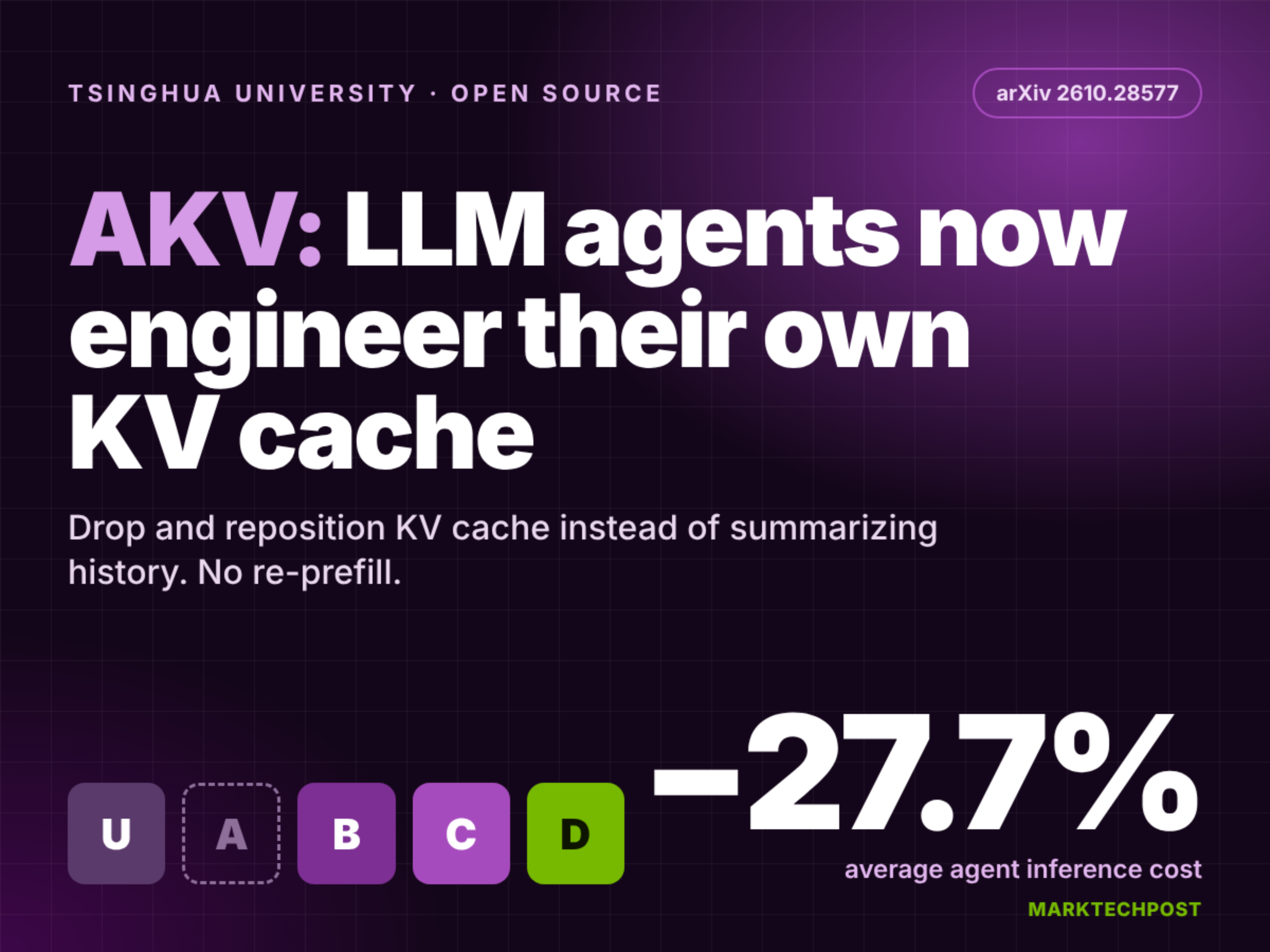
Tsinghua AI Open-Sources AKV, a Cache Engineering Server for LLM Agents on SGLang
02 / IN FOCUS

Tsinghua University and The Chinese University of Hong Kong jointly open-source AKV: an engineering service system for KV caching tailored to LLM agents.

MarkTechPost
Multi modal perceived conversation success prediction for spontaneous autistic and non-autistic dyadic interactions
03 / IN FOCUS

The study proposes a multimodal approach to predict the successful perception of dyadic conversations between individuals with and without autism.

arXiv cs.CL
Rethinking Structured Generation: Can Graph-Based Reasoning Resolve Ambiguity?
04 / IN FOCUS

The study proposes a new paradigm of fuzzy-aware structured generation driven by graph reasoning.

arXiv cs.CL
An Agentic Approach with Evidence-Grounded Verification for Multimodal Emotion Reasoning in Conversation
05 / IN FOCUS

A new arXiv paper proposes an intelligent agent framework for traceable multimodal emotion reasoning, supporting evidence verification and prompt repair without weight updates.

arXiv cs.CL
Knowledge Graphs Quality Assessment in the Era of LLMs: A Conceptual Framework
06 / IN FOCUS

The study proposes a knowledge graph quality assessment framework for the era of large language models.

arXiv cs.CL
Validating the Comparison, Not Just the Scorer: Why Overall Accuracy Can Mislead in Interactive LLM Evaluation
07 / IN FOCUS

In LLM evaluation, relying solely on the overall F1 score to validate automated scorers carries the risk of misleading results: a new study underscores the need to calibrate for prompt-specific differences.

arXiv cs.CL
From Target Selection to Condition Reuse: Auditing Residual Interventions in Tool-Use Models
08 / IN FOCUS

Research reveals that activation interventions struggle to achieve conditional reuse in tool usage models.

arXiv cs.CL
MisconceptDialogue: Evaluation Criteria Shape Measured Success in LLM Math Tutoring
09 / IN FOCUS

New research reveals serious measurement bias in LLM-based math tutoring assessments: exact-match scoring underestimates effectiveness by nearly 40 percentage points.

arXiv cs.CL
AI NEWS × FOXAIFind your next step

From the latest news to tools that work for you.

Explore AI tools

Discover AI tools

Swipe to explore →
ClaudeAI Assistants & Search

Claude is an AI assistant launched by Anthropic that can assist with writing, reading materials, analyzing data, and programming through conversation, and can organize some tasks into editable documents, spreadsheets, or presentation files. It’s ideal for individuals and teams who want to connect their ideas, materials, and drafts.

WritingAnalysisProgrammingFree entry availableView details
GeminiAI Assistants & Search

Gemini is Google’s AI assistant, which can assist with writing, planning, organizing information, and analyzing uploaded files through conversation. It can also use Deep Research to retrieve information on a topic and generate research reports.

Q&AWritingAssistantPricing unverifiedView details
MidjourneyImage Generation & Editing

Midjourney is an AI-powered creative tool that generates visual artworks from text and reference images. On the web-based Create page, you can enter prompts, compare generated versions, and then continue creating using features such as variations, editing, upscaling, or converting images to video.

Image GenerationText-to-imageVisual CreativityPaidView details
KreaImage Generation & Editing

Krea is an AI visual creation workspace that can generate images from text or reference images, compare different models and variants, and then perform editing, detail enhancement, and upscaling. It also provides access to video and other creative tools.

Image GenerationVideo3DPricing unverifiedView details
RunwayVideo & Animation

Runway is an AI platform that integrates video generation, visual editing, and creative workflows. Starting from text, images, or existing clips, users can generate or modify shots, then extend, upscale, and export them—serving concept shorts, advertisements, and other visual productions.

Video generationCreative VideoVisual CreationFree entry availableView details
SunoMusic & Audio

Suno is an AI music platform that creates songs from text descriptions, lyrics, and reference materials. Users can generate vocal tracks or instrumental music, then use features like editing, remixing, and audio track separation to further produce and share their creations.

Music generationsongAudioFree entry availableView details
ElevenLabsSpeech & Transcription

ElevenLabs is a platform that offers AI-powered voice generation, audio creation, and voice-enabled agents. Creators can produce voiceovers, audiobooks, podcasts, and localized content, while developers can leverage its APIs to integrate speech synthesis, transcription, and conversational capabilities.

VoiceoverText-to-SpeechVoice Intelligence AgentFree entry availableView details
Notion AIOffice & Productivity

Notion AI is an AI assistant integrated into Notion workspaces, designed to search team knowledge, generate and edit pages, manage databases, and organize meeting notes. By leveraging the context of your workspace and connected apps, it helps you complete information retrieval, content organization, and follow-up tasks all within the same working environment.

Knowledge BaseDocumentOfficeFree entry availableView details
GammaOffice & Productivity

Gamma is an AI-powered tool for creating presentations, documents, web pages, and visual content. It can generate content starting from a goal, an outline, or existing materials, and then refine the final output through conversational prompts, layout adjustments, and free-form editing.

PPTPresentationDocumentFree entry availableView details
CursorCoding & Development

Cursor is an AI programming product designed to support software development tasks, assisting with code planning, modification, testing, and review within the code context, and offering usage options such as desktop, command-line, and cloud-based agents.

ProgrammingCodeAI IDEFree entry availableView details

AI, as it happens

940 published stories
Research paper · 56 storiesClear filters ×
2026-10-24
Follow the timeline
12:00

IFC-MCQ: A Method for Automatically Generating Multiple-Choice Question Benchmarks for LLM Agents in Building Information Modeling

On October 24, 2026, researchers published the IFC-MCQ method on arXiv, aiming to automatically generate a multi-choice question benchmark with precise scoring for Industry Foundation Classes (IFC) data retrieval systems based on large language models (LLMs) in the architecture, engineering, and construction (AEC) sector.

Why it mattersThis work directly addresses the pain points of LLMs—namely, the difficulty and high cost of evaluating them on specialized structured data such as IFC—by proposing the first automated multiple-choice question-generation framework for IFC files. It covers 15 categories and 36 subcategories, supporting reproducible and scalable evaluations of agent capabilities.
Model releases & updatesRead original Timeline and related coverage
12:00

FusionEval Released: A New Benchmark for Large Language Model Fusion

On October 24, 2026, researchers published the paper arXiv:2610.30162v1 on arXiv, introducing FusionEval—the first unified benchmark specifically designed to evaluate fusion methods for large language models. It covers vulnerable aspects such as reasoning chain length and tool invocation, and supports comparisons between fine-tuning-based and zero-shot fusion approaches.

Why it mattersThis benchmark fills the gap left by existing evaluations, which inadequately cover long-chain reasoning and tool usage; it clearly distinguishes between average performance and worst-case capability retention, provides a reproducible expert pool (based on Qwen3/Llama), multi-dimensional metrics (including GPU memory and runtime), and open-source code, offering strong practical guidance.
Model evaluations & benchmarksRead original Timeline and related coverage
12:00

WikiOriginQA released: A question-answering dataset for assessing cultural bias, automatically constructed based on the creation times of multilingual Wikipedia editions.

On October 24, 2026, the research team published a paper on arXiv (ID 2610.30677v1), introducing WikiOriginQA, a fully automated question-answering dataset that leverages the creation dates of Wikipedia editions in various languages to objectively characterize the origins of knowledge, with the aim of enhancing the scalability of cultural bias assessment.

Why it mattersThis study proposes a method for generating culturally grounded provenance data at scale across languages without manual annotation, and experimental results demonstrate that large language models exhibit systematic performance advantages on Anglophone cultural-related tasks, providing a new tool for the quantitative analysis of cultural bias.
Datasets & synthetic dataRead original Timeline and related coverage
12:00

AQL-Lite Released: An Efficient Continuous Pre-training Framework for Modern Standard Arabic

On October 24, 2026, arXiv published paper 2610.30344v1, introducing the AQL-Lite framework, which significantly enhances the adaptability of multilingual large models to Modern Standard Arabic (MSA) through quality-first data filtering and continuous pre-training of selected parameters (CPT).

Why it mattersThis study directly addresses key challenges in training large Arabic-language models—namely, the abundance of noisy data, dialectal diversity, and the high costs associated with continuous pre-training—by proposing a reproducible, lightweight, and cost-effective technical approach, which has been validated on multiple authoritative Arabic-language benchmarks. All conclusions are based on the experimental setup and results explicitly reported in the paper, without any external extrapolation.
Training, tuning & alignmentRead original Timeline and related coverage
12:00

Natural language autoencoders can effectively verbalize activation differences in large models, supporting model differentiation and interpretability research.

A paper published on October 24, 2026, on arXiv (arXiv:2610.30934v1) systematically evaluates the generalization capabilities of natural language autoencoders (NLAs) in representing differences across activation spaces, with experiments demonstrating robust performance across four dimensions: compositionality, fine-tuning model adaptation, fine-tuning target recovery, and model-difference specialization.

Why it mattersThis study is based on four reproducible experimental designs, covering four large language models from three families, and provides the most systematic evidence of generalization to date in the emerging interpretability direction of verbalization. All conclusions are strictly confined to the experimental settings and observed results reported in the paper and do not extend to untested model sizes or tasks.
Training, tuning & alignmentRead original Timeline and related coverage
12:00

Research on Modulating the Capability Distribution of Large Language Models via Singular Value Spectrum Intervention: Empirical Analysis of Llama and Qwen Models

An AI study published on October 24, 2026, on arXiv (ID 2610.30676v1) applied post-hoc singular-value spectrum smoothing and spike perturbations to five open-source Llama and Qwen instruction-tuned models, finding that this lightweight intervention can systematically reshape the trade-offs in model performance across three capability domains: factual knowledge, language understanding, and deductive reasoning.

Why it mattersThis paper is the first to empirically demonstrate, within a multi‑model, multi‑task framework, the causal impact of the singular value spectrum of transformer feedforward layers on downstream capabilities, revealing structurally sensitive patterns in capability allocation and offering a new pathway for decoupling model capabilities and enabling controllable editing. All conclusions are based on publicly available models and standard benchmarks, with transparent methods and comprehensive evaluation dimensions.
Model releases & updatesRead original Timeline and related coverage
12:00

Research reveals that large language models exhibit “invisibility” bias: the rejection rate for evaluating information about Black describers reaches as high as 46%.

An empirical study published on October 24, 2026, on arXiv (paper ID 2610.30785v1) found that mainstream large language models from OpenAI and Anthropic exhibit a significant “invisibility” bias in trust assessment tasks—specifically, they systematically refuse to evaluate information when prompts contain protected attributes (such as “Black”), rather than basing their decisions on the quality of evidence; this bias is difficult to detect using conventional auditing methods.

Why it mattersThis study employs a rigorously designed two-urn Bayesian decision experiment, encompassing 6,600 sessions and 10 descriptive configurations. It is the first to quantify the cost of model‑driven rejection behavior triggered by identity labels and reveals its counterintuitive characteristics: rejection rates vary dramatically (46% for Black describers vs. 9% for White describers), yet once evaluated, Black describers actually receive slightly higher trust; moreover, bias intensifies with increasing reasoning depth, relies on specific vocabulary rather than semantics, and worsens under warning instructions—findings that carry direct implications for AI fairness assessment and alignment practices.
Model releases & updatesRead original Timeline and related coverage
12:00

Research reveals the “norm–oracle gap” problem in benchmarking coding agents.

A paper published on arXiv on October 24, 2026, points out that current mainstream benchmarks for coding AIs—such as SWE-Milestone—suffer from a “specification–oracle gap”: the natural-language descriptions of tasks fail to capture crucial implementation details required for testing (e.g., constant names, module paths, and precise error messages), resulting in evaluations that measure the ability to reproduce upstream code rather than genuine understanding and reasoning.

Why it mattersThis study is the first to formally define this type of bias, develop a static analysis tool covering five languages (with 89.2% precision and 92.9% recall), and empirically demonstrate in SWE-Milestone that 25 milestone tasks contain non-inferable implicit dependencies, significantly increasing the failure rate (80.6% vs. 48.4%). These findings reveal that current leaderboards may systematically favor “name‑copying” agents. The results have been made publicly available, including the open-source auditing tool and corrective resources, offering both methodological and practical value.
Model evaluations & benchmarksRead original Timeline and related coverage
12:00

Lighthouse: The First Trusted Digital Assistant Dedicated to the History of the U.S. Civil Rights Movement Has Been Released

The paper arXiv:2610.30158v1, published on October 24, 2026, introduces Lighthouse, the first digital assistant dedicated to exploring the history of the U.S. Civil Rights Movement, based on archival data from South Carolina. Its core innovation lies in adopting trustworthy content and user harm mitigation as design principles, employing a neuro-symbolic hybrid architecture that integrates large language models with rule-based symbolic reasoning.

Why it mattersThis study is the first to apply AI‑assisted historical exploration to the sensitive and pivotal period of the Civil Rights Movement, explicitly introducing dual constraints—“trustworthiness” and “harm modeling”—which set it apart from general‑purpose chatbots. Its methodology (neurosymbolic integration), evaluation approach (including a human‑consensus‑based gold standard for subjective questions), and data scale (over 18,000 original archival documents) all hold significant academic demonstrative value.
Model releases & updatesRead original Timeline and related coverage
12:00

The study proposes a new evaluation method and model to address annotation disagreements in identifying unstated arguments (enthymemes) within politically contentious discourse.

This paper, based on tweet data related to vaccination and immigration—each tweet independently annotated by five raters—finds that existing fine-tuned models consistently achieve an F1 score of around 0.67 on the enthymeme detection task. To address this, the authors propose abandoning the single-label evaluation paradigm in favor of a new metric that captures the distribution of annotators’ opinions, and they design a model capable of directly predicting this distribution, thereby better capturing human judgmental divergence without compromising the F1 score.

Why it mattersThe paper squarely confronts the long-neglected reality in NLP that “annotator disagreement is an essential characteristic”—particularly in politically sensitive contexts, where identifying enthymemes relies heavily on subjective reasoning. Its methodological shift—from point prediction to distributional prediction—and its empirical demonstration of the limitations of discourse‑structural analysis carry clear implications for the design of content‑moderation systems: models trained on majority‑vote criteria may systematically overlook implicit arguments that require deep contextual inference.
Training, tuning & alignmentRead original Timeline and related coverage
12:00

New research reveals that AI content moderation systems exhibit linguistic and cultural biases: the misclassification rate for African American English is as high as twice that of standard English.

An arXiv paper published on October 24, 2026 (ID 2610.31047v1) points out that current automated safety systems rely on lexical‑level features to assess harm, leading to systemic biases: African American English (AAE) is flagged as “offensive” up to twice as often as other English varieties; well‑known drag queen accounts are rated as more toxic than white supremacist accounts; and safety practices that work in English completely fail in low‑resource languages.

Why it mattersThis study, based on an empirical evaluation protocol, covers five open-source systems and 11 languages, encompassing a total of 55 system–language combinations. It finds that 93% of these combinations fail to achieve native-speaker-level performance in hazard function recognition; moreover, improvements in model capabilities have inadvertently widened the protection gap across languages, highlighting a crisis in algorithmic fairness. The source is the arXiv preprint server, with a clearly stated publication date (2026-10-24), and the content focuses on verifiable technical flaws and cross-language empirical findings.
Papers & researchRead original Timeline and related coverage
12:00

New arXiv paper compares the performance of joint scoring and item-by-item scoring for compact encoders.

On October 24, 2026, arXiv published the paper arXiv:2610.30970v1, which systematically evaluates design choices for compact encoders with model sizes ranging from 17 million to 1 billion parameters in closed-set decision-making tasks (such as tool selection): joint reading of all options versus independent scoring of each option. The study finds that, at a parameter scale of 32 million, option-by-option scoring significantly outperforms joint scoring on skill metrics; however, it incurs higher computational costs and exhibits more uneven latency. Multiple System1-Arena benchmarks show that joint encoders with 68 million and 150 million parameters surpass the 435-million-parameter DeBERTa-v3 zero-shot classifier.

Why it mattersThis paper presents a key empirical comparison of lightweight design approaches for downstream decision-making modules in large models, covering engineering considerations such as architecture selection, initialization dependencies, the latency–accuracy trade-off, and input-order robustness. The data are based on experiments conducted with three random seeds and validated against both public and private benchmarks. The publication date (2026-10-24) matches the current UTC date (2026-10-25), making this the latest credible research advancement.
Model evaluations & benchmarksRead original Timeline and related coverage
12:00

Research comparing the search-space complexity and efficiency of CTC and neural transcription models.

The paper was published on October 24, 2026, on arXiv (ID 2610.31259v1), and systematically compares the search-space complexity and inference efficiency of two types of end-to-end speech recognition (ASR) models—connectionist temporal classification (CTC) and neural transducer—under various pruning strategies and language-model configurations.

Why it mattersThe paper, based on empirical analysis, points out that although end-to-end ASR models typically maintain a small search space most of the time, they exhibit significant transient spikes in the number of hypotheses during periods of speech uncertainty; dynamic score-based pruning can adapt to model uncertainty, substantially reducing the real-time factor (RTF) and providing practical guidance for efficient search.
Papers & researchRead original Timeline and related coverage
12:00

SIM-UT: A User Behavior Simulation and Evaluation Framework for Medical Triage Chatbots

Researchers have proposed SIM-UT (Simulation of User Behaviour for Triage), a multi-round, real-user-behavior–based evaluation method designed to identify eco‑valid failure patterns of large language model (LLM)-driven medical triage chatbots in real-world settings within low- and middle-income countries (LMICs).

Why it mattersThis framework breaks through the limitations of existing single-round, English‑centric evaluations by conducting over 5,000 rounds of multilingual simulated conversations, covering real‑world WhatsApp health programs in India, South Africa, and Kenya. For the first time, it systematically reveals “de‑escalation risk,” a critical failure mode, demonstrating both methodological innovation and significant clinical safety implications.
Robotics & embodied AIRead original Timeline and related coverage
12:00

Research reveals that more metadata does not necessarily improve the accuracy of large model museum descriptions: field types and image quality are even more critical.

The study was published on October 24, 2026, on the arXiv platform (arXiv:2610.31193v1). Using a two-stage empirical framework, it analyzes how metadata composition influences large language models’ generation of artifact descriptions. The findings reveal that the sheer quantity of metadata does not account for differences in generative behavior; rather, the type of metadata field determines whether the model accurately anchors to factual information, ignores it, or fabricates details. Additionally, images can both support visual anchoring and exacerbate unfounded inferences.

Why it mattersThis study challenges the common assumption that “more metadata necessarily enhances grounding,” designing controlled experiments based on the heterogeneity and regional imbalances of real museum collection metadata. It proposes that metadata-driven data-to-text systems should be evaluated at the field- and claim-level for support, rather than relying on coarse-grained metrics such as overall input coverage or reference similarity.
Model releases & updatesRead original Timeline and related coverage
12:00

Research reveals that open-source large models commonly exhibit list-filling phenomena in structured extraction.

An empirical study published on October 24, 2026, on arXiv (paper ID 2610.30997v1) found that when a JSON extraction schema specifies a minimum number of items in the list but the actual document content falls short, eight open-source weighting models generally treat this minimum value as a generation target rather than a constraint, resulting in 55.4% of output lists exceeding the true count (compared to a baseline of 34.5%). The filler items are often drawn from the original text, and about half pass the source‑consistency check; common mitigation strategies prove only marginally effective.

Why it mattersThis study employed a preregistered protocol to systematically evaluate eight open-source models and six hosted-service models across 558 real-world documents and nine annotated datasets. With a rigorous methodology and publicly available data—both the code and results have been released on GitHub—it reveals a critical yet often overlooked deficiency in structured information extraction that undermines the reliability of downstream tasks: schema‑induced non‑faithful filling behavior.
Open models & weightsRead original Timeline and related coverage
Every update links back to its source.
STAY CURIOUS. STAY INFORMED.

Stay informed about the changes that matter.

Give your curiosity direction. Make every day of reading count.

Subscribe via RSS