








THE NEXT THING, IN PERSPECTIVEIndependent AI news

The latest AI news, in focus.

Official announcements and industry reporting. Follow the timeline of AI.

Today's news

News feed
Can AI help solve the COBOL code crisis?
01 / IN FOCUS

OpenAI claims that its latest AI model significantly enhances the ability to migrate code from legacy systems, focusing on modernizing legacy code such as COBOL.

The Verge · AI
When Traction Becomes Personal Exposure: What The Joonko Guilty Plea Means For Founders
02 / IN FOCUS

Former Joonko CEO Pleads Guilty to Securities Fraud: False Customer and Revenue Statements Result in Personal Liability for the Founder

Crunchbase AI
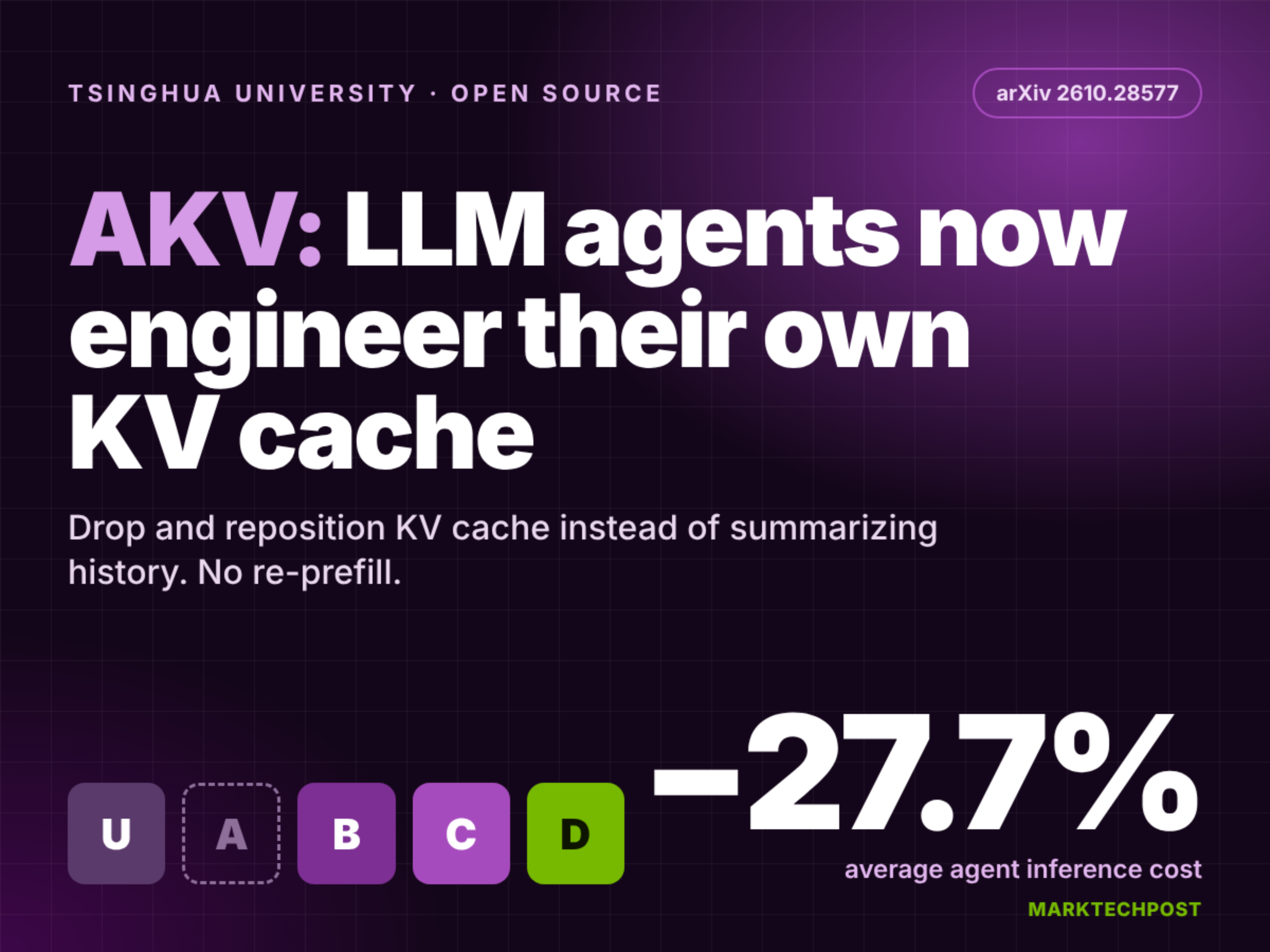
Tsinghua AI Open-Sources AKV, a Cache Engineering Server for LLM Agents on SGLang
03 / IN FOCUS

Tsinghua University and The Chinese University of Hong Kong jointly open-source AKV: an engineering service system for KV caching tailored to LLM agents.

MarkTechPost
Multi modal perceived conversation success prediction for spontaneous autistic and non-autistic dyadic interactions
04 / IN FOCUS

The study proposes a multimodal approach to predict the successful perception of dyadic conversations between individuals with and without autism.

arXiv cs.CL
新闻源配图 · arXiv cs.CL
05 / IN FOCUS

Research has released the Latin-specific language model LAMB, along with two new corpora: Acervus and Corpus Trinum.

arXiv cs.CL
新闻源配图 · arXiv cs.CL
06 / IN FOCUS

New research finds: The existing critic in reinforcement learning can be directly repurposed as a confidence estimator for large language models.

arXiv cs.CL
Rethinking Structured Generation: Can Graph-Based Reasoning Resolve Ambiguity?
07 / IN FOCUS

The study proposes a new paradigm of fuzzy-aware structured generation driven by graph reasoning.

arXiv cs.CL
An Agentic Approach with Evidence-Grounded Verification for Multimodal Emotion Reasoning in Conversation
08 / IN FOCUS

A new arXiv paper proposes an intelligent agent framework for traceable multimodal emotion reasoning, supporting evidence verification and prompt repair without weight updates.

arXiv cs.CL
新闻源配图 · arXiv cs.CL
09 / IN FOCUS

Query recall determines the retrieval performance of classical Arabic poetry: BM25 and dense encoders show markedly divergent behavior as query abstraction increases.

arXiv cs.CL
AI NEWS × FOXAIFind your next step

From the latest news to tools that work for you.

Explore AI tools

Discover AI tools

Swipe to explore →
ClaudeAI Assistants & Search

Claude is an AI assistant launched by Anthropic that can assist with writing, reading materials, analyzing data, and programming through conversation, and can organize some tasks into editable documents, spreadsheets, or presentation files. It’s ideal for individuals and teams who want to connect their ideas, materials, and drafts.

WritingAnalysisProgrammingFree entry availableView details
GeminiAI Assistants & Search

Gemini is Google’s AI assistant, which can assist with writing, planning, organizing information, and analyzing uploaded files through conversation. It can also use Deep Research to retrieve information on a topic and generate research reports.

Q&AWritingAssistantPricing unverifiedView details
MidjourneyImage Generation & Editing

Midjourney is an AI-powered creative tool that generates visual artworks from text and reference images. On the web-based Create page, you can enter prompts, compare generated versions, and then continue creating using features such as variations, editing, upscaling, or converting images to video.

Image GenerationText-to-imageVisual CreativityPaidView details
KreaImage Generation & Editing

Krea is an AI visual creation workspace that can generate images from text or reference images, compare different models and variants, and then perform editing, detail enhancement, and upscaling. It also provides access to video and other creative tools.

Image GenerationVideo3DPricing unverifiedView details
RunwayVideo & Animation

Runway is an AI platform that integrates video generation, visual editing, and creative workflows. Starting from text, images, or existing clips, users can generate or modify shots, then extend, upscale, and export them—serving concept shorts, advertisements, and other visual productions.

Video generationCreative VideoVisual CreationFree entry availableView details
SunoMusic & Audio

Suno is an AI music platform that creates songs from text descriptions, lyrics, and reference materials. Users can generate vocal tracks or instrumental music, then use features like editing, remixing, and audio track separation to further produce and share their creations.

Music generationsongAudioFree entry availableView details
ElevenLabsSpeech & Transcription

ElevenLabs is a platform that offers AI-powered voice generation, audio creation, and voice-enabled agents. Creators can produce voiceovers, audiobooks, podcasts, and localized content, while developers can leverage its APIs to integrate speech synthesis, transcription, and conversational capabilities.

VoiceoverText to speechVoice agentsFree entry availableView details
Notion AIOffice & Productivity

Notion AI is an AI assistant integrated into Notion workspaces, designed to search team knowledge, generate and edit pages, manage databases, and organize meeting notes. By leveraging the context of your workspace and connected apps, it helps you complete information retrieval, content organization, and follow-up tasks all within the same working environment.

Knowledge BaseDocumentOfficeFree entry availableView details
GammaOffice & Productivity

Gamma is an AI-powered tool for creating presentations, documents, web pages, and visual content. It can generate content starting from a goal, an outline, or existing materials, and then refine the final output through conversational prompts, layout adjustments, and free-form editing.

PPTPresentationDocumentFree entry availableView details
CursorCoding & Development

Cursor is an AI programming product designed to support software development tasks, assisting with code planning, modification, testing, and review within the code context, and offering usage options such as desktop, command-line, and cloud-based agents.

ProgrammingCodeAI IDEFree entry availableView details

AI, as it happens

947 published stories
Training, tuning & alignment · Research paper · 8 storiesClear filters ×
2026-10-26
Follow the timeline
12:00

New research finds: The existing critic in reinforcement learning can be directly repurposed as a confidence estimator for large language models.

An AI research paper published on October 26, 2026, on arXiv (ID 2610.31820v1) states that, for large language models (LLMs) trained using value-based reinforcement learning (value-based RL), their existing critic modules can serve as high-accuracy, highly calibrated confidence estimators without requiring additional training or data.

Why it mattersThis study reveals the mathematical equivalence between confidence estimation and Critic training in reinforcement learning (under a well-defined correctness metric), and empirically demonstrates the effectiveness and generalization capability of reusing the Critic across more than ten domains, including mathematics, code generation, tool invocation, and general reasoning. These findings hold direct engineering value for lowering the barriers to trustworthy LLM deployment.
Training, tuning & alignmentRead original Timeline and related coverage
2026-10-24
Follow the timeline
12:00

The study proposes a self-assessment reinforcement learning framework, SARL, which enhances the search state-awareness capability of retrieval-augmented large models.

On October 24, 2026, arXiv published the paper arXiv:2610.30435v1, introducing the Self-Assessment Reinforcement Learning (SARL) framework, which aims to address the issue in existing retrieval-augmented large language models where search agents lack the ability to perceive search states.

Why it mattersThis study addresses a critical limitation of retrieval-augmented large language models—namely, their tendency to generate hallucinatory reasoning and prematurely terminate searches when they fail to recognize previously acquired or missing information in complex tasks. It proposes an end-to-end reinforcement learning approach that requires no additional evaluation during testing, achieving significant performance improvements on multi-hop reasoning and deep-research benchmarks.
Training, tuning & alignmentRead original Timeline and related coverage
12:00

Release of a new benchmark for Nepali–English mixed-language speech recognition and a two-stage adaptation framework from synthesis to real-world conditions

On October 24, 2026, researchers published a paper on arXiv (ID 2610.30860v1), introducing the first Nepali–English code-switching ASR benchmark for spontaneous podcast scenarios, comprising 13,044 real-world utterances (15.45 hours), and proposing a two-stage adaptation approach that combines synthetic and real data: first, fine-tuning with synthetic speech generated by a 0.95-hour multi-speaker TTS model as supervision; then, incorporating group relative policy optimization (GRPO) with script-based rewards.

Why it mattersThis work directly addresses the core challenges of script obfuscation and high error rates at switching points in code-switching ASR for low-resource languages, by rigorously auditing data to prevent machine translation leaks and acoustic loops, and by making all validation texts, timestamps, episode metadata, and reconstruction scripts publicly available. The experimental results are statistically significant (p ≤ 0.001) and demonstrate generalization stability on monolingual benchmarks.
Training, tuning & alignmentRead original Timeline and related coverage
12:00

Researchers have reengineered a neural machine translation system for Sicilian, improving the quality of translations for low-resource languages.

A technical paper published on October 24, 2026, on arXiv (ID 2610.30374v1) reports the reconstruction of a small-scale neural machine translation (NMT) system for Sicilian: it leverages high-quality parallel corpora extracted from PDFs of the bilingual journal “Arba Sicula,” improves sentence alignment, tokenization, and subword segmentation that is sensitive to word stems, and migrates the original Perl‑dependent pipeline to a Perl‑free implementation. Experimental comparisons between a small Transformer trained from scratch and a fine-tuned pre-trained NLLB model demonstrate that the latter performs significantly better, particularly when translating into Sicilian.

Why it mattersThis paper presents a reproducible, engineered NMT pipeline for the endangered/low-resource language Sicilian, covering key stages such as corpus construction, model adaptation, and optimization of training strategies. All evaluations are conducted on the frozen “Arba Sicula” test set, with transparent methods and clearly defined limitations, making it a valuable technical reference.
Training, tuning & alignmentRead original Timeline and related coverage
12:00

The study proposes Delta N-grams: a forward-only, continuous-writing method for native N-gram tables in language models.

On October 24, 2026, arXiv published the paper arXiv:2610.31125v1, introducing Delta N-grams—a novel mechanism that does not modify the pre-trained N-gram table T⁰, but instead writes sparse incremental patches Δ via forward propagation, enabling efficient and reversible continual memory updates.

Why it mattersThis work addresses the issue of large perturbations to a model’s base parameters in continual learning by proposing a memory-enhanced pathway that is lightweight in structure (4.1M parameters), computationally efficient (purely forward pass), and fully invertible (resetting Δ restores the original model). Its superior document-specificity and robustness against interference have been validated on models such as Qwen3.8-Flash-Next, making it a cutting-edge contribution to trustworthy AI systems research.
Training, tuning & alignmentRead original Timeline and related coverage
12:00

AQL-Lite Released: An Efficient Continuous Pre-training Framework for Modern Standard Arabic

On October 24, 2026, arXiv published paper 2610.30344v1, introducing the AQL-Lite framework, which significantly enhances the adaptability of multilingual large models to Modern Standard Arabic (MSA) through quality-first data filtering and continuous pre-training of selected parameters (CPT).

Why it mattersThis study directly addresses key challenges in training large Arabic-language models—namely, the abundance of noisy data, dialectal diversity, and the high costs associated with continuous pre-training—by proposing a reproducible, lightweight, and cost-effective technical approach, which has been validated on multiple authoritative Arabic-language benchmarks. All conclusions are based on the experimental setup and results explicitly reported in the paper, without any external extrapolation.
Training, tuning & alignmentRead original Timeline and related coverage
12:00

Natural language autoencoders can effectively verbalize activation differences in large models, supporting model differentiation and interpretability research.

A paper published on October 24, 2026, on arXiv (arXiv:2610.30934v1) systematically evaluates the generalization capabilities of natural language autoencoders (NLAs) in representing differences across activation spaces, with experiments demonstrating robust performance across four dimensions: compositionality, fine-tuning model adaptation, fine-tuning target recovery, and model-difference specialization.

Why it mattersThis study is based on four reproducible experimental designs, covering four large language models from three families, and provides the most systematic evidence of generalization to date in the emerging interpretability direction of verbalization. All conclusions are strictly confined to the experimental settings and observed results reported in the paper and do not extend to untested model sizes or tasks.
Training, tuning & alignmentRead original Timeline and related coverage
12:00

The study proposes a new evaluation method and model to address annotation disagreements in identifying unstated arguments (enthymemes) within politically contentious discourse.

This paper, based on tweet data related to vaccination and immigration—each tweet independently annotated by five raters—finds that existing fine-tuned models consistently achieve an F1 score of around 0.67 on the enthymeme detection task. To address this, the authors propose abandoning the single-label evaluation paradigm in favor of a new metric that captures the distribution of annotators’ opinions, and they design a model capable of directly predicting this distribution, thereby better capturing human judgmental divergence without compromising the F1 score.

Why it mattersThe paper squarely confronts the long-neglected reality in NLP that “annotator disagreement is an essential characteristic”—particularly in politically sensitive contexts, where identifying enthymemes relies heavily on subjective reasoning. Its methodological shift—from point prediction to distributional prediction—and its empirical demonstration of the limitations of discourse‑structural analysis carry clear implications for the design of content‑moderation systems: models trained on majority‑vote criteria may systematically overlook implicit arguments that require deep contextual inference.
Training, tuning & alignmentRead original Timeline and related coverage
Every update links back to its source.
STAY CURIOUS. STAY INFORMED.

Stay informed about the changes that matter.

Give your curiosity direction. Make every day of reading count.

Subscribe via RSS