








THE NEXT THING, IN PERSPECTIVEIndependent AI news

The latest AI news, in focus.

Official announcements and industry reporting. Follow the timeline of AI.

Today's news

News feed
When Traction Becomes Personal Exposure: What The Joonko Guilty Plea Means For Founders
01 / IN FOCUS

Former Joonko CEO Pleads Guilty to Securities Fraud: False Customer and Revenue Statements Result in Personal Liability for the Founder

Crunchbase AI
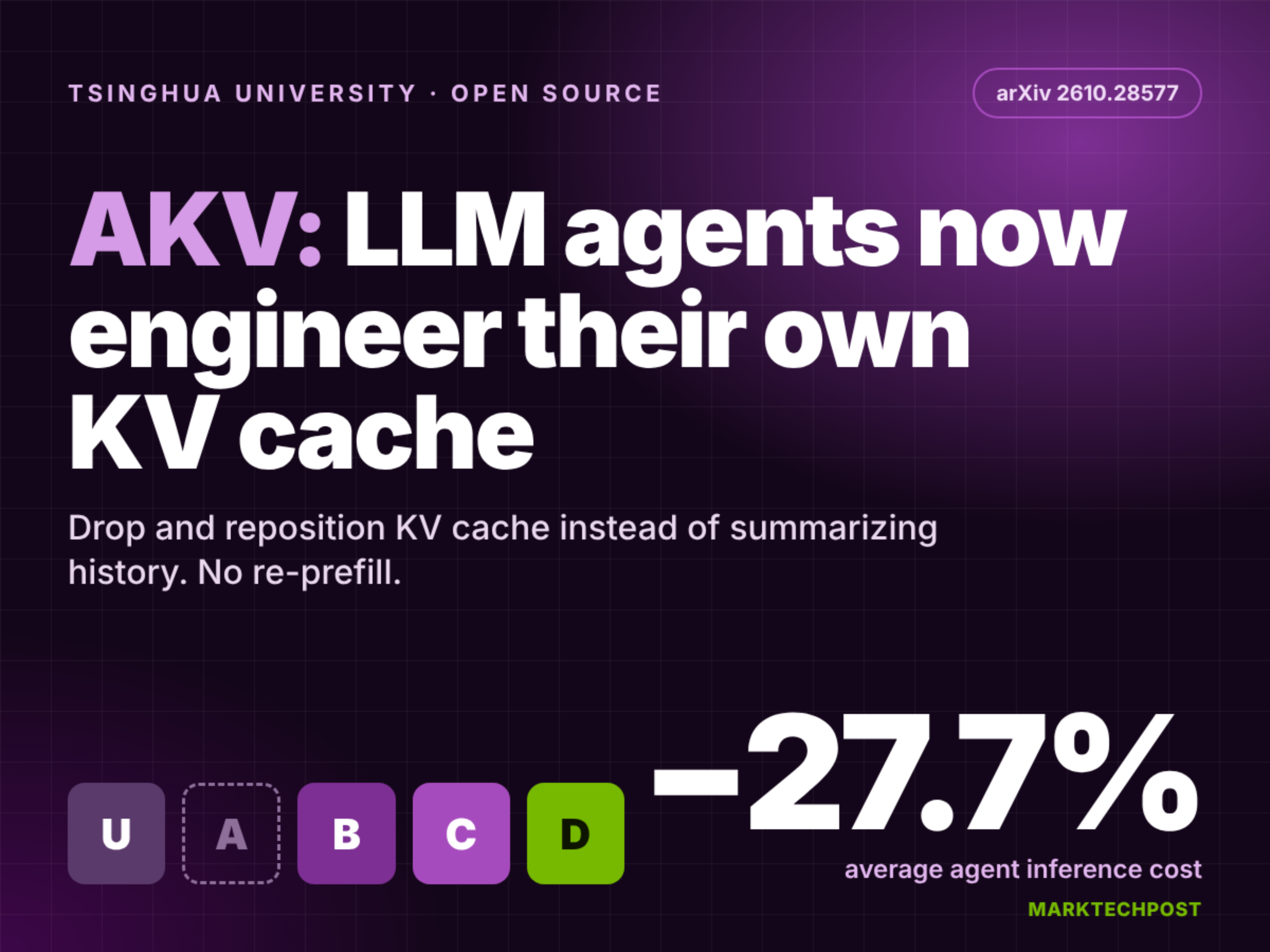
Tsinghua AI Open-Sources AKV, a Cache Engineering Server for LLM Agents on SGLang
02 / IN FOCUS

Tsinghua University and The Chinese University of Hong Kong jointly open-source AKV: an engineering service system for KV caching tailored to LLM agents.

MarkTechPost
Multi modal perceived conversation success prediction for spontaneous autistic and non-autistic dyadic interactions
03 / IN FOCUS

The study proposes a multimodal approach to predict the successful perception of dyadic conversations between individuals with and without autism.

arXiv cs.CL
Rethinking Structured Generation: Can Graph-Based Reasoning Resolve Ambiguity?
04 / IN FOCUS

The study proposes a new paradigm of fuzzy-aware structured generation driven by graph reasoning.

arXiv cs.CL
An Agentic Approach with Evidence-Grounded Verification for Multimodal Emotion Reasoning in Conversation
05 / IN FOCUS

A new arXiv paper proposes an intelligent agent framework for traceable multimodal emotion reasoning, supporting evidence verification and prompt repair without weight updates.

arXiv cs.CL
Knowledge Graphs Quality Assessment in the Era of LLMs: A Conceptual Framework
06 / IN FOCUS

The study proposes a knowledge graph quality assessment framework for the era of large language models.

arXiv cs.CL
Validating the Comparison, Not Just the Scorer: Why Overall Accuracy Can Mislead in Interactive LLM Evaluation
07 / IN FOCUS

In LLM evaluation, relying solely on the overall F1 score to validate automated scorers carries the risk of misleading results: a new study underscores the need to calibrate for prompt-specific differences.

arXiv cs.CL
From Target Selection to Condition Reuse: Auditing Residual Interventions in Tool-Use Models
08 / IN FOCUS

Research reveals that activation interventions struggle to achieve conditional reuse in tool usage models.

arXiv cs.CL
MisconceptDialogue: Evaluation Criteria Shape Measured Success in LLM Math Tutoring
09 / IN FOCUS

New research reveals serious measurement bias in LLM-based math tutoring assessments: exact-match scoring underestimates effectiveness by nearly 40 percentage points.

arXiv cs.CL
AI NEWS × FOXAIFind your next step

From the latest news to tools that work for you.

Explore AI tools

Discover AI tools

Swipe to explore →
ClaudeAI Assistants & Search

Claude is an AI assistant launched by Anthropic that can assist with writing, reading materials, analyzing data, and programming through conversation, and can organize some tasks into editable documents, spreadsheets, or presentation files. It’s ideal for individuals and teams who want to connect their ideas, materials, and drafts.

WritingAnalysisProgrammingFree entry availableView details
GeminiAI Assistants & Search

Gemini is Google’s AI assistant, which can assist with writing, planning, organizing information, and analyzing uploaded files through conversation. It can also use Deep Research to retrieve information on a topic and generate research reports.

Q&AWritingAssistantPricing unverifiedView details
MidjourneyImage Generation & Editing

Midjourney is an AI-powered creative tool that generates visual artworks from text and reference images. On the web-based Create page, you can enter prompts, compare generated versions, and then continue creating using features such as variations, editing, upscaling, or converting images to video.

Image GenerationText-to-imageVisual CreativityPaidView details
KreaImage Generation & Editing

Krea is an AI visual creation workspace that can generate images from text or reference images, compare different models and variants, and then perform editing, detail enhancement, and upscaling. It also provides access to video and other creative tools.

Image GenerationVideo3DPricing unverifiedView details
RunwayVideo & Animation

Runway is an AI platform that integrates video generation, visual editing, and creative workflows. Starting from text, images, or existing clips, users can generate or modify shots, then extend, upscale, and export them—serving concept shorts, advertisements, and other visual productions.

Video generationCreative VideoVisual CreationFree entry availableView details
SunoMusic & Audio

Suno is an AI music platform that creates songs from text descriptions, lyrics, and reference materials. Users can generate vocal tracks or instrumental music, then use features like editing, remixing, and audio track separation to further produce and share their creations.

Music generationsongAudioFree entry availableView details
ElevenLabsSpeech & Transcription

ElevenLabs is a platform that offers AI-powered voice generation, audio creation, and voice-enabled agents. Creators can produce voiceovers, audiobooks, podcasts, and localized content, while developers can leverage its APIs to integrate speech synthesis, transcription, and conversational capabilities.

VoiceoverText-to-SpeechVoice Intelligence AgentFree entry availableView details
Notion AIOffice & Productivity

Notion AI is an AI assistant integrated into Notion workspaces, designed to search team knowledge, generate and edit pages, manage databases, and organize meeting notes. By leveraging the context of your workspace and connected apps, it helps you complete information retrieval, content organization, and follow-up tasks all within the same working environment.

Knowledge BaseDocumentOfficeFree entry availableView details
GammaOffice & Productivity

Gamma is an AI-powered tool for creating presentations, documents, web pages, and visual content. It can generate content starting from a goal, an outline, or existing materials, and then refine the final output through conversational prompts, layout adjustments, and free-form editing.

PPTPresentationDocumentFree entry availableView details
CursorCoding & Development

Cursor is an AI programming product designed to support software development tasks, assisting with code planning, modification, testing, and review within the code context, and offering usage options such as desktop, command-line, and cloud-based agents.

ProgrammingCodeAI IDEFree entry availableView details

AI, as it happens

942 published stories
Products & applications · 82 storiesClear filters ×
2026-10-24
Follow the timeline
12:00

TutorCaseBench Released: The First LLM Tutoring Evaluation Benchmark for Special Education Scenarios

On October 24, 2026, researchers published TutorCaseBench on arXiv (ID 2610.30828v1)—an LLM tutoring evaluation benchmark built on real-world cases from pedagogy, educational psychology, and special education, focusing on the ability to support students with learning and behavioral challenges. The benchmark comprises 923 dialogue segments, covering five categories of challenging behaviors, and employs a dual-track assessment approach: open-ended generation (1,560 questions) and multiple-choice questions (2,537 questions). Among 11 state-of-the-art large models, the top performer met the evaluation criteria in only 55.8% of the open-ended items.

Why it mattersThis study fills a critical gap in existing AI‑based educational assessment, which has overlooked the complexity of students with special needs. Its methodology emphasizes evidence‑based tracing—combining qualitative case studies with source‑grounded rubrics—and all data are openly available, ensuring reproducibility and relevance to educational practice. The findings clearly reveal significant shortcomings of current LLMs in generating contextually appropriate responses, offering important warnings and guidance for the practical implementation of educational AI.
Industry applicationsRead original Timeline and related coverage
02:51

Google open-sources a medical foundation model to help implement global tuberculosis screening.

Google, together with partners such as Nexus AI, has brought a chest‑X‑ray–based AI tool for tuberculosis screening from the laboratory to primary‑care settings in six countries, and has open‑sourced multimodal foundation models like MedGemma and MedSigLIP, supporting offline deployment, localized adaptation, and data sovereignty.

Industry applications# Official# ResearchRead original Timeline and related coverage
2026-10-23
Follow the timeline
18:09

Black October: A Comprehensive Overview of the AI-Driven Cybersecurity Crisis—From Its Peak to Defensive Response

Around October 21–22, 2026, over a span of approximately 48 hours, more than a dozen high‑severity AI‑related vulnerabilities and intrusion incidents were reported worldwide, including PHP2Shell, GitLab RCE (CVSS 10), NGINX/HTTP/3 DoS, LiteLLM password theft, eMudhra CA key leakage, and Quest Diagnostics medical data exposure. State actors such as Storm‑0940 leveraged open‑source intelligent penetration‑testing frameworks like ARTEX to launch large‑scale attacks. Concurrently, AI security defense systems were rapidly being developed, encompassing formal verification, open‑source patching agents, standardization of agent capabilities, and hardware‑level optimizations.

Industry applications# IndividualRead original Timeline and related coverage
05:17

Building a Production-Ready AI Service Framework: The New Focus of Enterprise AI Competition

As AI transitions from the experimental stage to large-scale production, corporate competitiveness is shifting from model selection to the serving harness—a suite of engineering systems that encompasses architecture design, memory management, scheduling strategies, and inference optimization. In an article published in MIT Technology Review, EXL points out that the key determinant of AI’s real-world impact is no longer model parameters or benchmark scores, but rather the ability to translate model capabilities into business value with controllable costs, reliable latency, and sustainable scalability.

Enterprise & work applications# MediaRead original Timeline and related coverage
02:00

Microsoft claims its AI diagnostic tool achieves accuracy up to four times that of human doctors, with the related research published in the journal Science.

Microsoft AI CEO Mustafa Suleyman told The Verge that the company has developed an AI diagnostic tool whose accuracy in testing for multiple diseases is up to four times that of human doctors; the findings were published in the top-tier journal Science, based on a comparative evaluation of real-world medical cases and emergency‑room data against Microsoft’s proprietary benchmark (name not fully disclosed).

Industry applications# MediaRead original Timeline and related coverage
01:48

Amazon Quick has obtained HIPAA qualification, but compliance responsibility still rests with the customer.

Amazon Quick is an HIPAA‑compliant service offered by AWS that enables healthcare organizations to process Protected Health Information (PHI) upon signing a Business Associate Agreement (BAA); however, compliance with HIPAA does not equate to full regulatory compliance. Customers must rigorously manage its PHI processing workflows, encryption mechanisms, logging policies, and irreversible configuration requirements.

Industry applications# Official# TutorialsRead original Timeline and related coverage
2026-10-22
Follow the timeline
18:00

Building Context-Aware AI: A New Paradigm for Enterprise Decision Intelligence

Celonis Chief Scientist Devavrat Shah argues that enterprise AI must be embedded in real-world business contexts—such as workflows, role-based permissions, and process constraints—in order to achieve “decision intelligence”; AI divorced from context is prone to errors, resource waste, or ineffective outputs. His technical approach relies on a “context layer” and a digital twin architecture, emphasizing incremental validation, role-based governance, and workforce empowerment. However, all these claims are subjective assertions and have not been independently verified.

Enterprise & work applications# MediaRead original Timeline and related coverage
2026-10-21
Follow the timeline
13:01

Tenex builds an AI-native SDLC: outcome-based pricing, agent-driven development, and the last mile of enterprise AI deployment.

Tenex is an AI-native software delivery company established 18 months ago (as of 2026), with a team of 75 employees, serving roughly half of the Fortune 2000 companies and a comparable number of mid-sized enterprises. Its core practices include: a dynamic engineer compensation system anchored in story points; a quality‑assurance mechanism led by AI strategists; the MetaHarness framework, which embeds context directly within Git; and a capability realignment focused on “high‑value, non‑coding tasks.” Meanwhile, it has been observed that enterprise AI adoption remains concentrated on general‑purpose LLM deployments and engineering‑side agents, with backend office‑type production‑grade AI agents achieving only about 5% penetration.

Enterprise & work applications# IndividualRead original Timeline and related coverage
02:22

Ukraine has, for the first time in combat, used drones to evacuate wounded personnel, marking a new phase in battlefield first aid.

Ukrainian forces successfully carried out a globally rare aerial evacuation of wounded personnel using a heavy six-rotor drone at the front line, validating the unmanned battlefield medical evacuation concept that has long been in the experimental phase. The time and location of the operation were not disclosed, but related video footage was released by the Ukrainian military on October 19, 2026.

Industry applications# MediaRead original Timeline and related coverage
2026-10-20
Follow the timeline
23:20

The New Economics of Enterprise AI: From “Can It Be Used?” to “How to Achieve Efficient Output”

The article uses the widespread adoption of electricity as an analogy, noting that enterprise AI is transitioning from a phase of isolated experiments to one of infrastructure‑level deployment. The central question has shifted from “Can we deploy AI?” to “How can we deliver measurable business outcomes at the lowest effective cost?” It introduces “the effective cost per useful output” as a key metric and analyzes the economic differences among three AI operating models—building an in‑house stack, leveraging on‑demand cloud services, and integrating a private AI platform—while emphasizing the decisive impact of operational practices such as utilization rates, model selection, and cache management on ROI.

Enterprise & work applications# MediaRead original Timeline and related coverage
2026-10-16
Follow the timeline
2026-10-15
Follow the timeline
Every update links back to its source.
STAY CURIOUS. STAY INFORMED.

Stay informed about the changes that matter.

Give your curiosity direction. Make every day of reading count.

Subscribe via RSS