
15:42
Today's news

01 / IN FOCUS
Former Joonko CEO Pleads Guilty to Securities Fraud: False Customer and Revenue Statements Result in Personal Liability for the Founder
Crunchbase AI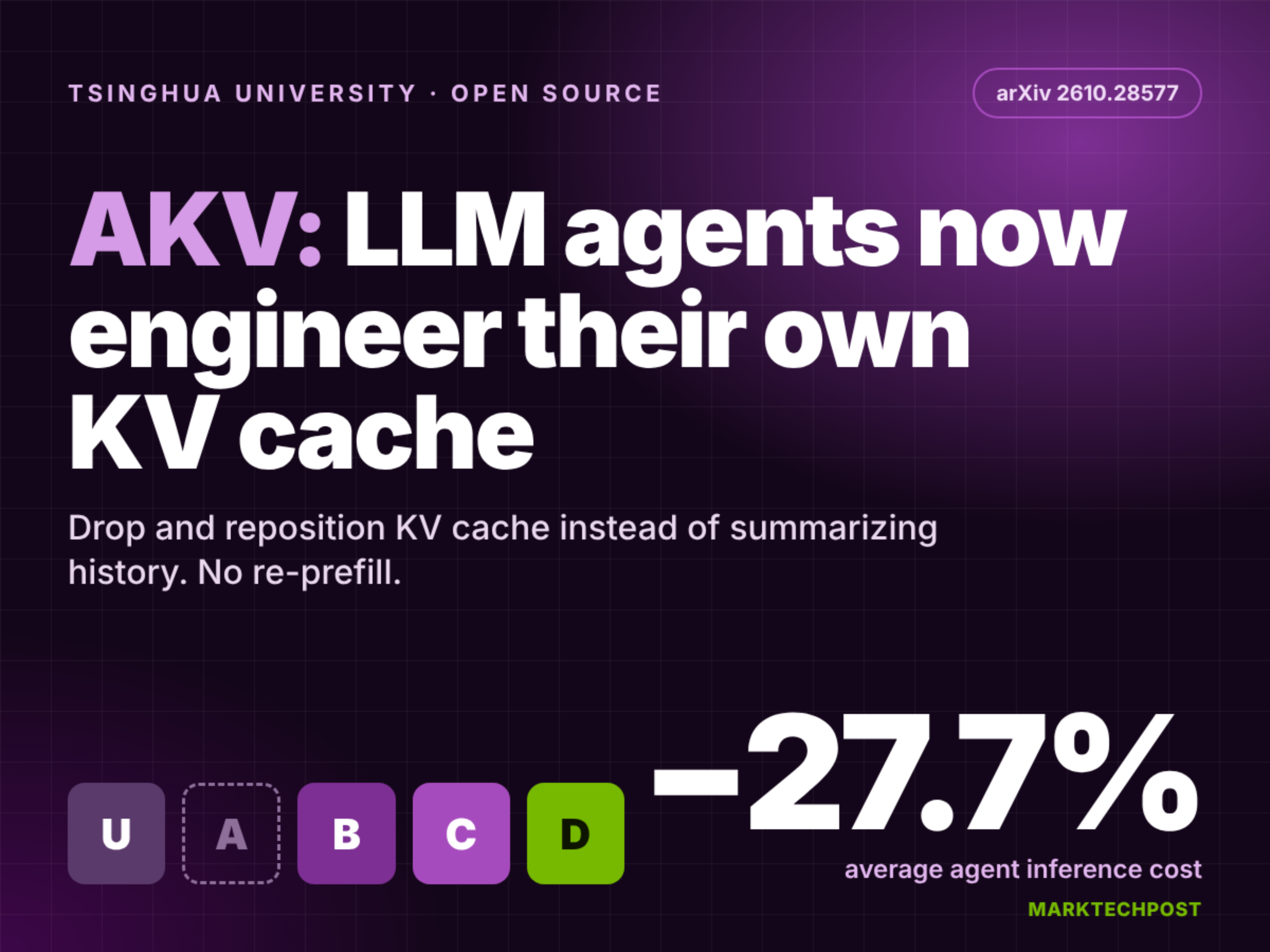
02 / IN FOCUS
Tsinghua University and The Chinese University of Hong Kong jointly open-source AKV: an engineering service system for KV caching tailored to LLM agents.
MarkTechPost
03 / IN FOCUS
The study proposes a multimodal approach to predict the successful perception of dyadic conversations between individuals with and without autism.
arXiv cs.CL04 / IN FOCUS
The study proposes a new paradigm of fuzzy-aware structured generation driven by graph reasoning.
arXiv cs.CL05 / IN FOCUS
A new arXiv paper proposes an intelligent agent framework for traceable multimodal emotion reasoning, supporting evidence verification and prompt repair without weight updates.
arXiv cs.CL06 / IN FOCUS
The study proposes a knowledge graph quality assessment framework for the era of large language models.
arXiv cs.CL07 / IN FOCUS
In LLM evaluation, relying solely on the overall F1 score to validate automated scorers carries the risk of misleading results: a new study underscores the need to calibrate for prompt-specific differences.
arXiv cs.CL08 / IN FOCUS
Research reveals that activation interventions struggle to achieve conditional reuse in tool usage models.
arXiv cs.CL09 / IN FOCUS
New research reveals serious measurement bias in LLM-based math tutoring assessments: exact-match scoring underestimates effectiveness by nearly 40 percentage points.
arXiv cs.CLAI NEWS × FOXAIFind your next step
Explore AI tools From the latest news to tools that work for you.
Discover AI tools
Swipe to explore →C ClaudeAI Assistants & Search
 GeminiAI Assistants & Search
 MidjourneyImage Generation & Editing
 KreaImage Generation & Editing
 RunwayVideo & Animation
 SunoMusic & Audio
 ElevenLabsSpeech & Transcription
 Notion AIOffice & Productivity
 GammaOffice & Productivity
 CursorCoding & Development
ClaudeAI Assistants & SearchClaude is an AI assistant launched by Anthropic that can assist with writing, reading materials, analyzing data, and programming through conversation, and can organize some tasks into editable documents, spreadsheets, or presentation files. It’s ideal for individuals and teams who want to connect their ideas, materials, and drafts.
GGeminiAI Assistants & SearchGemini is Google’s AI assistant, which can assist with writing, planning, organizing information, and analyzing uploaded files through conversation. It can also use Deep Research to retrieve information on a topic and generate research reports.
MMidjourneyImage Generation & EditingMidjourney is an AI-powered creative tool that generates visual artworks from text and reference images. On the web-based Create page, you can enter prompts, compare generated versions, and then continue creating using features such as variations, editing, upscaling, or converting images to video.
KKreaImage Generation & EditingKrea is an AI visual creation workspace that can generate images from text or reference images, compare different models and variants, and then perform editing, detail enhancement, and upscaling. It also provides access to video and other creative tools.
RRunwayVideo & AnimationRunway is an AI platform that integrates video generation, visual editing, and creative workflows. Starting from text, images, or existing clips, users can generate or modify shots, then extend, upscale, and export them—serving concept shorts, advertisements, and other visual productions.
SSunoMusic & AudioSuno is an AI music platform that creates songs from text descriptions, lyrics, and reference materials. Users can generate vocal tracks or instrumental music, then use features like editing, remixing, and audio track separation to further produce and share their creations.
EElevenLabsSpeech & TranscriptionElevenLabs is a platform that offers AI-powered voice generation, audio creation, and voice-enabled agents. Creators can produce voiceovers, audiobooks, podcasts, and localized content, while developers can leverage its APIs to integrate speech synthesis, transcription, and conversational capabilities.
NNotion AIOffice & ProductivityNotion AI is an AI assistant integrated into Notion workspaces, designed to search team knowledge, generate and edit pages, manage databases, and organize meeting notes. By leveraging the context of your workspace and connected apps, it helps you complete information retrieval, content organization, and follow-up tasks all within the same working environment.
GGammaOffice & ProductivityGamma is an AI-powered tool for creating presentations, documents, web pages, and visual content. It can generate content starting from a goal, an outline, or existing materials, and then refine the final output through conversational prompts, layout adjustments, and free-form editing.
CCursorCoding & DevelopmentCursor is an AI programming product designed to support software development tasks, assisting with code planning, modification, testing, and review within the code context, and offering usage options such as desktop, command-line, and cloud-based agents.
AI, as it happens
940 published storiesModels · 202 storiesClear filters ×
2026-10-22
Follow the timeline13:00
Several leading financial institutions in Europe have adopted open-source large models to build proprietary intelligent systems.
At the GTC Berlin conference, European financial institutions including Revolut, Starling Bank, Lloyds, and Santander announced that they are building production‑grade AI capabilities based on NVIDIA’s accelerated computing platform and open‑source weight models—such as PRAGMA, the Nemotron series, and the Kumo family—covering core use cases like trading analytics, speech recognition, fraud detection, and data pipeline acceleration, while emphasizing data sovereignty, cost control, and compliant deployment.
13:00
NVIDIA Cosmos Platform Upgrade: New Toolchain for Training, Evaluating, and Deploying World Models
NVIDIA has expanded the Cosmos platform by introducing the Cosmos Data Factory blueprint, the Cosmos Framework training optimization tool, and the Cosmos 3 NIM microservice, supporting multimodal data generation, adaptation to open-source world models (such as GR00T and QWEN), and low-latency inference; real-world applications have already been deployed by Porsche, ANYbotics, Ultralytics, ADNOC, and others.
13:00
Several European institutions have deployed the NVIDIA Earth-2 open-source model to advance localized weather and climate prediction applications.
NVIDIA has released the Earth-2 open-source AI model family for Europe, including the region-specific nowcasting model StormScope EU, and is collaborating with organizations such as AXA, Vaisala Xweather, the University of Manchester, and TotalEnergies to conduct real-world validation, covering tasks like storm risk assessment, air quality modeling, solar power generation forecasting, and radar terrain inversion.
13:00
NVIDIA’s open-source models are helping to bring AI projects in the public sector to fruition across multiple European countries.
NVIDIA, in collaboration with governments and technology partners across multiple European countries, is advancing sovereign, controllable AI applications—leveraging open-source large models such as Nemotron and synthetic persona datasets—in Germany, Poland, the United Kingdom, France, Greece, and other nations. These efforts span areas including medical image analysis, employment services, digital government assistants, classified information processing, and localized language modeling.
04:27
Recursive releases Flint: a lightweight, AI-driven programming model that can run locally.
AI startup Recursive has unveiled Flint, an open-source coding model that it claims was developed primarily using its in-house AI research system, Eureka Machine. With just 40 billion parameters and only 2.5 billion activations in practice, the model can run offline on a standard laptop—such as an M4 Pro MacBook—at an inference speed of 131 tokens per second, outperforming most models of comparable size on benchmarks like SWE-Bench.
03:30
Walmart launches an AI-powered shopping gateway, supporting autonomous shopping workflows and enhancing user control.
Walmart has officially launched Agent Gateway (an AI agent gateway) along with its accompanying Agent Profiles feature, enabling authorized AI agents—such as ChatGPT, Gemini, Meta Muse, and others—to perform searches and place orders on behalf of users across Walmart and Sam’s Club platforms. User control over agent activities is ensured through mechanisms like independent account configuration, transaction approvals, and spending limits. This move stands in stark contrast to Amazon’s recent ban on AI‑powered shopping agents.
02:51
OpenAI's latest GPT-6 series models will be available on Google Cloud and the Antigravity platform.
OpenAI’s cutting-edge GPT-6 and 6.1 series models (Astra, Sol, Luna) will be launched on Google Cloud Model Garden in the coming weeks and integrated into Google’s agent-driven programming tool, Antigravity; this move makes Google the first mainstream cloud provider to offer all three major closed-source large models—Gemini, Claude, and GPT.
2026-10-21
Follow the timeline21:04
Claude Mods: The first implementation of an attention interface, a human-programmable agent interaction layer
Claude Mods is Anthropic’s programmable plugin system for Claude Code, representing an early form of the “Attention Interface”—it shifts the traditional machine-oriented agent harness toward a customizable interaction layer centered on human attention. Users can write Mods in TypeScript/JS or have Claude generate them automatically using natural language, thereby determining when to be interrupted, what content to see, and what decisions to make.
21:04
Claude Mods: A programmable attention interface that reshapes the collaboration paradigm between humans and AI agents
Claude Mods is a programmable plugin system for developers launched by Anthropic, marking a shift of the ‘agent harness’ from a machine-side interface to a human-side interface—namely, the ‘Attention Interface’. It enables users to customize Claude Code’s behavior, rendering, and interaction logic via TypeScript/JavaScript, thereby facilitating co-design workflows between humans and AI. This mechanism has already been applied to built-in features (such as You Should Know) and supports users in building plugins themselves or having them generated with Claude’s assistance.
20:00
Mistral partners with NVIDIA to advance AI-native engineering workflows, releases Mistral Large 4, and jointly develops physical and agent-based AI evaluation benchmarks.
Mistral and NVIDIA announced a deepened collaboration, integrating Mistral’s Large 4 model, physics-based modeling pipelines, and NVIDIA’s accelerated computing stack (CUDA-X, Warp, Omniverse) to co-develop AI-native engineering workflows for industries such as aerospace, automotive, and semiconductors. The two parties will jointly release open-source datasets and public evaluation benchmarks, covering the assessment of agent capabilities in physics-informed AI and CAE/EDA use cases.
18:30
NVIDIA’s European cloud partners are accelerating the expansion of sovereign, open, and secure AI infrastructure.
NVIDIA announced that its cloud partners across Europe, the Nordics, Africa, and Central Asia are scaling up regional AI computing infrastructure based on the NVIDIA DSX platform, focusing on sovereign computing (local deployment), open model support (such as Mistral Large 4 and the Nemotron series), and AI agent security boundaries (via the OpenShell reference architecture), covering use cases including training, inference, physics‑based AI, and retail agents.
18:00
NVIDIA releases a portfolio of open-source models across multiple domains, driving the development of sovereign AI in European industries.
NVIDIA announced the expansion of its open-source model family to encompass areas such as language, robotics, bioinformatics, and quantum computing, unveiling the Nemotron 3.5 series, the Kumo structured-data model, the Cosmos world model, the Alpamayo 2 Edge autonomous-driving model, the BioNeMo RFD4-Proteina protein-design model, and the Ising quantum-computing model. All these models are now available to developers and enterprises, with access to weights and tools, supporting localized customization and independent deployment.
14:54
14:54
10-21
NVIDIA releases Kumo Relational: the first foundation model for structured data that outperforms supervised learning without any training.
NVIDIA has launched Kumo Relational, a pre-trained relational foundation model that can perform predictive tasks—such as churn prediction, fraud detection, and demand forecasting—directly on enterprise‑grade relational databases, without the need for task fine-tuning, feature engineering, or table flattening. In 41 benchmark tests spanning 15 databases, it outperformed supervised models like XGBoost across the board, and on the SAP SALT enterprise benchmark, its MRR metric surpassed AutoGluon by 8%. The model supports databases with up to 500 billion rows and enables zero‑code predictive queries via Predictive Query Language (PQL).
10-21
How we built ChatGPT’s novel ad stack for user trust and relevance
Learn how OpenAI built ChatGPT’s LLM-powered ad stack to understand conversational intent, keep ads separate from answers, and deliver relevant ads at scale.
04:00
Gemini’s personal intelligence features have officially launched on in-car systems: Android Auto is rolling out starting today, with Google’s built-in in-car system to follow within a few months.
In October 2026, Google announced that it would extend Gemini’s Personal Intelligence feature to in-vehicle scenarios, initially rolling it out to Android Auto users and expanding to vehicles equipped with the Google Built-in system over the following months. This feature is optional and relies on user authorization to access local data such as Gmail and Calendar to enhance response relevance.
03:34
Battle Drones - a vibe coded RTS with audio-based multiplayer
My latest vibe coded game experiment is a Command & Conquer style RTS (Real Time Strategy) game called Battle Drones (play it here). Unlike my previous experiments, this one is actually fun to play. I'm somewhat embarrassed to admit that I got there by telling Claude to "Make it a LOT more fun". It also supports multiplayer between nearby devices using audio to synchronize game state! Here's what I've built so far, and some of the things I learned along the way. Battle Drones How I built this v1: the initial prototype v2: full sprites v3: varied terrain v4: the fun update v5: Battle Drones goes 3D v8: Archipelago v10: Goliath, and agent battles Agent battles v11: Random Maps v12: Multiplayer via sound Some thoughts Update: Online multiplayer support Battle Drones My initial goal was to bui
00:42
AWS Bedrock has launched cross-region inference in the Canada region, supporting calls to the nominal GPT-5.6/GPT-6/GPT-6.1 models.
Amazon Web Services announced that Canadian customers can, via Amazon Bedrock, invoke models branded as OpenAI GPT-5.6, GPT-6, and GPT-6.1 in the ca-central-1 (Canada Central) and ca-west-1 (Canada West/Calgary) regions using cross-region inference (CRIS); the actual inference takes place in North American or global AWS commercial regions, while data remains at rest in the Canadian source region.
Every update links back to its source.