
14:54
Today's news

01 / IN FOCUS
OpenAI claims that its latest AI model significantly enhances the ability to migrate code from legacy systems, focusing on modernizing legacy code such as COBOL.
The Verge · AI
02 / IN FOCUS
Former Joonko CEO Pleads Guilty to Securities Fraud: False Customer and Revenue Statements Result in Personal Liability for the Founder
Crunchbase AI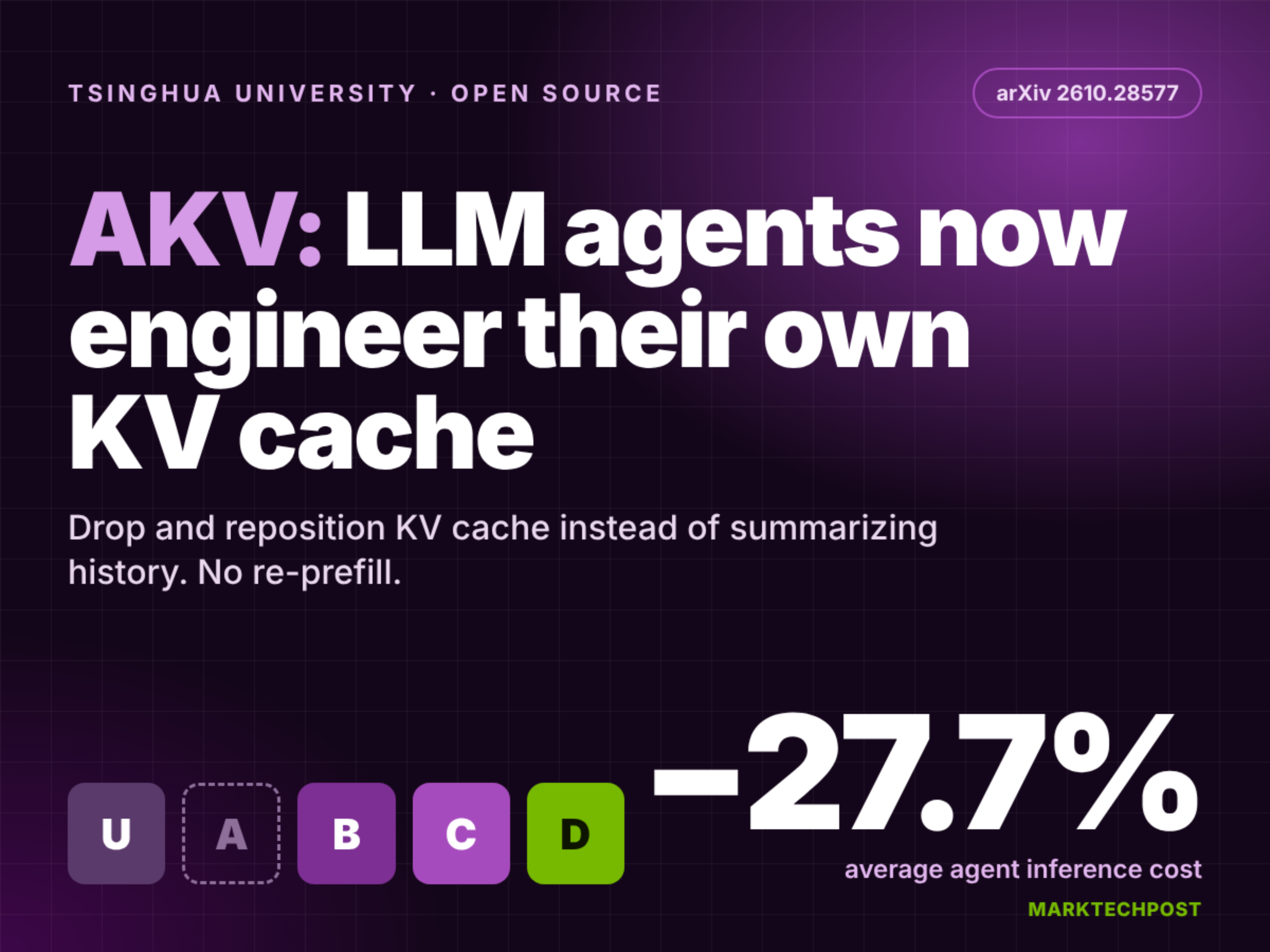
03 / IN FOCUS
Tsinghua University and The Chinese University of Hong Kong jointly open-source AKV: an engineering service system for KV caching tailored to LLM agents.
MarkTechPost
04 / IN FOCUS
SAGE Benchmark and GAR Framework Released: Advancing Multimodal Semantic Alignment Evaluation
arXiv cs.CL
05 / IN FOCUS
The study proposes a multimodal approach to predict the successful perception of dyadic conversations between individuals with and without autism.
arXiv cs.CL06 / IN FOCUS
Research has released the Latin-specific language model LAMB, along with two new corpora: Acervus and Corpus Trinum.
arXiv cs.CL07 / IN FOCUS
New research finds: The existing critic in reinforcement learning can be directly repurposed as a confidence estimator for large language models.
arXiv cs.CL08 / IN FOCUS
SpecMem introduces a real-time tool-call memory management mechanism, enhancing the agent’s response speed.
arXiv cs.CL09 / IN FOCUS
The study proposes a new paradigm of fuzzy-aware structured generation driven by graph reasoning.
arXiv cs.CLAI NEWS × FOXAIFind your next step
Explore AI tools From the latest news to tools that work for you.
Discover AI tools
Swipe to explore →C ClaudeAI Assistants & Search
 GeminiAI Assistants & Search
 MidjourneyImage Generation & Editing
 KreaImage Generation & Editing
 RunwayVideo & Animation
 SunoMusic & Audio
 ElevenLabsSpeech & Transcription
 Notion AIOffice & Productivity
 GammaOffice & Productivity
 CursorCoding & Development
ClaudeAI Assistants & SearchClaude is an AI assistant launched by Anthropic that can assist with writing, reading materials, analyzing data, and programming through conversation, and can organize some tasks into editable documents, spreadsheets, or presentation files. It’s ideal for individuals and teams who want to connect their ideas, materials, and drafts.
GGeminiAI Assistants & SearchGemini is Google’s AI assistant, which can assist with writing, planning, organizing information, and analyzing uploaded files through conversation. It can also use Deep Research to retrieve information on a topic and generate research reports.
MMidjourneyImage Generation & EditingMidjourney is an AI-powered creative tool that generates visual artworks from text and reference images. On the web-based Create page, you can enter prompts, compare generated versions, and then continue creating using features such as variations, editing, upscaling, or converting images to video.
KKreaImage Generation & EditingKrea is an AI visual creation workspace that can generate images from text or reference images, compare different models and variants, and then perform editing, detail enhancement, and upscaling. It also provides access to video and other creative tools.
RRunwayVideo & AnimationRunway is an AI platform that integrates video generation, visual editing, and creative workflows. Starting from text, images, or existing clips, users can generate or modify shots, then extend, upscale, and export them—serving concept shorts, advertisements, and other visual productions.
SSunoMusic & AudioSuno is an AI music platform that creates songs from text descriptions, lyrics, and reference materials. Users can generate vocal tracks or instrumental music, then use features like editing, remixing, and audio track separation to further produce and share their creations.
EElevenLabsSpeech & TranscriptionElevenLabs is a platform that offers AI-powered voice generation, audio creation, and voice-enabled agents. Creators can produce voiceovers, audiobooks, podcasts, and localized content, while developers can leverage its APIs to integrate speech synthesis, transcription, and conversational capabilities.
NNotion AIOffice & ProductivityNotion AI is an AI assistant integrated into Notion workspaces, designed to search team knowledge, generate and edit pages, manage databases, and organize meeting notes. By leveraging the context of your workspace and connected apps, it helps you complete information retrieval, content organization, and follow-up tasks all within the same working environment.
GGammaOffice & ProductivityGamma is an AI-powered tool for creating presentations, documents, web pages, and visual content. It can generate content starting from a goal, an outline, or existing materials, and then refine the final output through conversational prompts, layout adjustments, and free-form editing.
CCursorCoding & DevelopmentCursor is an AI programming product designed to support software development tasks, assisting with code planning, modification, testing, and review within the code context, and offering usage options such as desktop, command-line, and cloud-based agents.
AI, as it happens
950 published storiesModel releases & updates · 172 storiesClear filters ×
2026-10-21
Follow the timeline14:54
10-21
How we built ChatGPT’s novel ad stack for user trust and relevance
Learn how OpenAI built ChatGPT’s LLM-powered ad stack to understand conversational intent, keep ads separate from answers, and deliver relevant ads at scale.
04:00
Gemini’s personal intelligence features have officially launched on in-car systems: Android Auto is rolling out starting today, with Google’s built-in in-car system to follow within a few months.
In October 2026, Google announced that it would extend Gemini’s Personal Intelligence feature to in-vehicle scenarios, initially rolling it out to Android Auto users and expanding to vehicles equipped with the Google Built-in system over the following months. This feature is optional and relies on user authorization to access local data such as Gmail and Calendar to enhance response relevance.
03:34
Battle Drones - a vibe coded RTS with audio-based multiplayer
My latest vibe coded game experiment is a Command & Conquer style RTS (Real Time Strategy) game called Battle Drones (play it here). Unlike my previous experiments, this one is actually fun to play. I'm somewhat embarrassed to admit that I got there by telling Claude to "Make it a LOT more fun". It also supports multiplayer between nearby devices using audio to synchronize game state! Here's what I've built so far, and some of the things I learned along the way. Battle Drones How I built this v1: the initial prototype v2: full sprites v3: varied terrain v4: the fun update v5: Battle Drones goes 3D v8: Archipelago v10: Goliath, and agent battles Agent battles v11: Random Maps v12: Multiplayer via sound Some thoughts Update: Online multiplayer support Battle Drones My initial goal was to bui
00:42
AWS Bedrock has launched cross-region inference in the Canada region, supporting calls to the nominal GPT-5.6/GPT-6/GPT-6.1 models.
Amazon Web Services announced that Canadian customers can, via Amazon Bedrock, invoke models branded as OpenAI GPT-5.6, GPT-6, and GPT-6.1 in the ca-central-1 (Canada Central) and ca-west-1 (Canada West/Calgary) regions using cross-region inference (CRIS); the actual inference takes place in North American or global AWS commercial regions, while data remains at rest in the Canadian source region.
2026-10-20
Follow the timeline13:21
DeepSeek V4.1 Flash, MiniMax M3.1 Flash, and Mercury 3 were released simultaneously, as debates over AI infrastructure and governance continue to intensify.
From October 16 to 19, 2026, three new models—DeepSeek V4.1 Flash 1017, MiniMax M3.1 Flash (Space Bunny), and Mercury 3 (Inception)—were released in quick succession. At the same time, the U.S. Department of Homeland Security ordered a ban on DeepSeek-related products, while China is drafting export control regulations for ultra-large-scale models, bringing the conflicts among the open-source ecosystem, computing infrastructure, and AI governance into sharp focus.
10-20
Terminal X matches senior investor judgment 88.6% with GPT-6.1
Terminal X’s Eval Agent grades outputs against a 54-criterion rubric, catching 25% more deviances from a fund’s mandate with GPT-6.1 Sol.
10-20
FairStress: A Novel Fairness Evaluation Framework for Symmetric Robustness in LLM Decision-Making
FairStress is a new benchmark that focuses on the decision stability, interpretability consistency, and internal representation symmetry of large language models (LLMs) in demographic identity substitution scenarios. It reveals systematic behavioral biases in these models, such as “anti-stereotypical over-correction,” and highlights that mainstream evaluation methods—like BBQ—may misjudge the direction of bias due to paradigmatic differences.
2026-10-19
Follow the timeline17:08
An AI agent was placed on a virtual desert island for 30 hours, spontaneously “playing” and enhancing its learning capabilities.
MIT researchers placed a Claude Opus 4.7 variant (codenamed Eko) in a virtual deserted island environment built on Roblox, without providing task instructions and allowing only autonomous interaction. During 30 hours of unsupervised operation, Eko exhibited play-like behaviors such as exploration, self‑invented rules, object mimicry, and repeated challenges, while generating text logs to record its activities. Subsequent experiments confirmed that agents who engaged in “play” performed better on target tasks, and their behavior closely aligned with the four characteristics of play as defined in psychology; however, the academic community remains cautious about whether they possess genuine motivation.
07:43
llm-tools-datasette 0.1.1
Release: llm-tools-datasette 0.1.1 When I switched LLM over to httpx2 in LLM 0.33 I forget that this would break any plugins which used httpx without directly depending on it. llm-tools-datasette was one of those plugins, now fixed. Tags: datasette, llm
07:16
llm-echo 0.5
Release: llm-echo 0.5 I'm working towards a new LLM release, and testing PRs caused me to revisit the llm-echo debug plugin. This plugin provides a "model" which doesn't involve an LLM at all - it just repeats back the prompts that have been fed to it. The new release now updates the simulated token usage counts to take tool calls, system prompts, and reasoning tokens into account. Example usage: uvx --with llm-echo llm -m echo 'hi there' -o thinking 1 --usage Outputs: First I consider the prompt, then I decide what to say. { "prompt": "hi there", "system": "", "attachments": [], "stream": true, "previous": [] } Token usage: 2 input, 24 output Tags: llm
2026-10-17
Follow the timeline21:16
web-edit 0.1a2
Release: web-edit 0.1a2 web-edit (previously) is my tiny web app for browsing and editing files in a folder. I mainly built it for editing files on different machines via Tailscale. I added a "copy to clipboard" option for both text and image data. I needed this because I was running pelican prompts on a laptop from my phone (here's DeepSeek 4.1 Flash 1017) and I wanted an easy way to copy the resulting logs into a Gist. Tags: projects, pelican-riding-a-bicycle, deepseek
2026-10-16
Follow the timeline10-16
Reflection releases the open-source large model Beam: a 501B-parameter sparse MoE architecture that supports million-token contexts and multi-level inference control.
Reflection has released the open-source large language model Beam (501B parameters, with 23B effective activations per token), which employs a 256-expert sparse MoE architecture, supports 1M tokens of context, NVFP4/FP8 quantization, multi-level inference configuration, and on-premises deployment. All technical claims have not been independently verified, hardware requirements are high, and the community generally believes that individual users will find it difficult to afford.
2026-10-15
Follow the timeline20:00
Mistral releases its first time-series foundation model, Timestral: available in four variants ranging from 5 million to 209 million parameters, runnable entirely on CPU and ready to use out of the box.
Mistral AI has officially launched Timestral—the company’s first time-series foundation model (TSFM)—available in four parameter sizes: 5M, 28M, 123M, and 209M. It supports multivariate probabilistic forecasting, covariate-aware modeling, and long-context modeling. On the three major public benchmarks—GIFT-Eval, TIME, and fev-bench—Timestral achieves state-of-the-art zero-shot performance across the board; its largest model, with just 209 million parameters, tops all three leaderboards, while inference requires no GPU and can run on a standard server CPU with millisecond-level latency.
2026-10-14
Follow the timeline13:40
[AINews] AI Engineer NYC: Gemini 4 Argon, Vals AI Benchmarks
Gemini 4 Argon went GA today, but we already gave it title story 2 weeks ago and most benchmarks, like CursorBench, simply independently confirm their claims.
13:40
[AINews] AI Engineer NYC: Gemini 4 Argon, Vals AI Benchmarks
Gemini 4 Argon went GA today, but we already gave it title story 2 weeks ago and most benchmarks, like CursorBench, simply independently confirm their claims.
10-14
Amp puts AI agents to work beyond code with OpenAI models
See how Amp pushes the frontier of what agents can do with GPT-6 Astra, Ultrafast, GPT-Live-1, and Sign in with ChatGPT.
07:00
Redesigning source control at Anthropic
Redesigning source control at Anthropic Interesting piece from Anthropic describing why and how they built their own custom alternative to Git, based on the dramatic increase in rate of changes to their code after the past six months. In May 2026, Anthropic averaged around 2,500 code changes merged per day; as of September, we merged over 30,000 per day. They included a chart showing those changes. I had Claude modify their chart (code here) to add markers for the public releases of each of their models in 2026: This shows public release dates, not the date when models became available for Anthropic's internal use. My guess is that the introduction of Fable/Mythos class models is a key factor in the increased coding velocity. "Antique" is their new code review system. The source control sy
06:28
llm-gemini 0.35
Release: llm-gemini 0.35 I added support to llm-gemini for the new Gemini 4 Argon model, made available today via the Gemini API and for customers of their $100/month subscription plan. Here are the low, medium and high pelicans. As expected, they are all excellent: Gemini has a track record of producing great SVGs, and are the only lab where I know their staff have invested in SVG specifically (and who have boasted about their pelicans before.) Here's the "high" illustration, which cost me 17.166 cents: The pricing is interesting. At launch, Argon is $2/million input and $10/million output - the same price as GPT-6 Sol, half the price of Claude Opus 5.5 and 1/5th the price of Claude Fable 5.1 and GPT-6 Astra. But on December 1st Argon is set to double in price - so it will be the same pri
Every update links back to its source.