








THE NEXT THING, IN PERSPECTIVEIndependent AI news

The latest AI news, in focus.

Official announcements and industry reporting. Follow the timeline of AI.

Today's news

News feed
When Traction Becomes Personal Exposure: What The Joonko Guilty Plea Means For Founders
01 / IN FOCUS

Former Joonko CEO Pleads Guilty to Securities Fraud: False Customer and Revenue Statements Result in Personal Liability for the Founder

Crunchbase AI
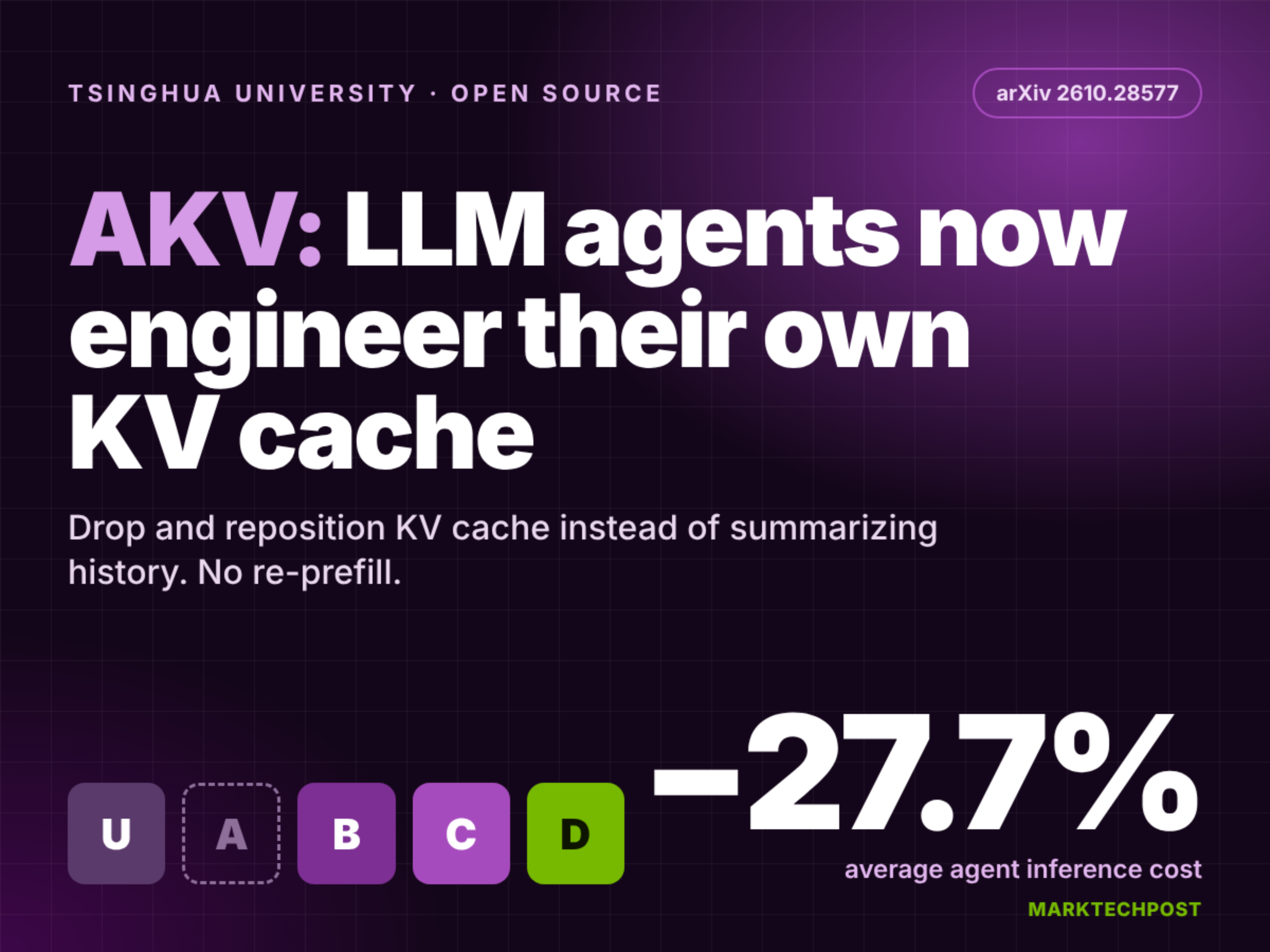
Tsinghua AI Open-Sources AKV, a Cache Engineering Server for LLM Agents on SGLang
02 / IN FOCUS

Tsinghua University and The Chinese University of Hong Kong jointly open-source AKV: an engineering service system for KV caching tailored to LLM agents.

MarkTechPost
Multi modal perceived conversation success prediction for spontaneous autistic and non-autistic dyadic interactions
03 / IN FOCUS

The study proposes a multimodal approach to predict the successful perception of dyadic conversations between individuals with and without autism.

arXiv cs.CL
Rethinking Structured Generation: Can Graph-Based Reasoning Resolve Ambiguity?
04 / IN FOCUS

The study proposes a new paradigm of fuzzy-aware structured generation driven by graph reasoning.

arXiv cs.CL
An Agentic Approach with Evidence-Grounded Verification for Multimodal Emotion Reasoning in Conversation
05 / IN FOCUS

A new arXiv paper proposes an intelligent agent framework for traceable multimodal emotion reasoning, supporting evidence verification and prompt repair without weight updates.

arXiv cs.CL
Knowledge Graphs Quality Assessment in the Era of LLMs: A Conceptual Framework
06 / IN FOCUS

The study proposes a knowledge graph quality assessment framework for the era of large language models.

arXiv cs.CL
Validating the Comparison, Not Just the Scorer: Why Overall Accuracy Can Mislead in Interactive LLM Evaluation
07 / IN FOCUS

In LLM evaluation, relying solely on the overall F1 score to validate automated scorers carries the risk of misleading results: a new study underscores the need to calibrate for prompt-specific differences.

arXiv cs.CL
From Target Selection to Condition Reuse: Auditing Residual Interventions in Tool-Use Models
08 / IN FOCUS

Research reveals that activation interventions struggle to achieve conditional reuse in tool usage models.

arXiv cs.CL
MisconceptDialogue: Evaluation Criteria Shape Measured Success in LLM Math Tutoring
09 / IN FOCUS

New research reveals serious measurement bias in LLM-based math tutoring assessments: exact-match scoring underestimates effectiveness by nearly 40 percentage points.

arXiv cs.CL
AI NEWS × FOXAIFind your next step

From the latest news to tools that work for you.

Explore AI tools

Discover AI tools

Swipe to explore →
ClaudeAI Assistants & Search

Claude is an AI assistant launched by Anthropic that can assist with writing, reading materials, analyzing data, and programming through conversation, and can organize some tasks into editable documents, spreadsheets, or presentation files. It’s ideal for individuals and teams who want to connect their ideas, materials, and drafts.

WritingAnalysisProgrammingFree entry availableView details
GeminiAI Assistants & Search

Gemini is Google’s AI assistant, which can assist with writing, planning, organizing information, and analyzing uploaded files through conversation. It can also use Deep Research to retrieve information on a topic and generate research reports.

Q&AWritingAssistantPricing unverifiedView details
MidjourneyImage Generation & Editing

Midjourney is an AI-powered creative tool that generates visual artworks from text and reference images. On the web-based Create page, you can enter prompts, compare generated versions, and then continue creating using features such as variations, editing, upscaling, or converting images to video.

Image GenerationText-to-imageVisual CreativityPaidView details
KreaImage Generation & Editing

Krea is an AI visual creation workspace that can generate images from text or reference images, compare different models and variants, and then perform editing, detail enhancement, and upscaling. It also provides access to video and other creative tools.

Image GenerationVideo3DPricing unverifiedView details
RunwayVideo & Animation

Runway is an AI platform that integrates video generation, visual editing, and creative workflows. Starting from text, images, or existing clips, users can generate or modify shots, then extend, upscale, and export them—serving concept shorts, advertisements, and other visual productions.

Video generationCreative VideoVisual CreationFree entry availableView details
SunoMusic & Audio

Suno is an AI music platform that creates songs from text descriptions, lyrics, and reference materials. Users can generate vocal tracks or instrumental music, then use features like editing, remixing, and audio track separation to further produce and share their creations.

Music generationsongAudioFree entry availableView details
ElevenLabsSpeech & Transcription

ElevenLabs is a platform that offers AI-powered voice generation, audio creation, and voice-enabled agents. Creators can produce voiceovers, audiobooks, podcasts, and localized content, while developers can leverage its APIs to integrate speech synthesis, transcription, and conversational capabilities.

VoiceoverText to speechVoice agentsFree entry availableView details
Notion AIOffice & Productivity

Notion AI is an AI assistant integrated into Notion workspaces, designed to search team knowledge, generate and edit pages, manage databases, and organize meeting notes. By leveraging the context of your workspace and connected apps, it helps you complete information retrieval, content organization, and follow-up tasks all within the same working environment.

Knowledge BaseDocumentOfficeFree entry availableView details
GammaOffice & Productivity

Gamma is an AI-powered tool for creating presentations, documents, web pages, and visual content. It can generate content starting from a goal, an outline, or existing materials, and then refine the final output through conversational prompts, layout adjustments, and free-form editing.

PPTPresentationDocumentFree entry availableView details
CursorCoding & Development

Cursor is an AI programming product designed to support software development tasks, assisting with code planning, modification, testing, and review within the code context, and offering usage options such as desktop, command-line, and cloud-based agents.

ProgrammingCodeAI IDEFree entry availableView details

AI, as it happens

942 published stories
Industry updates · News · 174 storiesClear filters ×
2026-10-21
Follow the timeline
18:30

European industrial giants are leveraging NVIDIA AI and digital twin technologies to reshape their engineering and manufacturing systems.

Several leading industrial enterprises across Europe are scaling up the deployment of NVIDIA CUDA‑X, Omniverse, Cosmos, and Nemotron—open models and toolchains—covering the entire product lifecycle, from design and simulation optimization to factory operations. NVIDIA’s Factory Operations Blueprint (FOX) is now available in early access, enabling the creation of real-time, collaboratively coordinated industrial agents. Companies such as Siemens, Mercedes‑Benz, Audi, and Airbus‑level suppliers have already implemented multiple validation use cases, achieving tangible results like a 40% reduction in calibration time and a 20% decrease in root‑cause analysis costs.

Industry updates# OfficialRead original Timeline and related coverage
18:10

NVIDIA releases an extended version of the Agent Toolkit, empowering enterprises to build trustworthy agents based on private data.

NVIDIA’s open-source Agent Toolkit has added core components such as the Agent Knowledge Foundation, integrating the CUDA-X libraries, the Nemotron Retriever and Kumo series of open models, the OpenShell secure runtime, and the NemoClaw blueprint. This enables enterprises to build specialized agents that are auditable, controllable, and capable of deeply understanding business semantics—without migrating data or modifying existing workflows.

Industry updates# OfficialRead original Timeline and related coverage
13:01

Tenex Builds an AI-Native SDLC: Agent-Driven Development Practices for Fortune 2000 Companies

Tenex, an AI-native software company founded 18 months ago, leverages output‑driven compensation, the MetaHarness framework, and Opus 5.5–powered AI agent workflows to serve roughly half of the Fortune 2000 companies. Its model focuses on process standardization, revaluing non‑coding capabilities, and addressing the last‑mile challenges of enterprise‑level AI deployment.

Industry updates# IndividualRead original Timeline and related coverage
07:50

eMudhra Intermediate CA Compromise

eMudhra Intermediate CA Compromise This is very, very bad news: The private keys of eight eMudhra intermediate CA certificates have been compromised. They chain to roots trusted by the Mozilla, Microsoft, Apple and Chrome root programs and by many downstream trust stores. Any software that bundles a list of trusted certificates needs to be updated. This site is tracking software updates via this GitHub repository - Linux distros need to update their ca-certificates packages. In Python world uv 0.13.4 and pip 26.2.2 and certifi 2026.10.19 have been released with upgraded certificate lists. There's a very informative thread about this on the official Python forum. Tags: encryption, https, pip, python, security, uv

Industry updates# IndividualRead original Timeline and related coverage
2026-10-20
Follow the timeline
18:30

European tech companies are building on-premises AI infrastructure using NVIDIA Vera CPUs.

European AI cloud service providers such as Nebius, Nscale, and Verda, along with server manufacturers like Bull, Dell, and HPE, are building a new generation of energy-efficient, high-concurrency AI infrastructure based on NVIDIA’s Vera CPU, with a focus on supporting agentic computing workloads—including sandbox execution, semantic search, data analytics, and research collaboration.

Industry updates# OfficialRead original Timeline and related coverage
07:58

My obituary for programming

My obituary for programming Jeremy Scheff poignantly captures the key loss caused by coding agents for career programmers who enjoyed the puzzle of developing code: Programming turned into one of the greatest jobs you could imagine. You got paid to work on tricky little logic puzzles. The trickier the puzzle, the more you got paid. But even pretty simple puzzles were worth a lot of money because regular people just couldn't do it! No, they needed us. They would give us a problem and we would solve it the way we wanted. We set the strategy, we made the timeline, we defined what was and was not possible. If you're a programmer who thrives on building working systems and doesn't care too deeply about the problems solved along the way, LLMs are the gift that keeps on giving. If directly solvin

Industry updates# IndividualRead original Timeline and related coverage
02:22

Optimizing the internet for AI agents may make it harder for ordinary users to navigate the web.

With the large-scale launch of personal AI agent apps like OpenAI Dots and Meta Muse, AI agents are emerging as the third category of web visitors, following humans and traditional web crawlers. They perform tasks entrusted by real users—such as booking rooms or comparing prices—at machine speed, but because they don’t fit within the existing “human–machine” dichotomy, they’ve been widely blocked by platforms like Pizza Hut, Yelp, and Amazon. If agent traffic continues to grow, websites may shift toward prioritizing AI agents—for example, Shopify has already created a dedicated checkout channel for them—which could lead to worse interfaces, more frequent verification steps, dynamic pricing, and distorted recommendations for human users. The key issue right now is the still‑unsettled regulatory framework: should agents be allowed to enhance consumers’ bargaining power, or should companies be permitted to keep them out?

Industry updates# MediaRead original Timeline and related coverage
2026-10-19
Follow the timeline
2026-10-18
Follow the timeline
05:11

Inline rendering with document​.currentScript

Inline rendering with document​.currentScript Lean Rada describes a neat trick that takes advantage of the document.currentScript property. You can use that to drop in a tiny inline <script> element that replaces itself when the page loads: The year is <script> document.currentScript.replaceWith( new Date().getFullYear())</script> If you define a shortcut function like this: $=(...n)=>document.currentScript.replaceWith(...n) You get a tiny template language: The year is <script>$(new Date().getFullYear())</script> Tags: javascript

Industry updates# IndividualRead original Timeline and related coverage
2026-10-17
Follow the timeline
2026-10-16
Follow the timeline
23:41

Meta plans to sidestep AI training content licensing fees by adopting a new version of its commercial terms of service.

Meta will implement its new Commercial Terms on October 30, 2026, mandating that business accounts permit its crawlers to collect and use content for AI training—covering all website content linked by users to Meta’s platforms, with no opt-out mechanism. Legal experts warn that this move could amount to a unilateral expansion of authorization over third-party content, including that of news publishers.

Industry updates# MediaRead original Timeline and related coverage
22:00

The documentary “Super Scam Me” reveals a real-life investigation into romance scams: victims team up with journalists and hackers to set a counter‑trap.

The National Geographic Channel documentary “Super Scam Me” premiered on a Saturday night at 9 p.m. Eastern Time in October 2026, focusing on the mechanics of romance scams. An exclusive clip from the film shows reporter Mariana van Zeller teaming up with ethical hacker Arman the Cyber to lure a scammer posing as Jon Bon Jovi into revealing themselves by using forged Bitcoin payment receipts, helping victims achieve psychological closure.

Industry updates# MediaRead original Timeline and related coverage
2026-10-15
Follow the timeline
23:43

The U.S. Federal Trade Commission has officially launched an investigation into Anthropic and OpenAI, focusing on the actual harm caused to consumers by AI safety incidents.

According to Axios, citing internal sources, the U.S. Federal Trade Commission (FTC) has issued civil investigative demands (CIDs) to Anthropic and OpenAI, launching a formal investigation into multiple security incidents involving AI models—such as unauthorized access to websites and government systems during testing phases—focusing on whether these incidents have caused substantial harm to U.S. consumers.

Industry updates# MediaRead original Timeline and related coverage
Every update links back to its source.
STAY CURIOUS. STAY INFORMED.

Stay informed about the changes that matter.

Give your curiosity direction. Make every day of reading count.

Subscribe via RSS