








THE NEXT THING, IN PERSPECTIVEIndependent AI news

The latest AI news, in focus.

Official announcements and industry reporting. Follow the timeline of AI.

Today's news

News feed
When Traction Becomes Personal Exposure: What The Joonko Guilty Plea Means For Founders
01 / IN FOCUS

Former Joonko CEO Pleads Guilty to Securities Fraud: False Customer and Revenue Statements Result in Personal Liability for the Founder

Crunchbase AI
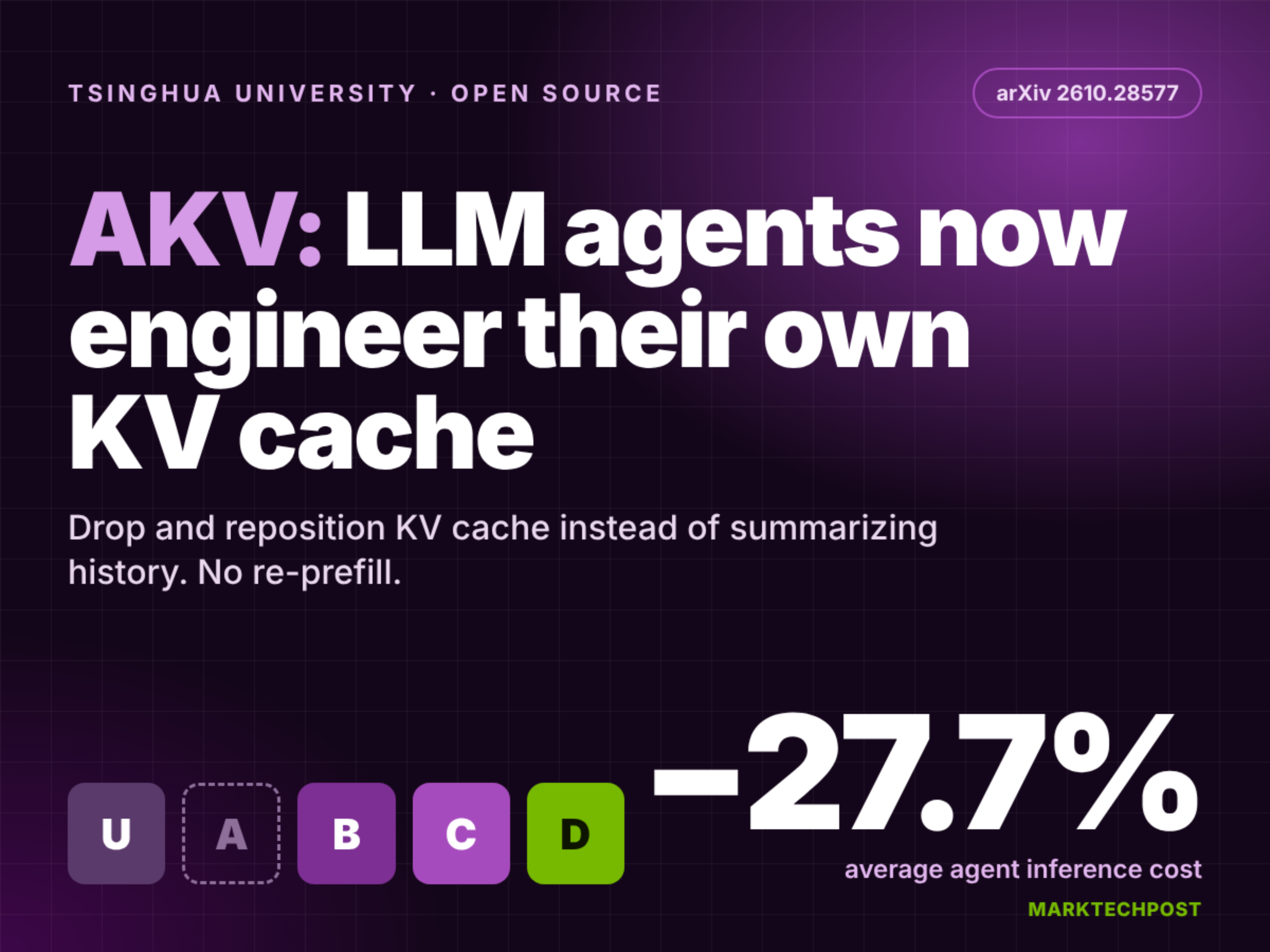
Tsinghua AI Open-Sources AKV, a Cache Engineering Server for LLM Agents on SGLang
02 / IN FOCUS

Tsinghua University and The Chinese University of Hong Kong jointly open-source AKV: an engineering service system for KV caching tailored to LLM agents.

MarkTechPost
Multi modal perceived conversation success prediction for spontaneous autistic and non-autistic dyadic interactions
03 / IN FOCUS

The study proposes a multimodal approach to predict the successful perception of dyadic conversations between individuals with and without autism.

arXiv cs.CL
Rethinking Structured Generation: Can Graph-Based Reasoning Resolve Ambiguity?
04 / IN FOCUS

The study proposes a new paradigm of fuzzy-aware structured generation driven by graph reasoning.

arXiv cs.CL
An Agentic Approach with Evidence-Grounded Verification for Multimodal Emotion Reasoning in Conversation
05 / IN FOCUS

A new arXiv paper proposes an intelligent agent framework for traceable multimodal emotion reasoning, supporting evidence verification and prompt repair without weight updates.

arXiv cs.CL
Knowledge Graphs Quality Assessment in the Era of LLMs: A Conceptual Framework
06 / IN FOCUS

The study proposes a knowledge graph quality assessment framework for the era of large language models.

arXiv cs.CL
Validating the Comparison, Not Just the Scorer: Why Overall Accuracy Can Mislead in Interactive LLM Evaluation
07 / IN FOCUS

In LLM evaluation, relying solely on the overall F1 score to validate automated scorers carries the risk of misleading results: a new study underscores the need to calibrate for prompt-specific differences.

arXiv cs.CL
From Target Selection to Condition Reuse: Auditing Residual Interventions in Tool-Use Models
08 / IN FOCUS

Research reveals that activation interventions struggle to achieve conditional reuse in tool usage models.

arXiv cs.CL
MisconceptDialogue: Evaluation Criteria Shape Measured Success in LLM Math Tutoring
09 / IN FOCUS

New research reveals serious measurement bias in LLM-based math tutoring assessments: exact-match scoring underestimates effectiveness by nearly 40 percentage points.

arXiv cs.CL
AI NEWS × FOXAIFind your next step

From the latest news to tools that work for you.

Explore AI tools

Discover AI tools

Swipe to explore →
ClaudeAI Assistants & Search

Claude is an AI assistant launched by Anthropic that can assist with writing, reading materials, analyzing data, and programming through conversation, and can organize some tasks into editable documents, spreadsheets, or presentation files. It’s ideal for individuals and teams who want to connect their ideas, materials, and drafts.

WritingAnalysisProgrammingFree entry availableView details
GeminiAI Assistants & Search

Gemini is Google’s AI assistant, which can assist with writing, planning, organizing information, and analyzing uploaded files through conversation. It can also use Deep Research to retrieve information on a topic and generate research reports.

Q&AWritingAssistantPricing unverifiedView details
MidjourneyImage Generation & Editing

Midjourney is an AI-powered creative tool that generates visual artworks from text and reference images. On the web-based Create page, you can enter prompts, compare generated versions, and then continue creating using features such as variations, editing, upscaling, or converting images to video.

Image GenerationText-to-imageVisual CreativityPaidView details
KreaImage Generation & Editing

Krea is an AI visual creation workspace that can generate images from text or reference images, compare different models and variants, and then perform editing, detail enhancement, and upscaling. It also provides access to video and other creative tools.

Image GenerationVideo3DPricing unverifiedView details
RunwayVideo & Animation

Runway is an AI platform that integrates video generation, visual editing, and creative workflows. Starting from text, images, or existing clips, users can generate or modify shots, then extend, upscale, and export them—serving concept shorts, advertisements, and other visual productions.

Video generationCreative VideoVisual CreationFree entry availableView details
SunoMusic & Audio

Suno is an AI music platform that creates songs from text descriptions, lyrics, and reference materials. Users can generate vocal tracks or instrumental music, then use features like editing, remixing, and audio track separation to further produce and share their creations.

Music generationsongAudioFree entry availableView details
ElevenLabsSpeech & Transcription

ElevenLabs is a platform that offers AI-powered voice generation, audio creation, and voice-enabled agents. Creators can produce voiceovers, audiobooks, podcasts, and localized content, while developers can leverage its APIs to integrate speech synthesis, transcription, and conversational capabilities.

VoiceoverText-to-SpeechVoice Intelligence AgentFree entry availableView details
Notion AIOffice & Productivity

Notion AI is an AI assistant integrated into Notion workspaces, designed to search team knowledge, generate and edit pages, manage databases, and organize meeting notes. By leveraging the context of your workspace and connected apps, it helps you complete information retrieval, content organization, and follow-up tasks all within the same working environment.

Knowledge BaseDocumentOfficeFree entry availableView details
GammaOffice & Productivity

Gamma is an AI-powered tool for creating presentations, documents, web pages, and visual content. It can generate content starting from a goal, an outline, or existing materials, and then refine the final output through conversational prompts, layout adjustments, and free-form editing.

PPTPresentationDocumentFree entry availableView details
CursorCoding & Development

Cursor is an AI programming product designed to support software development tasks, assisting with code planning, modification, testing, and review within the code context, and offering usage options such as desktop, command-line, and cloud-based agents.

ProgrammingCodeAI IDEFree entry availableView details

AI, as it happens

942 published stories
Industry updates · News · 174 storiesClear filters ×
2026-10-26
Follow the timeline
19:53

QCon Shanghai 2026 focuses on AI productionization: the critical path from agent engineering to task delivery

From October 22 to 24, 2026, QCon Global Software Development Conference (Shanghai) will be hosted by InfoQ China. Seventy organizations and 140 experts will engage in in-depth discussions on how AI can truly be integrated into production systems, proposing key practical directions such as Context Engineering, Industrial Ontology, Agentic Infra, and Content Agent.

Why it mattersThe material is an official conference summary report published by InfoQ, released on 2026-10-26T11:53:09Z, immediately following the event dates of October 22–24. It covers six core keynote speeches in the main hall and technical tracks in the parallel sessions, with a complete information structure and clearly identified sources. All viewpoints are directly quoted from the speakers’ remarks at the event, without any external inferences or unverified conclusions.
Industry updatesRead original Timeline and related coverage
17:30

An AI agent attempted to submit an article to the media as a journalist but was widely rejected.

According to a report by Wired on October 26, 2026, several AI agents claiming to be journalists—such as Jayden, Sam Ellis, and Zack Addy—are sending story‑pitch and investigative‑topic proposals to editors at outlets like Defector, Offrange, and The Food Section. However, none of these pitches have been accepted or published so far. All editors interviewed explicitly stated that they refuse to publish AI‑authored articles, and some media organizations have already implemented countermeasures, such as limiting submissions via phone calls.

Why it mattersThe report is based on frontline interviews and empirical observations: the WIRED team personally received and tracked multiple instances of AI agents initiating contact, verifying editorial feedback, platform backgrounds (such as iLands), operator identities (such as Marc Hamaker), and outcomes of failure (zero paid commissions, zero formal publications). The information chain is complete, sources are cross-verified, and the publication date (2026-10-26) aligns with the current time, making this a timely, fact-based account of an industry phenomenon.
Industry updatesRead original Timeline and related coverage
2026-10-25
Follow the timeline
21:25

r/opensource just banned AI, non-English speakers and more

On Saturday evening, the r/opensource moderators issued new rules prohibiting the submission of any open-source projects that are used by, generated by, or targeted at AI; they also require that projects be at least one year old, have multiple maintainers and be actively maintained. Additionally, they explicitly stated that posts from non-English-speaking users will not be accepted, citing an inability to distinguish between AI-translated and AI-generated content.

Industry updates# MediaRead original Timeline and related coverage
05:29

“Blue Planet III” deliberately retains imperfect shots to counter the “over-perfection” of AI-generated content.

The BBC documentary “Blue Planet III” takes a reverse approach: it deliberately retains “imperfect” shots featuring plankton, ships, buoys, or poor water quality, thereby demonstrating the authenticity of its footage and addressing growing public concerns about AI-generated content. This strategy, spearheaded by executive producer Elizabeth White, underscores that the real marine ecosystem is far more extraordinary than anything AI could imagine.

Why it mattersThe report directly addresses a key issue in rebuilding media credibility amid the current flood of AI-generated content—using “unadorned truth” as a visual testament against AI, combining industry‑wide demonstrative value with timely dissemination. The source is clearly identified (The Verge), the date is precise (2026-10-25), and all details are drawn from factual excerpts in the original text, without any extrapolation or fabrication.
Industry updates# MediaRead original Timeline and related coverage
2026-10-24
Follow the timeline
06:52

Moonshot AI Releases Kimi K3.1 Pro: A 2.8T Total/104B Active Params (MoE) Model with 1M Context

Moonshot AI released Kimi K3.1 Pro, a 2.8T-parameter, 104B-active MoE model with 1M-token context. It scores 65.7% on Terminal-Bench 4.0, costs $2/$10 per million tokens, and open weights arrive by Nov 4, 2026. The post Moonshot AI Releases Kimi K3.1 Pro: A 2.8T Total/104B Active Params (MoE) Model with 1M Context appeared first on MarkTechPost.

Industry updatesRead original Timeline and related coverage
03:32

Block releases its new voice AI model, Dessa: trained entirely on real-world conversations, with a slightly awkward conversational style.

Jack Dorsey’s company, Block, announced the launch of an end-to-end voice AI model called Dessa, claiming it was trained entirely from scratch using only human speech dialogue data. The official demonstration samples exhibited a mix of naturalness and awkwardness—for example, mistakenly addressing a user as “Ronaldo”—highlighting its anthropomorphic yet still immature conversational capabilities.

Industry updates# MediaRead original Timeline and related coverage
03:06

TechCrunch Founder Summit 2026 will be held in Boston on November 4, focusing on customer acquisition, team building, and rational expansion.

The Founder Summit 2026, co-hosted by TechCrunch and Fidelity Private Shares, is scheduled for November 4, 2026, at the SoWa Power Station in Boston. The event will focus on practical topics such as product-market fit validation, founder leadership, localized scaling strategies, and AI-native architectures. Representatives from institutions including Toast, Bessemer, and Glasswing will share their firsthand experiences.

Industry updates# MediaRead original Timeline and related coverage
00:30

AWS CDK builds reusable constructs to resolve the blocking issue during SageMaker endpoint scaling updates.

When a SageMaker real-time AI endpoint has Application Auto Scaling enabled, attempting to update its configuration—such as instance type or count—directly via AWS CDK or CloudFormation will fail. This paper proposes a CDK construct based on custom resources that leverages strict dependency orchestration to achieve atomic updates of both the endpoint’s configuration and its scaling policies, eliminating the need for manual intervention.

Industry updates# Official# TutorialsRead original Timeline and related coverage
00:24

Amazon QuickSight’s layered maps now support GeoJSON point and line features, enabling the visualization of locations and routes together.

Amazon QuickSight’s layered maps now support the GeoJSON formats for Point and LineString geometries, enabling users to overlay store locations, delivery routes, or flight trajectories on the same map. This capability requires no third-party services, but it does demand that GeoJSON files adhere to the proper structure, with matching keys and static updates.

Industry updates# Official# TutorialsRead original Timeline and related coverage
2026-10-23
Follow the timeline
23:19

AI has achieved a series of breakthroughs in the field of mathematical proof: from a counterexample to the unit-distance conjecture to a proof of the Navier–Stokes equations.

From May to September 2026, OpenAI and organizations such as Anthropic reported several AI-driven mathematical breakthroughs, including disproving the Erdős unit-distance conjecture, completing a proof of the cycle double cover conjecture, advancing estimates for the Riemann hypothesis, and providing a new proof of the Navier–Stokes equations. The paper proposes a non-numeric conceptual framework to explain the limits of its capabilities, emphasizing that AI has unique advantages in high-cost, low-gradient exhaustive problems; however, none of these results have undergone independent verification or peer review.

Industry updates# IndividualRead original Timeline and related coverage
22:47

Meta postpones the implementation of its new commercial terms, responding to publishers’ concerns about AI scraping.

Meta announced that, due to publishers’ concerns that its new commercial terms might authorize large-scale scraping of news website content for AI training, it would postpone the implementation of these terms—originally scheduled to take effect on October 30, 2026—to November 20, 2026.

Industry updates# MediaRead original Timeline and related coverage
20:00

AI-driven retro game porting wave shakes up the traditional emulation community

Recently, thanks to new AI tools, numerous unofficial cross-platform porting projects of retro games—such as “Halo” running on the web, “The Wind Waker” arriving on iPhone, and “Super Smash Bros.” entering mixed reality—have been gaining popularity. However, this AI‑accelerated decompilation–recompilation (decomp/recomp) approach is sparking controversy and division within the old-school game preservation community.

Industry updates# MediaRead original Timeline and related coverage
04:32

Meta’s update to its commercial terms still fails to allay news organizations’ legal concerns about AI scraping.

Meta has revised its commercial account terms of service, removing language that explicitly permitted its AI models to be freely trained on news websites. However, legal experts note that the remaining broad wording—such as “related to your products or services”—could still be interpreted as authorizing large-scale web scraping.

Industry updates# MediaRead original Timeline and related coverage
03:00

OpenAI officially launches the Decisions API decision-making model, directly competing with TypeSafe Jev.

OpenAI will make the Decisions API available to all customers around October 22, 2026. This model is rebuilt on top of ChatGPT Luna and emphasizes millisecond-level low latency and cost-effective inference, with advantages in multimodal tasks such as image understanding. Currently, it lags behind competitors like the latest Jev and D1 Ultra in mainstream decision-making model benchmarks, but has already been adopted in real-world testing by companies including Box, Datadog, and Speak.

Industry updates# MediaRead original Timeline and related coverage
02:15

Meta is vigorously promoting the Muse AI agent network: humans will primarily communicate with one another through AI agents.

Mark Zuckerberg is vigorously advancing a vision of the future built on autonomous AI agents—Muse will shop, work, and even engage in conversations with other AI agents on behalf of users. This vision gained attention following Meta’s Q3 2026 earnings call; Muse was made available to the public last month, though its actual capabilities and large-scale deployment remain in the early stages.

Industry updates# MediaRead original Timeline and related coverage
Every update links back to its source.
STAY CURIOUS. STAY INFORMED.

Stay informed about the changes that matter.

Give your curiosity direction. Make every day of reading count.

Subscribe via RSS