








THE NEXT THING, IN PERSPECTIVEIndependent AI news

The latest AI news, in focus.

Official announcements and industry reporting. Follow the timeline of AI.

Today's news

News feed
When Traction Becomes Personal Exposure: What The Joonko Guilty Plea Means For Founders
01 / IN FOCUS

Former Joonko CEO Pleads Guilty to Securities Fraud: False Customer and Revenue Statements Result in Personal Liability for the Founder

Crunchbase AI
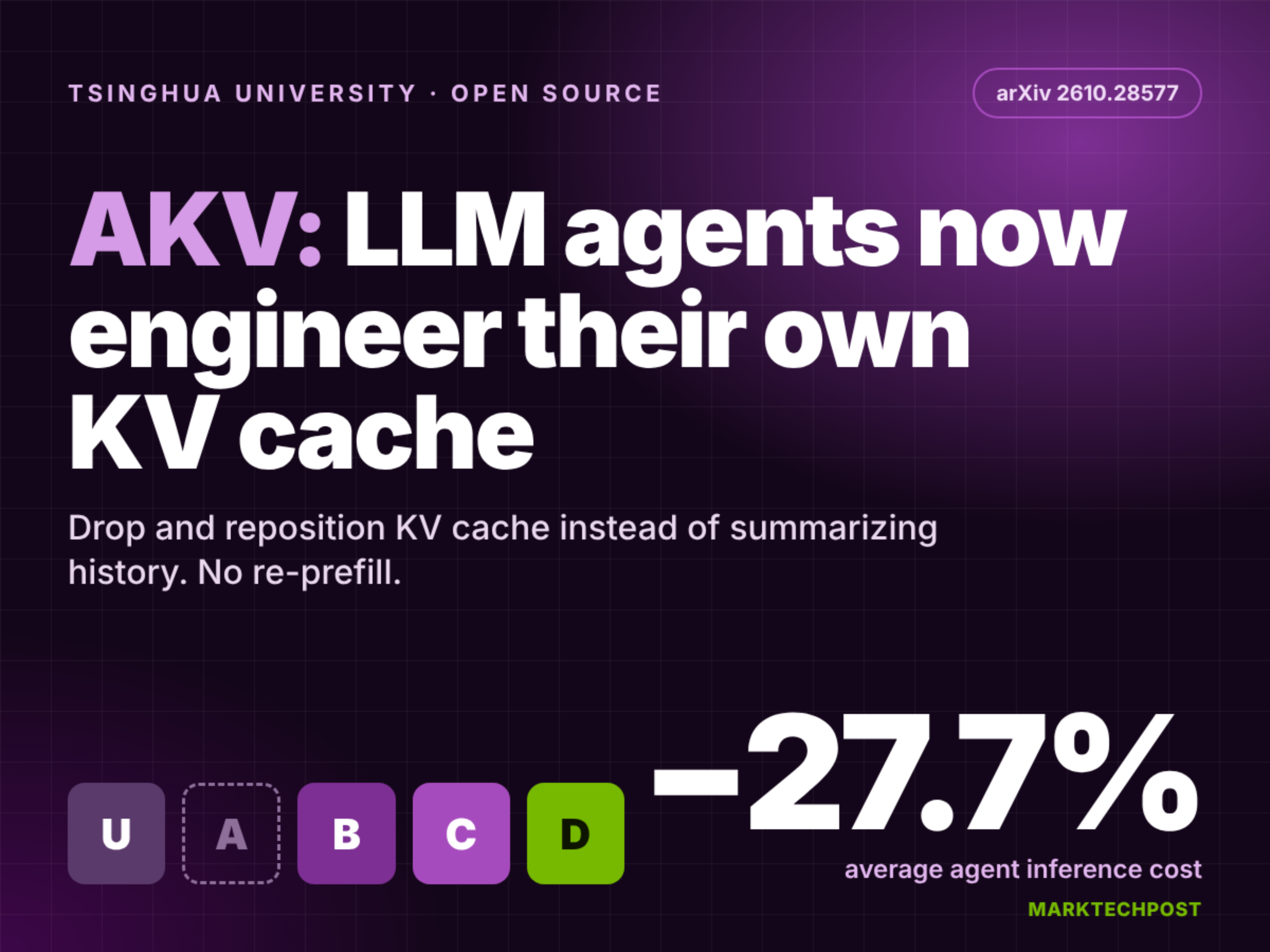
Tsinghua AI Open-Sources AKV, a Cache Engineering Server for LLM Agents on SGLang
02 / IN FOCUS

Tsinghua University and The Chinese University of Hong Kong jointly open-source AKV: an engineering service system for KV caching tailored to LLM agents.

MarkTechPost
Multi modal perceived conversation success prediction for spontaneous autistic and non-autistic dyadic interactions
03 / IN FOCUS

The study proposes a multimodal approach to predict the successful perception of dyadic conversations between individuals with and without autism.

arXiv cs.CL
Rethinking Structured Generation: Can Graph-Based Reasoning Resolve Ambiguity?
04 / IN FOCUS

The study proposes a new paradigm of fuzzy-aware structured generation driven by graph reasoning.

arXiv cs.CL
An Agentic Approach with Evidence-Grounded Verification for Multimodal Emotion Reasoning in Conversation
05 / IN FOCUS

A new arXiv paper proposes an intelligent agent framework for traceable multimodal emotion reasoning, supporting evidence verification and prompt repair without weight updates.

arXiv cs.CL
Knowledge Graphs Quality Assessment in the Era of LLMs: A Conceptual Framework
06 / IN FOCUS

The study proposes a knowledge graph quality assessment framework for the era of large language models.

arXiv cs.CL
Validating the Comparison, Not Just the Scorer: Why Overall Accuracy Can Mislead in Interactive LLM Evaluation
07 / IN FOCUS

In LLM evaluation, relying solely on the overall F1 score to validate automated scorers carries the risk of misleading results: a new study underscores the need to calibrate for prompt-specific differences.

arXiv cs.CL
From Target Selection to Condition Reuse: Auditing Residual Interventions in Tool-Use Models
08 / IN FOCUS

Research reveals that activation interventions struggle to achieve conditional reuse in tool usage models.

arXiv cs.CL
MisconceptDialogue: Evaluation Criteria Shape Measured Success in LLM Math Tutoring
09 / IN FOCUS

New research reveals serious measurement bias in LLM-based math tutoring assessments: exact-match scoring underestimates effectiveness by nearly 40 percentage points.

arXiv cs.CL
AI NEWS × FOXAIFind your next step

From the latest news to tools that work for you.

Explore AI tools

Discover AI tools

Swipe to explore →
ClaudeAI Assistants & Search

Claude is an AI assistant launched by Anthropic that can assist with writing, reading materials, analyzing data, and programming through conversation, and can organize some tasks into editable documents, spreadsheets, or presentation files. It’s ideal for individuals and teams who want to connect their ideas, materials, and drafts.

WritingAnalysisProgrammingFree entry availableView details
GeminiAI Assistants & Search

Gemini is Google’s AI assistant, which can assist with writing, planning, organizing information, and analyzing uploaded files through conversation. It can also use Deep Research to retrieve information on a topic and generate research reports.

Q&AWritingAssistantPricing unverifiedView details
MidjourneyImage Generation & Editing

Midjourney is an AI-powered creative tool that generates visual artworks from text and reference images. On the web-based Create page, you can enter prompts, compare generated versions, and then continue creating using features such as variations, editing, upscaling, or converting images to video.

Image GenerationText-to-imageVisual CreativityPaidView details
KreaImage Generation & Editing

Krea is an AI visual creation workspace that can generate images from text or reference images, compare different models and variants, and then perform editing, detail enhancement, and upscaling. It also provides access to video and other creative tools.

Image GenerationVideo3DPricing unverifiedView details
RunwayVideo & Animation

Runway is an AI platform that integrates video generation, visual editing, and creative workflows. Starting from text, images, or existing clips, users can generate or modify shots, then extend, upscale, and export them—serving concept shorts, advertisements, and other visual productions.

Video generationCreative VideoVisual CreationFree entry availableView details
SunoMusic & Audio

Suno is an AI music platform that creates songs from text descriptions, lyrics, and reference materials. Users can generate vocal tracks or instrumental music, then use features like editing, remixing, and audio track separation to further produce and share their creations.

Music generationsongAudioFree entry availableView details
ElevenLabsSpeech & Transcription

ElevenLabs is a platform that offers AI-powered voice generation, audio creation, and voice-enabled agents. Creators can produce voiceovers, audiobooks, podcasts, and localized content, while developers can leverage its APIs to integrate speech synthesis, transcription, and conversational capabilities.

VoiceoverText-to-SpeechVoice Intelligence AgentFree entry availableView details
Notion AIOffice & Productivity

Notion AI is an AI assistant integrated into Notion workspaces, designed to search team knowledge, generate and edit pages, manage databases, and organize meeting notes. By leveraging the context of your workspace and connected apps, it helps you complete information retrieval, content organization, and follow-up tasks all within the same working environment.

Knowledge BaseDocumentOfficeFree entry availableView details
GammaOffice & Productivity

Gamma is an AI-powered tool for creating presentations, documents, web pages, and visual content. It can generate content starting from a goal, an outline, or existing materials, and then refine the final output through conversational prompts, layout adjustments, and free-form editing.

PPTPresentationDocumentFree entry availableView details
CursorCoding & Development

Cursor is an AI programming product designed to support software development tasks, assisting with code planning, modification, testing, and review within the code context, and offering usage options such as desktop, command-line, and cloud-based agents.

ProgrammingCodeAI IDEFree entry availableView details

AI, as it happens

940 published stories
Agents & automation · 43 storiesClear filters ×
2026-10-26
Follow the timeline
12:00

A new arXiv paper proposes an intelligent agent framework for traceable multimodal emotion reasoning, supporting evidence verification and prompt repair without weight updates.

On October 26, 2026, arXiv published a preprint paper (ID 2610.31685v1) that proposes a traceable multimodal emotion‑reasoning intelligent agent architecture based on frozen large models. By leveraging modality‑specific perception agents, an integration agent, an MLLM critic, and an evidence‑verification stage, the framework achieves error attribution and adaptive optimization of the prompt space, improving the F‑score for emotion recognition across several open‑source multimodal large models (with 2B–38B parameters) by 0.6–2.2 points on the MER2025 dataset.

Why it mattersThis study addresses the trade-off between high instruction fine-tuning costs and the non‑debuggable pipeline of intelligent agents in current multimodal emotion‑reasoning systems by proposing the first end-to-end interpretable framework that integrates evidence citation, certainty verification, failure attribution, and targeted prompt repair. All improvements are implemented without modifying model weights and have been empirically validated across four open-source MLLMs of varying scales, demonstrating both methodological innovation and practical engineering utility.
Agent frameworksRead original Timeline and related coverage
02:06

LangChain releases the five core components of its “Enterprise-Level Agent Framework”

On October 25, 2026, LangChain published a blog post systematically outlining the five universal architectural principles it has distilled from deploying AI agents (GTM Agent, OpenSWE, Content Studio) within its marketing, sales, and engineering teams: native integration with the work environment (Slack), a dynamic identity model (OBO + fixed credentials), a two-tiered memory mechanism (global/user-level), sandboxed code execution, and a high proportion of scheduled operations (not manually triggered). All agents are built on the Managed Deep Agents platform.

Why it mattersThis information originates from the official LangChain blog, published on 2026-10-25T18:06:32.000Z—earlier than the current system time of 2026-10-25T23:01:18.857Z. The content focuses on implemented internal agent practices, with specific details such as Slack thread isolation, GitHub account attribution logic, and tiered permissions for Notion/Twitter, without including unverified predictions or external claims, thus meeting requirements for timeliness and factual accuracy.
Agent frameworksRead original Timeline and related coverage
2026-10-25
Follow the timeline
11:32

Microsoft open-sources Agensh: a decentralized framework that supports 1024 autonomous, collaboratively operating AI coding agents.

On October 25, 2026, Microsoft Research open-sourced Agensh, a multi-agent runtime framework that operates without a central coordinator, enabling 1 to 1,024 LLM-powered coding agents to self-organize and collaborate on ProgramBench. The system achieves decentralized coordination through shared dashboards inspired by Gitea, Mattermost, and DeLM, with all agents following the same prompt-driven five-step loop; its scalability has been validated in a Linux + Docker environment.

Why it mattersThis achievement represents a significant evolution in multi-agent system architectures—abandoning the traditional “master‑agent” paradigm and enabling large‑scale self‑organization through prompt engineering and lightweight service composition. Empirical results on ProgramBench (e.g., 128 agents achieving a 49% improvement in task load balancing across five tasks) establish a new benchmark for distributed AI engineering. Released under the MIT License and compatible with mainstream single‑agent tools such as Copilot CLI, it offers valuable guidance for practical development.
Agent frameworksRead original Timeline and related coverage
2026-10-24
Follow the timeline
19:12

Anthropic open-sources the OS-level sandbox sandbox-runtime: providing container-free file and network isolation for AI agents.

On October 24, 2026, Anthropic open-sourced sandbox-runtime (srt), an OS-level sandboxing tool that operates without containers, designed to restrict file read/write and network access permissions for AI agents, MCP servers, and CLI tools. It supports macOS (Seatbelt), Linux (bubblewrap), and Windows (alpha), with npm package version 0.0.81 under the Apache-2.0 license.

Why it mattersThis tool represents a significant advancement in AI security infrastructure—achieving fine-grained, full-process-tree coverage through the operating system’s native isolation mechanisms, directly addressing the risks of prompt injection and privilege escalation, and has already been deployed for internal validation within Claude Code.
MCP & agent protocolsRead original Timeline and related coverage
00:21

Bayer Crop Science has built the multi-agent decision-making engine ADE based on Amazon Bedrock AgentCore.

Bayer Crop Science has built the Agentic Decision Engine (ADE) on Amazon Bedrock AgentCore—a natural-language multi-agent platform for breeding experts, analysts, and researchers—as an enhancement layer rather than a replacement for its existing Connected Decision Engine (CDE). The system is now live in production, serving over 100 R&D users and enabling approximately 80% of issues to be resolved independently through 22 domain-specific agents and about 20 API tools.

Agent frameworks# Official# TutorialsRead original Timeline and related coverage
2026-10-23
Follow the timeline
02:09

Donating Agent Skills to the Agentic AI Foundation

Donating Agent Skills to the Agentic AI Foundation News today from Anthropic: We’re committed to keeping Agent Skills open, community-driven, and vendor-neutral. Today, we are donating the standard to the Agentic AI Foundation (AAIF) under the Linux Foundation, which we co-founded with Block and OpenAI last year, and to which we donated the Model Context Protocol (MCP). I'm pleased to note I called this one last December, when Anthropic first declared skills to be an "open standard": I wouldn't be surprised to see this end up in the AAIF, recently the new home of the MCP specification. Fun side note: since my blog content is available to Claude via the datasette-mcp plugin I found that post by prompting Claude to "Use simonwillison.net MCP to find if I ever talked about how I want skills t

MCP & agent protocols# IndividualRead original Timeline and related coverage
2026-10-22
Follow the timeline
10-22

A Multi-Layered Approach to AI Agent Hallucination Detection: A Practical Framework for Production Environments

This paper systematically categorizes four typical types of hallucinations exhibited by AI agents in real-world workflows—factual, contextual, fictional, and self-contradictory—and proposes that detection should rely on a multi-dimensional approach, incorporating credibility checks, source verification, self-consistency assessment, semantic entropy analysis, and human–machine collaboration thresholds, rather than on a single scoring metric. It underscores that such detection must be embedded within the workflow’s closed loop and deeply integrated with observability, error handling, and human review pathways.

n8n updatesRead original Timeline and related coverage
10-22

Self-Hosted Large Models vs. Cloud APIs: How to Route Requests Intelligently

This article compares the trade-offs between self-hosted large language models and cloud APIs in terms of data privacy, cost, latency, and capabilities. It outlines the hardware requirements (such as VRAM and quantization) for open-source deployable models, discusses typical technology stacks, and uses n8n as an example to demonstrate how to build hybrid routing workflows that dynamically distribute requests between on-premises and cloud-based models based on task sensitivity, complexity, or compliance requirements.

n8n updatesRead original Timeline and related coverage
10-22

API Versioning Strategy: Ensuring Workflow Integration Stability

This article compares four mainstream API versioning strategies—URI, HTTP headers, dates, and query parameters—analyzing their differences in readability, cache compatibility, and debugging convenience, and provides a detailed explanation of how to achieve a smooth migration by actively monitoring deprecation/sunset headers, response codes (such as 410 Gone), and n8n’s built-in workflow mechanisms.

n8n updatesRead original Timeline and related coverage
10-22

Stateful vs Stateless: Context Management Strategies in AI Agent Development

This article explores the core differences between stateful and stateless architectures in AI agent systems, analyzes their practical impacts on scalability, fault tolerance, and contextual continuity, and uses the n8n platform as an example to demonstrate how to design memory nodes and state stores in a layered manner to achieve flexible, controllable state management.

n8n updatesRead original Timeline and related coverage
07:36

Deep Insight: How AWS’s Open-Source Multi-Agent System Addresses Five Major Production-Grade Challenges

AWS Solutions Architecture Team has launched Deep Insight, an open-source multi-agent system designed for automated CSV data analysis and natural-language report generation. It systematically addresses five common challenges in production environments—agent orchestration, role-based model selection, stable operation, secure code execution, and observability—and has been validated in real-world scenarios such as LG Electronics and the re:Invent 2025 TechRecon.

Agent frameworks# Official# TutorialsRead original Timeline and related coverage
05:23

AWS releases the Adaptive Agent Framework (AAIF): a hierarchical AI task scheduling solution that enables edge-cloud collaboration based on Strands Agents.

AWS has introduced the Adaptive Agentic Intelligence Framework (AAIF), which leverages Strands Agents to build a hierarchical agent architecture. It dynamically routes tasks via local small language models (SLMs): routine IoT telemetry and visual analytics are executed at the edge, while complex reasoning is offloaded to Amazon Bedrock’s large cloud-based models. The framework supports hybrid deployment, keeps costs under control, and incorporates responsible AI governance recommendations; however, it currently exists as a proof-of-concept implementation and does not yet provide third-party validation or commercial deployment data.

Agent frameworks# Official# TutorialsRead original Timeline and related coverage
2026-10-21
Follow the timeline
01:59

Smartsheet launches the Model Context Protocol (MCP) server, enabling AI agents to connect directly to real-time project data on AWS.

Smartsheet has officially launched the general‑purpose Model Context Protocol (MCP) server, which uses a standardized protocol to enable AI agents to read and write structured data—such as project tables, rows, columns, and automations—in Smartsheet. The service is now available within the AWS ecosystem, supporting access from two types of clients: Amazon Quick, aimed at business users, and Kiro, designed for developers. This allows for natural‑language‑driven cross‑tool task updates, status synchronization, and context‑aware development.

MCP & agent protocols# Official# TutorialsRead original Timeline and related coverage
01:52

AWS releases a technical preview: Amazon Quick and Bedrock AgentCore enable the construction of governable, conversational supply chain intelligence systems.

AWS has launched a modular agent architecture based on the Model Context Protocol (MCP), leveraging AgentCore to standardize enterprise‑level tool interfaces. Amazon Quick provides a natural‑language interaction interface for business users, enabling real‑time, approval‑driven supply chain decision support across ERP, procurement, monitoring, and other systems. This solution is currently in technical preview and is not guaranteed to be production‑ready or available for customer deployment.

MCP & agent protocols# Official# TutorialsRead original Timeline and related coverage
00:22

AWS Agent Registry officially released: supports runtime semantic discovery and dynamic orchestration of MCP servers and A2A agents.

On October 26, 2026, AWS announced the general availability of its Agent Registry service, a managed offering that leverages hybrid semantic-plus-keyword search to dynamically discover, instantiate, and execute approved Model Context Protocol (MCP) servers and Agent-to-Agent (A2A) agents at runtime, replacing hard-coded tool integrations and addressing bottlenecks in the large-scale orchestration of enterprise-grade AI agents.

MCP & agent protocols# Official# TutorialsRead original Timeline and related coverage
2026-10-20
Follow the timeline
10-20

n8n completes its 2026 brand refresh: a new logo, a new typeface, and an evolving pink primary color.

On October 14, 2026, at the In The Loop conference, n8n officially unveiled its brand refresh, featuring a new dynamic logo, a custom typeface that balances technological sophistication with humanistic appeal, and an optimized pink-based color scheme complemented by grayscale accent colors. These updates are designed to reflect its strategic positioning as it evolves from a workflow automation platform into a responsive system that supports agentic AI.

n8n updatesRead original Timeline and related coverage
2026-10-19
Follow the timeline
2026-10-16
Follow the timeline
10-16

12 Enterprise-Grade Workflow Automation Platforms Compared: n8n, ServiceNow, Power Automate, and Others Selected

The n8n blog has published an in-depth guide comparing 12 mainstream enterprise-grade workflow automation platforms, focusing on five key dimensions: deployment models, integration capabilities, governance mechanisms, AI/agent support, and cost models. The guide underscores the core demands of technical teams regarding data sovereignty, multi-AI vendor switching, and code extensibility.

n8n updatesRead original Timeline and related coverage
2026-10-13
Follow the timeline
Every update links back to its source.
STAY CURIOUS. STAY INFORMED.

Stay informed about the changes that matter.

Give your curiosity direction. Make every day of reading count.

Subscribe via RSS