
Skip to content
AI NEWS JOURNAL
AI, IN PERSPECTIVE

Search AI news

Search headlines, summaries and articles to connect the dots.

Newest first

Tsinghua University and The Chinese University of Hong Kong jointly open-source AKV: an engineering service system for KV caching tailored to LLM agents.

On October 26, 2026, researchers from Tsinghua University and the Chinese University of Hong Kong open-sourced AKV—a KV cache engineering server built on SGLang and specifically designed for large language model (LLM) agents. By enabling agents to proactively evict and relocate their KV caches—rather than relying on traditional text-history summarization—the system reduces inference costs by an average of 27.7% across four agent benchmarks and improves task scores by 1.7 points on average. The code is licensed under the Apache-2.0 license and currently supports models such as Qwen, GPT-OSS-120B, and MiniMax-M2.7.
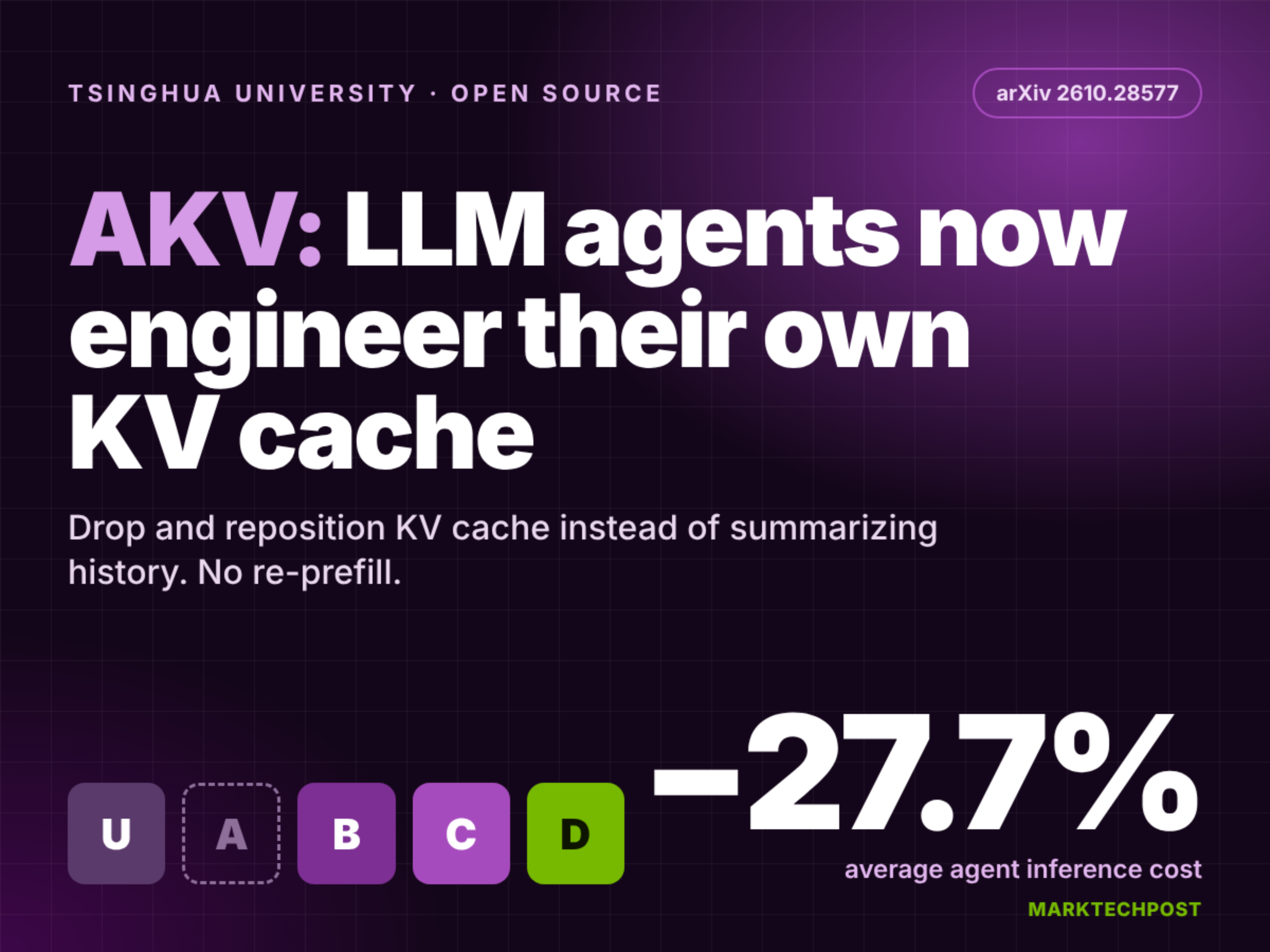
Tsinghua AI Open-Sources AKV, a Cache Engineering Server for LLM Agents on SGLang

Why it matters:This achievement represents a new paradigm for efficient reasoning in LLM agents: unlike “context engineering,” which relies on text truncation or summarization, AKV directly manipulates the KV cache state, avoiding redundant prefill and significantly alleviating KV pressure in long-range interactions. Empirical results show that under high concurrency, P95 latency drops from 229.9 seconds to 30.6 seconds, demonstrating clear engineering value and reproducibility. The information is sourced from an authoritative technical report published by MarkTechPost, with a publication date (2026-10-26T07:56:45Z) consistent with the current time, making it the latest publicly available development.

Timeline and related coverage

ULME Framework Achieves True Unification of Text Embedding and Language Modeling: A New Paper on arXiv Proposes a Predictive Coupling Mechanism

On October 24, 2026, arXiv published the paper arXiv:2610.30705v1, introducing ULME—a post-training framework for causal-decoder–based large language models that, through a predictive coupling mechanism, achieves, for the first time, a mutually reinforcing unification of text embedding and language-generation capabilities. This approach was validated on the Qwen2.5/Qwen3 series (with 0.5B–8B parameters), yielding MTEB improvements of 3.3–4.1 points while maintaining performance on generation tasks such as MMLU.

ULME: Predictive Coupling for Mutually Reinforcing Embedding and Language Modeling

Why it matters:This paper directly addresses the core issue of fragmented multimodal LLM capabilities: embeddings and generation have long been handled either by separate models or by “pseudo-unified” models that rely solely on parameter sharing. ULME achieves a substantial architectural breakthrough by employing learnable slots and joint training with three objectives—including a stop-gradient prediction loss—enabling the generation process to actively shape the embedding representations. The study features broad experimental coverage, strong baselines, comprehensive metrics, and was published on a reputable preprint platform, balancing timeliness with technical rigor.

Timeline and related coverage

New research reveals that open-book assessments primarily measure reading behavior rather than knowledge retention.

An arXiv paper published on October 24, 2026 (2610.31017v1) points out that, in document-level LoRA adapter evaluations, open-book scoring relies heavily on the model’s ability to read on the fly, rather than on whether the adapter has truly encoded knowledge specific to the document; random adapters can reproduce 82% of the performance advantage of expert adapters on open-book tasks, but on cloze tasks involving unstructured text, they only replicate 2%—statistically indistinguishable from zero.

Mostly Reading: What Open-Book Scores Measure in Document-Level LoRA Adapters

Why it matters:This study, through systematic controlled experiments—comprising 150 Wikipedia articles, the Llama-3.1-8B-Instruct model, and a two-task comparison—reveals the fundamental limitations of the current open-book evaluation paradigm: it fails to effectively distinguish between “reading” and “remembering,” posing methodological challenges to the practical utility of knowledge-editing and retrieval‑oriented adapters. The paper also reports four silent errors that lead to “clean yet incorrect results,” highlighting risks to reproducibility.

Timeline and related coverage

VocabX: Reduces the inference cost of domain-specific small language models by 77% through cost-weighted vocabulary specialization.

Dharma-AI has introduced the VocabX method, which reconfigures the vocabulary of language models for specific tasks—such as automated scoring of Portuguese essays—by optimizing for cost rather than word frequency. Without modifying the model architecture, parameters, or training pipeline, empirical results show a 77% reduction in inference costs, while the evaluation score (bench score) improved from 0.703 to 0.810.

Timeline and related coverage

IBM releases the Granite Speech 5.0 series of speech models: supporting multilingual transcription, translation, and speaker attribution.

IBM has released three open-source speech models in the Granite Speech 5.0 series—granite-speech-5.0-2b (high-precision multilingual ASR/MT), granite-speech-5.0-470m-turboctc (ultra-fast edge-side multilingual transcription), and the updated granite-speech-4.1-2b-plus (enhanced multi-speaker conversational modeling)—all licensed under Apache 2.0 and compatible with mainstream inference frameworks.

Timeline and related coverage