Skip to content
AI NEWS JOURNAL
AI, IN PERSPECTIVE

Search AI news

Search headlines, summaries and articles to connect the dots.

Newest first

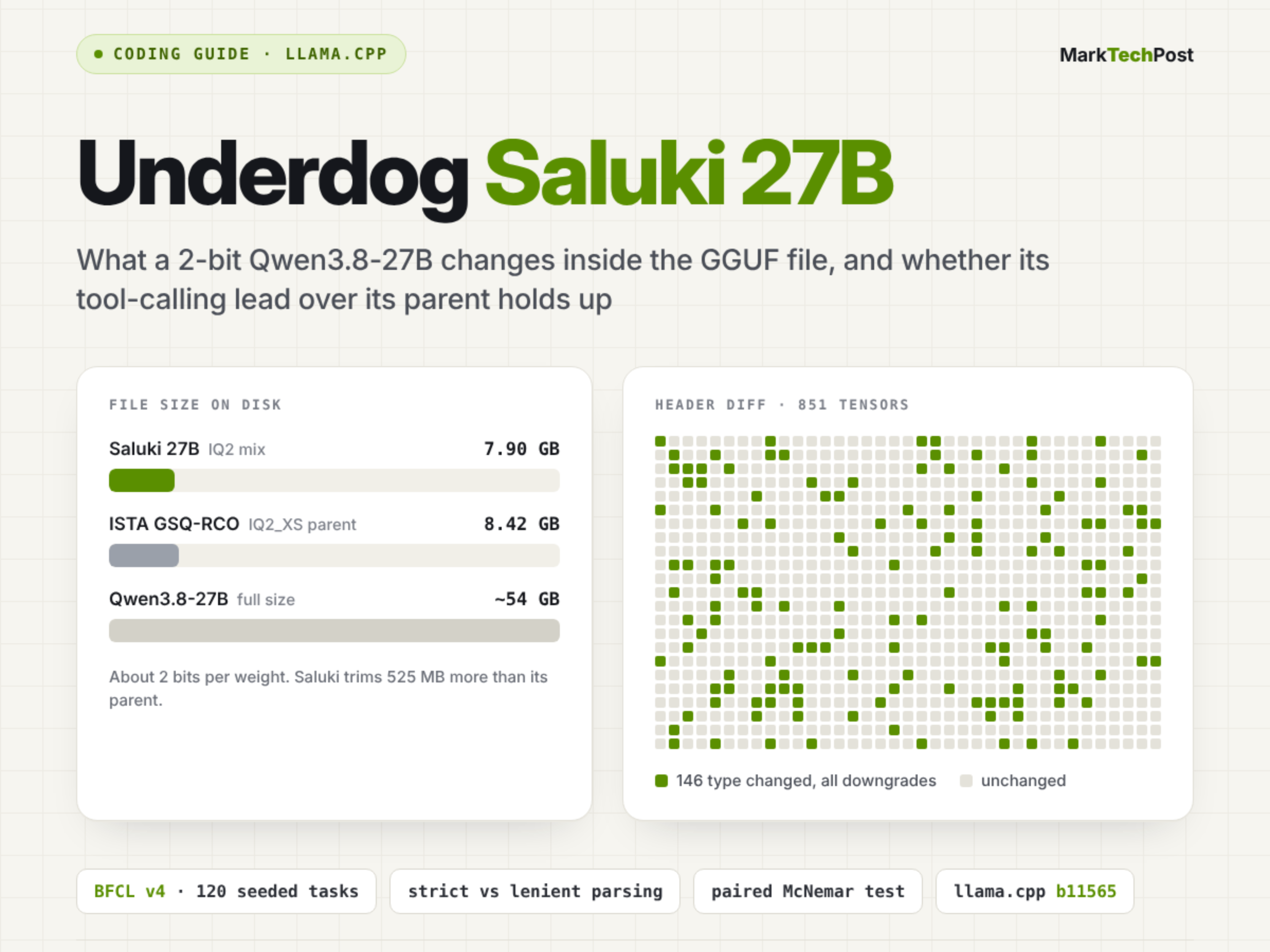
Underdog Saluki 27B: Technical Analysis of the 2-bit Qwen3.8-27B Tool-Calling Model Based on GSQ-RCO

This article introduces Saluki 27B, a model released by Underdog—a 7.9 GB, 2-bit quantized variant of Qwen3.8-27B—built using the GSQ-RCO method from ISTA-DASLab. It claims to outperform the original 54 GB full-precision model on the BFCL v4 benchmark across 120 tasks; however, all performance conclusions are based solely on the developers’ assertions and have not been independently verified.

How to Run Underdog Saluki 27B: 2-Bit Qwen3.8-27B Tool-Calling Guide
Timeline and related coverage

Taking on NVIDIA head-on to challenge Apple—Microsoft’s high-end AI PC gamble

Microsoft is courting local AI developers and high-end creators with the Surface Laptop Ultra, which features NVIDIA RTX Spark. The hardware brings large-capacity unified memory, CUDA, and RTX graphics capabilities to a portable device, but whether it can sustain competition against Macs will still depend on app optimization, agent-based experiences, and real-world workflows.

Why it matters:Ultimately, this competition comes down to whether on-device AI can genuinely boost creativity and development efficiency, and whether the associated costs—hardware, software, and migration—are justified. Hardware opens up new possibilities, but the ecosystem and real-world user experience determine how many users those possibilities can reach.

Timeline and related coverage

Apple’s first foldable-screen iPhone, the Duo, has already experienced widespread screen cracking shortly after going on sale.

Multiple users have reported that Apple’s first foldable smartphone, the iPhone Duo, develops screen cracks and splits right above the hinge shortly after unboxing, with failures occurring at a high rate. Cases have been documented in both Australia and China, reportedly due to tolerances in the hinge assembly. Apple has yet to issue an official response, and the outcome of the after-sales service assessment will determine whether the device will be replaced free of charge or require costly out-of-pocket repairs.

Why it matters:The incident involves widespread early‑stage quality issues with a new device, directly challenging the boundaries between consumer rights and corporate responsibility. Coupled with public concerns about the applicability of the “three‑guarantee” regulations and the positioning of AppleCare+ services, it carries significant warning implications and serves as a valuable reference for rights protection.

Timeline and related coverage

“Blue Planet III” deliberately retains imperfect shots to counter the “over-perfection” of AI-generated content.

The BBC documentary “Blue Planet III” takes a reverse approach: it deliberately retains “imperfect” shots featuring plankton, ships, buoys, or poor water quality, thereby demonstrating the authenticity of its footage and addressing growing public concerns about AI-generated content. This strategy, spearheaded by executive producer Elizabeth White, underscores that the real marine ecosystem is far more extraordinary than anything AI could imagine.

Blue Planet III is keeping the rough edges in the age of AI

Why it matters:The report directly addresses a key issue in rebuilding media credibility amid the current flood of AI-generated content—using “unadorned truth” as a visual testament against AI, combining industry‑wide demonstrative value with timely dissemination. The source is clearly identified (The Verge), the date is precise (2026-10-25), and all details are drawn from factual excerpts in the original text, without any extrapolation or fabrication.

Timeline and related coverage

llama.cpp releases version b11868: enhanced Hexagon NPU multi-core Flash Attention support, with cross-platform compilation and build capabilities.

llama.cpp v2.45.0 (tag b11868) has been officially released, with the core update being the introduction of a KV-head splitting mechanism in the Hexagon backend to optimize multi-core HMX Flash Attention performance and unify the FA splitting control flag. Binary packages are simultaneously available for all major platforms, including macOS, Linux, Windows, Android, iOS, and openEuler, supporting multiple backends such as CUDA 12/13, Vulkan, ROCm, OpenVINO, SYCL, and Snapdragon (Adreno + Hexagon).

Timeline and related coverage

llama.cpp releases version b11867: server-side entry point refactored, with full support for multiple platforms and heterogeneous acceleration backends.

llama.cpp has officially released version b11867 on GitHub. Key changes include a refactored server entry point (PR #31113) and the addition of the server_role mechanism. Additionally, more than 40 precompiled binaries are now available, covering macOS, Linux, Windows, Android, iOS, and openEuler, with support for diverse hardware backends such as CPU, CUDA (12.4/12.8/13.4), Vulkan, ROCm 10.0, OpenVINO, SYCL (FP16/FP32), and Snapdragon (Adreno + Hexagon).

Timeline and related coverage

llama.cpp releases version b11865: adds RDMA receive boundary checking and supports multiple platform backends, including CUDA 13.4, ROCm 10.0, and Snapdragon NPU.

The llama.cpp project has released build version b11865, with core changes including the addition of memory-boundary checks in the RDMA receive logic (PR #30399) and a significant expansion of hardware-acceleration support, covering CUDA 13.4, ROCm 10.0, Vulkan, OpenVINO, SYCL, and Qualcomm Snapdragon—providing full-stack heterogeneous computing backends for CPU, Adreno, and Hexagon. macOS KleidiAI support and openEuler builds have been explicitly marked as DISABLED.

Timeline and related coverage

llama.cpp releases version b11861: fixes an inference exception caused by the minimax-m3 model’s quantized scaling tensor not being propagated.

llama.cpp v.b11861 fixes the weight distortion issue in the minimax-m3 model that occurred under NVFP4/MXFP8 quantization due to the scale tensor not being injected into the computation graph, thereby preventing “token soup” and residual vanishing; it also provides multi-platform binary builds covering macOS, Linux, Windows, Android, iOS, and openEuler.

Timeline and related coverage

AI Graveyard: A Continuously Updated List of Failed AI Projects and Startups

TechCrunch reported on October 25, 2026, reviewing several AI projects from 2023 to 2026 that failed to meet expectations, including startups and products such as Relay, Character.ai, Sora, and Humane AI Pin, as well as failed attempts or major adjustments by major companies like OpenAI, Apple, and Microsoft.

The AI graveyard: a running list of projects and startups that didn’t make it

Why it matters:This report provides an industry‑wide, phenomenon‑driven overview, with broad coverage and a clear timeline (including specific shutdown or delay dates), and cites S&P Global Market Intelligence data to substantiate the high attrition rate—42%—of enterprise‑level AI projects. It combines detailed case studies with structural analysis, making it a highly valuable reference.

Timeline and related coverage

Pennsylvania signs AI advertising disclosure law with exceptions including text-only content

Josh Shapiro signed SB806 on October 22, 2026. It sets disclosure requirements for AI-based advertisements that create a false consumer perception of goods or services, with exceptions including text-only content.

Pennsylvania will require labels on AI-generated ads

Why it matters:The signing date and statutory text can be checked against official records. The report distinguishes disclosure conditions and exceptions rather than describing a blanket labeling rule for all AI advertising.

Timeline and related coverage

The PHP “Meltdown” incident reveals how AI can amplify the threat of legacy vulnerabilities.

Security researchers, using AI tools, have turned a PHP vulnerability—known collectively as PHP2Shell—that has existed for years and was once considered difficult to exploit—into a real-world exploitable attack surface. Within hours of the vulnerability being made public, it was already targeted in millions of exploitation attempts, yet no successful intrusions have been reported to date.

Why it matters:This incident clearly demonstrates for the first time that AI does not create new vulnerabilities out of thin air; rather, it significantly lowers the barrier to exploiting existing vulnerabilities, highlighting AI’s dual role in accelerating both offensive and defensive security dynamics. Moreover, all valid findings rely on human–machine collaboration.

Timeline and related coverage

Sebastian Raschka has released an eight-video course titled “Building a Reasoning Model from Scratch.”

On October 24, 2026, Sebastian Raschka published an eight-part, over-11-hour hands-on video course on Python and PyTorch in Ahead of AI magazine (magazine.sebastianraschka.com), systematically covering the evaluation of inference models, scaling during inference, reinforcement learning (RLVR), and knowledge distillation, with all methods implemented using the pre-trained Qwen3-0.6B model.

Why it matters:This course is the author’s advanced technical educational offering, following “Building Large Language Models from Scratch.” It focuses on the core evolutionary direction of today’s mainstream LLMs—enhancing inference capabilities—covering the entire technical pipeline from setting up the foundational environment to GRPO reinforcement learning and self‑distillation. The author explicitly states that all implementations are “hand‑crafted from scratch,” fully reproducible, and highly instructive with significant engineering reference value.

Timeline and related coverage

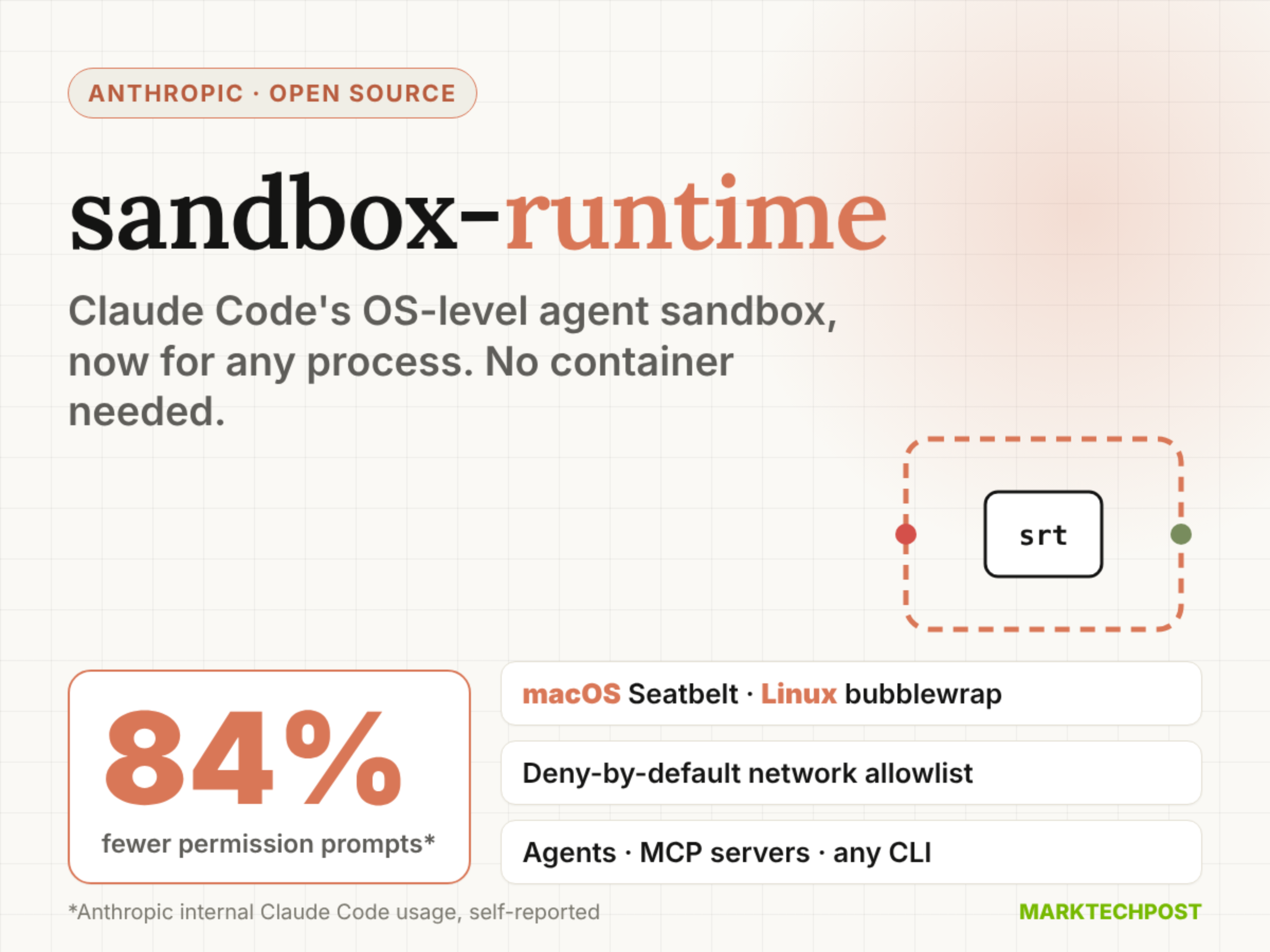
Anthropic open-sources the OS-level sandbox sandbox-runtime: providing container-free file and network isolation for AI agents.

On October 24, 2026, Anthropic open-sourced sandbox-runtime (srt), an OS-level sandboxing tool that operates without containers, designed to restrict file read/write and network access permissions for AI agents, MCP servers, and CLI tools. It supports macOS (Seatbelt), Linux (bubblewrap), and Windows (alpha), with npm package version 0.0.81 under the Apache-2.0 license.

Meet Anthropic’s sandbox-runtime: OS-Level Sandboxing for AI Agents, No Containers

Why it matters:This tool represents a significant advancement in AI security infrastructure—achieving fine-grained, full-process-tree coverage through the operating system’s native isolation mechanisms, directly addressing the risks of prompt injection and privilege escalation, and has already been deployed for internal validation within Claude Code.

Timeline and related coverage

TutorCaseBench Released: The First LLM Tutoring Evaluation Benchmark for Special Education Scenarios

On October 24, 2026, researchers published TutorCaseBench on arXiv (ID 2610.30828v1)—an LLM tutoring evaluation benchmark built on real-world cases from pedagogy, educational psychology, and special education, focusing on the ability to support students with learning and behavioral challenges. The benchmark comprises 923 dialogue segments, covering five categories of challenging behaviors, and employs a dual-track assessment approach: open-ended generation (1,560 questions) and multiple-choice questions (2,537 questions). Among 11 state-of-the-art large models, the top performer met the evaluation criteria in only 55.8% of the open-ended items.

TutorCaseBench: A Case-Grounded Benchmark for Evaluating LLM Tutors in Supporting Students with Challenging Behaviors

Why it matters:This study fills a critical gap in existing AI‑based educational assessment, which has overlooked the complexity of students with special needs. Its methodology emphasizes evidence‑based tracing—combining qualitative case studies with source‑grounded rubrics—and all data are openly available, ensuring reproducibility and relevance to educational practice. The findings clearly reveal significant shortcomings of current LLMs in generating contextually appropriate responses, offering important warnings and guidance for the practical implementation of educational AI.

Timeline and related coverage

Clinicians Lead the Development of Verifiable Safety Guidelines: Establishing a Traceable Layer of Safeguards for Mental Health Chatbots

On October 24, 2026, arXiv published the paper arXiv:2610.30690v1, which proposes a four‑rule safety‑check rulebook defined, finalized, and adjudicated under the guidance of two clinical physicians. After formal verification, this rulebook is deployed as a guardrail layer to govern the outputs of large language models (LLMs) in mental health contexts. All judgments within this guardrail can be traced back to a single naming rule and sixteen factual verifications, aiming to enhance the interpretability and testability of safety assessments.

From Clinical Judgment to Checkable Rules: Clinician-Led Guardrails for Mental-Health Chatbots

Why it matters:This study offers a safety‑enhancing approach distinct from mainstream prompt engineering, LLM‑as‑a‑Judge, or Constitutional AI. Its core innovation lies in structuring and formalizing clinical decision‑making while maintaining a complete audit trail throughout the process. All key claims—such as the number of rules, validation methods, factual base, comparative experimental data, and cost metrics—are explicitly stated in the original text, and the publication date (2026‑10‑24) aligns with the current UTC date (2026‑10‑25), ensuring timeliness and a solid foundation of credibility.

Timeline and related coverage

The study proposes an ontology-driven behavioral analysis framework for Bengali-language cyberbullying, ODCBNA.

The paper, published on October 24, 2026, on arXiv (ID 2610.30885v1), proposes an offender-centric analytical framework called ODCBNA, which integrates ontology design, knowledge graph construction, behavior modeling, community analysis, and influence modeling, and conducts empirical analysis based on the Bengali-language cyberbullying corpus BenCoDiC.

From Perpetrators' Digital Footprints to Behavioral Communities: An Ontology-Driven Framework for Bengali Cyberbullying Analysis--- FULL VERSION

Why it matters:The material is an arXiv preprint, published on 2026-10-24—no later than the current date of 2026-10-26—with a clear source and a complete structure. The content focuses on methodological innovation and reproducible analytical results (such as identifying 1,063 perpetrators, detecting six Louvain communities, and ranking feature contributions), meeting the requirements for timeliness and factual accuracy in academic information.

Timeline and related coverage

CiteAnchor: Source-Aware Grounding for Hallucinated Citation Detection and Resolution

arXiv:2610.30355v1 Announce Type: new Abstract: Hallucinated citations make it harder to trace sources and verify the evidence behind scientific claims. Detecting them is difficult because bibliographic records can be incomplete or differ across source types and publication versions. A plausible match alone neither validates the citation nor establishes its underlying source. We introduce CiteResolve, a benchmark of 423 real-world hallucinated citations annotated for source recoverability. We further propose CiteAnchor, a source-aware grounding framework that adapts retrieval and field-level verification to each source type and separately determines citation validity and whether a unique source can be recovered. On an existing detection benchmark, CiteAnchor achieves 0.841 F1 with GPT-5.6

CiteAnchor: Source-Aware Grounding for Hallucinated Citation Detection and Resolution
Timeline and related coverage