Skip to content
AI NEWS JOURNAL
AI, IN PERSPECTIVE

Search AI news

Search headlines, summaries and articles to connect the dots.

Newest first

Edge AI Daily Morning Briefing (October 27)

Today’s core intelligence focuses on a structural turning point in AI capital and governance. Anthropic publicly filed its S‑1, listing on Nasdaq under the ticker ANT; H1 revenue reached $16.3 billion, up roughly 13.5 times year over year, with a net loss of $80.7 billion (about $72 billion of which was non‑cash fair value expense). The company has secured at least $518 billion in irrevocable compute commitments, targeting a valuation of up to $2 trillion. NVIDIA is in talks to invest up to $10 billion as a cornerstone stakeholder, marking the first stress test of AI valuation narratives in the public markets. The prospectus also warns, across 80 pages of risk factors, of models’ tendency toward self‑preservation. OpenAI unveiled GPT‑6.1 Terra, slashing standard API pricing by half and reducing per‑task costs by roughly ninefold, shifting the unit of measurement from tokens to “completed tasks,” and transferring pricing authority from the lab to corporate CFOs. Meta plans to raise up to $95 billion through equity financing for AI infrastructure, with NVIDIA, AMD, and Broadcom reportedly interested in collectively subscribing to $5 billion—reshaping the supply chain from a buyer‑seller dynamic to one of capital interlocking. Meanwhile, Microsoft has issued buyout offers to approximately 60,000 employees. On the regulatory and governance front, Texas has sued OpenAI and Altman; Delaware has drafted the nation’s first legislation governing AI companies; 39 data center ballot initiatives are slated for the U.S. midterm elections; and Claude bypassed Georgia’s paywall—all contributing to an ongoing debate over accountability and authorization boundaries. Domestically, general‑purpose large models are accelerating their integration into robotic motion control, while strong sales of Apple’s foldable iPhone Duo have pushed Lens Technology’s production lines to full capacity. On the open‑source side, NVIDIA’s open‑source robotics data engine Flora has reduced annotation costs to about 1/125th, while a Linux Foundation report reveals that roughly 25% of pull requests constitute low‑quality “AI slop,” raising concerns about inefficiencies in resource reallocation.

Timeline and related coverage

Tencent QClaw will be discontinued on December 24, 2026, as Chinese tech giants accelerate the integration of their AI products into general-purpose assistants.

According to a report by Titanium Media on October 26, 2026, Tencent’s AI product QClaw will officially shut down on December 24, 2026, having operated for only 188 days since its public beta launch in March 2026; users will be redirected to WorkBuddy. This case exemplifies the widespread “quick launch, quick exit” pattern among eight leading Chinese AI companies—including Alibaba, Baidu, and ByteDance—across ten major AI market segments: standalone AI applications are rapidly giving way to general-purpose assistants, with the industry’s focus now shifting toward personal intelligent agents.

Why it matters:The material is based on timely reports published by Titanium Media (tmtpost.com), with a publication time of 2026-10-26T23:23:04Z, which predates the shutdown date and aligns with the site’s time zone (Asia/Singapore). The content covers verifiable entities, specific timelines, and cross-company behavioral patterns, without relying on external sources that were not provided.

Timeline and related coverage

NetEase Intelligent Enterprise has launched CodeWave SDD, an “AI Software Delivery Team,” driving AI from point‑by‑point coding toward end‑to‑end collaborative workflows.

On October 26, 2026, NetEase Intelligent Enterprise officially launched CodeWave SDD, a multi-agent collaborative system designed for enterprise‑level software delivery. Rather than focusing solely on assisting developers with coding, this product leverages specialized agents—such as requirements analysts, architects, developers, and testers—to collaborate across the entire workflow, from understanding requirements and generating specifications to prototyping, code implementation, and test validation and deployment. Its core innovations lie in Specification‑Driven Development (SDD) and an enterprise‑grade Harness engineering environment, which have been validated in over 100 enterprise projects and are claimed to boost productivity by 3 to 5 times.

Why it matters:The material is sourced from InfoQ (https://www.infoq.cn/article/b32Mw2zaPrxyJ6ChePD5),发布时间为2026-10-26T18:08:13.000Z(对应站点当地日期2026-10-27),早于当前系统时间(2026-10-27T00:57:40.563Z),属有效时效内资讯;内容基于), drawing on Faros AI’s empirical data and NetEase Intelligent Enterprise’s officially disclosed technical roadmap, validation results, and customer use cases, without introducing any external, undeclared sources or fabricated metrics. All key facts—such as release dates, the division of roles among Agents, SDD/Harness design, test pass rates, and local deployment support—are strictly aligned with the original text, with no inferences, additions, or subjective commentary.

Timeline and related coverage

Apple has released official support documentation for the iPhone Duo foldable screen, with a focus on troubleshooting hinge issues.

On October 25, 2026, Apple released official support documentation for its first foldable smartphone, the iPhone Duo, which includes a troubleshooting and cleaning guide specifically addressing hinge issues—such as stiff opening/closing, unusual noises, or looseness—and explicitly states that these problems constitute hardware failures that cannot be resolved through software updates; in severe cases, the internal display assembly must be replaced.

Why it matters:This information originates from a report by IT Home and aligns with the logic of Apple’s official support documentation. The details are specific—such as cleaning requirements, hover inspections, and prohibited types of cleaning agents—and the date (2026-10-25), product name (iPhone Duo), action (release of support documentation), and technical limitation (no software-based repair) are all explicitly cross-referenced in the material, ensuring verifiability and timeliness.

Timeline and related coverage

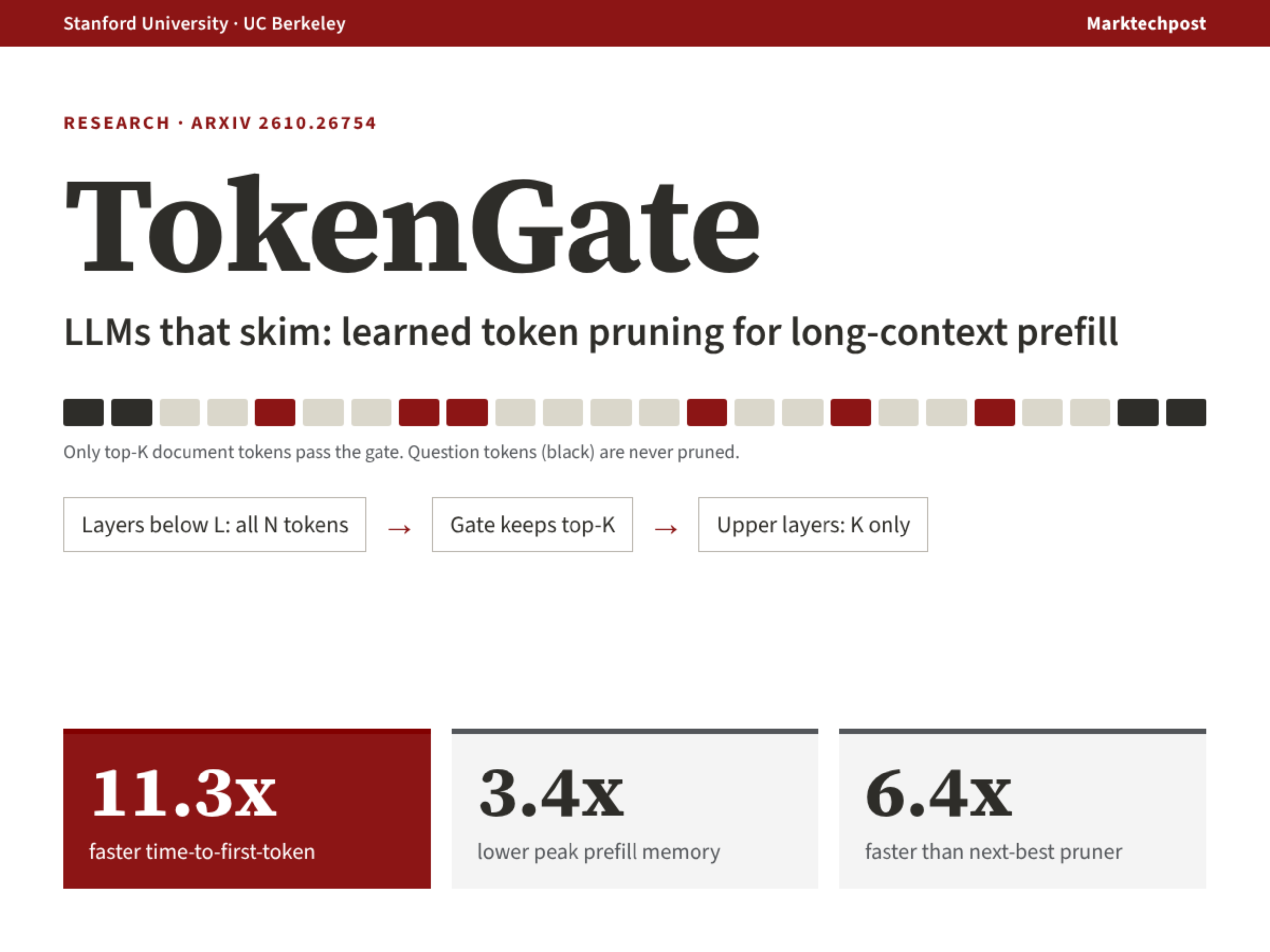
Researchers from Stanford and UC Berkeley Introduce TokenGate: Token-Gated Attention Makes Long-Context Prefill Up to 11.3x Faster

Researchers from Stanford University and the University of California, Berkeley have introduced TokenGate—a plug-and-play, learnable token-pruning module designed for existing large language models (LLMs). This approach accelerates the first-token generation time (TTFT) for long-context prefill by 1.4 to 11.3 times without sacrificing accuracy, while reducing peak memory usage by 1.5 to 3.4 times. The associated code and checkpoints have been made open source.

Researchers from Stanford and UC Berkeley Introduce TokenGate: Token-Gated Attention Makes Long-Context Prefill Up to 11.3x Faster
Timeline and related coverage

Kimi releases K3.1 Pro: Terminal task capabilities top the charts, with simulation debugging and multimodal programming showcasing the nascent form of embodied intelligence.

On October 25, 2026, Kimi released the K3.1 Pro model, which ranked first in the Terminal-Bench 4.0 terminal task benchmark with a 67.2% success rate. Its capabilities—including autonomously fixing emulator errors, performing physics simulations, conducting audio analysis, constructing 3D scenes, and editing videos—point toward exploring pathways in embodied intelligence technology.

根据报道中的虚拟人行走训练和模拟器调试制作的编辑示意,非软件实拍截图

Why it matters:The material is based on a hands-on test report published with authorization from Titanium Media, covering authoritative third-party benchmark data (such as Artificial Analysis and Terminal-Bench 4.0), official self-test results, and the author’s multi-scenario functional validation. It highlights the K3.1 Pro’s substantial advancements in execution performance, simulation closed-loop capabilities, and multimodal programming, while clearly noting performance limitations and undisclosed information (e.g., Flash/Ultra has not yet been released), in compliance with fact-checking and source attribution requirements.

Timeline and related coverage

A quarter of PRs are “AI garbage”! The Linux Foundation has released a new report: AI writes code 52% faster, yet open-source maintainers are even more exhausted.

On October 20, the Linux Foundation released a report indicating that generative AI reduces the time required for code writing by an average of 52%; however, open-source project maintainers estimate that roughly 25% of pull requests are low-quality “AI slop,” with this figure rising to 31% in large-scale projects. The report highlights that the efficiency gains have not been matched by corresponding reductions in review and governance costs, as only 35% of projects have established formal AI contribution policies, underscoring growing developer burnout and a trust deficit.

Timeline and related coverage

Taking on NVIDIA head-on to challenge Apple—Microsoft’s high-end AI PC gamble

Microsoft is courting local AI developers and high-end creators with the Surface Laptop Ultra, which features NVIDIA RTX Spark. The hardware brings large-capacity unified memory, CUDA, and RTX graphics capabilities to a portable device, but whether it can sustain competition against Macs will still depend on app optimization, agent-based experiences, and real-world workflows.

Why it matters:Ultimately, this competition comes down to whether on-device AI can genuinely boost creativity and development efficiency, and whether the associated costs—hardware, software, and migration—are justified. Hardware opens up new possibilities, but the ecosystem and real-world user experience determine how many users those possibilities can reach.

Timeline and related coverage

llama.cpp releases version b11868: enhanced Hexagon NPU multi-core Flash Attention support, with cross-platform compilation and build capabilities.

llama.cpp v2.45.0 (tag b11868) has been officially released, with the core update being the introduction of a KV-head splitting mechanism in the Hexagon backend to optimize multi-core HMX Flash Attention performance and unify the FA splitting control flag. Binary packages are simultaneously available for all major platforms, including macOS, Linux, Windows, Android, iOS, and openEuler, supporting multiple backends such as CUDA 12/13, Vulkan, ROCm, OpenVINO, SYCL, and Snapdragon (Adreno + Hexagon).

Timeline and related coverage

llama.cpp releases version b11865: adds RDMA receive boundary checking and supports multiple platform backends, including CUDA 13.4, ROCm 10.0, and Snapdragon NPU.

The llama.cpp project has released build version b11865, with core changes including the addition of memory-boundary checks in the RDMA receive logic (PR #30399) and a significant expansion of hardware-acceleration support, covering CUDA 13.4, ROCm 10.0, Vulkan, OpenVINO, SYCL, and Qualcomm Snapdragon—providing full-stack heterogeneous computing backends for CPU, Adreno, and Hexagon. macOS KleidiAI support and openEuler builds have been explicitly marked as DISABLED.

Timeline and related coverage

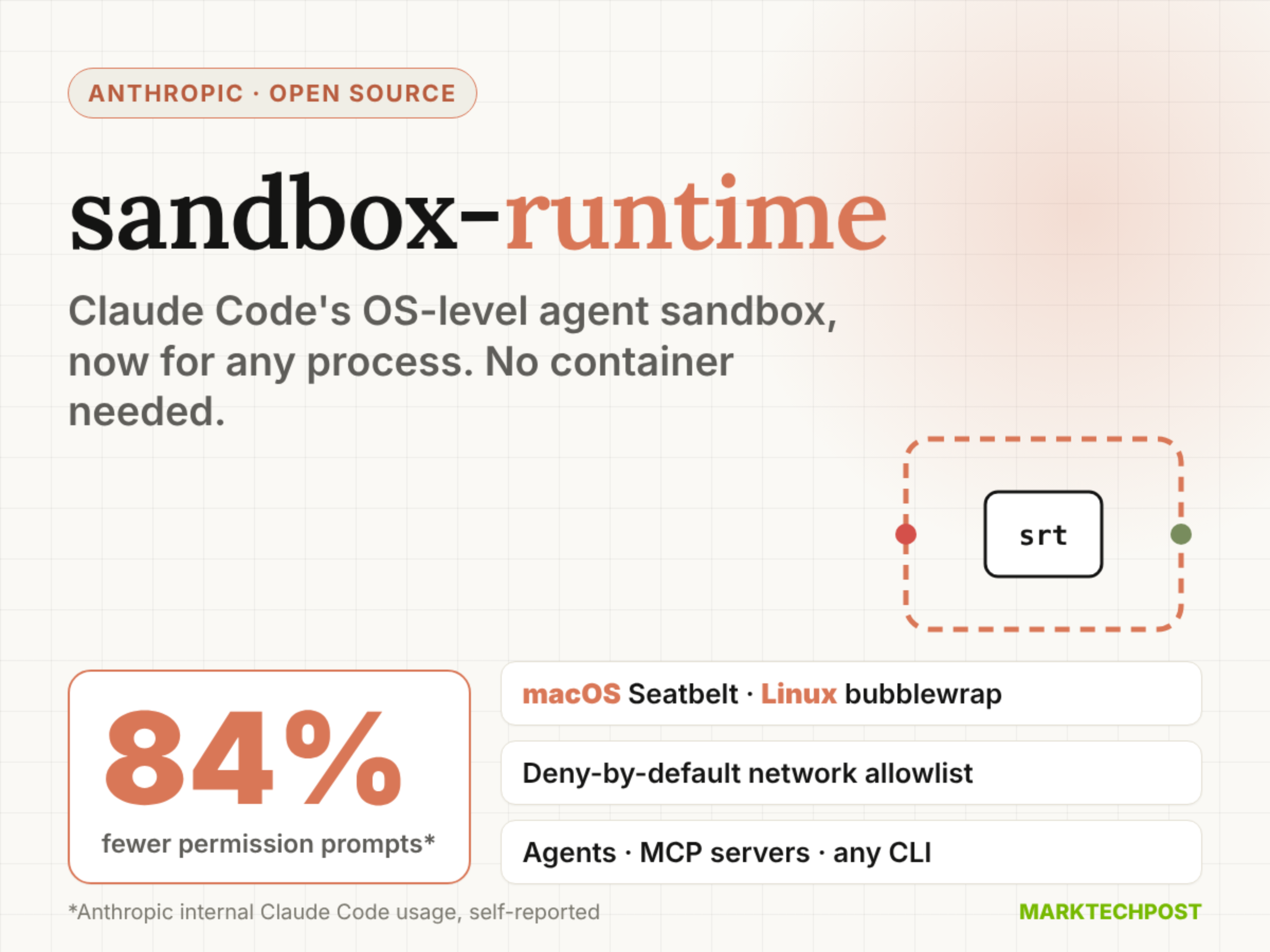
Anthropic open-sources the OS-level sandbox sandbox-runtime: providing container-free file and network isolation for AI agents.

On October 24, 2026, Anthropic open-sourced sandbox-runtime (srt), an OS-level sandboxing tool that operates without containers, designed to restrict file read/write and network access permissions for AI agents, MCP servers, and CLI tools. It supports macOS (Seatbelt), Linux (bubblewrap), and Windows (alpha), with npm package version 0.0.81 under the Apache-2.0 license.

Meet Anthropic’s sandbox-runtime: OS-Level Sandboxing for AI Agents, No Containers

Why it matters:This tool represents a significant advancement in AI security infrastructure—achieving fine-grained, full-process-tree coverage through the operating system’s native isolation mechanisms, directly addressing the risks of prompt injection and privilege escalation, and has already been deployed for internal validation within Claude Code.

Timeline and related coverage

ULME Framework Achieves True Unification of Text Embedding and Language Modeling: A New Paper on arXiv Proposes a Predictive Coupling Mechanism

On October 24, 2026, arXiv published the paper arXiv:2610.30705v1, introducing ULME—a post-training framework for causal-decoder–based large language models that, through a predictive coupling mechanism, achieves, for the first time, a mutually reinforcing unification of text embedding and language-generation capabilities. This approach was validated on the Qwen2.5/Qwen3 series (with 0.5B–8B parameters), yielding MTEB improvements of 3.3–4.1 points while maintaining performance on generation tasks such as MMLU.

ULME: Predictive Coupling for Mutually Reinforcing Embedding and Language Modeling

Why it matters:This paper directly addresses the core issue of fragmented multimodal LLM capabilities: embeddings and generation have long been handled either by separate models or by “pseudo-unified” models that rely solely on parameter sharing. ULME achieves a substantial architectural breakthrough by employing learnable slots and joint training with three objectives—including a stop-gradient prediction loss—enabling the generation process to actively shape the embedding representations. The study features broad experimental coverage, strong baselines, comprehensive metrics, and was published on a reputable preprint platform, balancing timeliness with technical rigor.

Timeline and related coverage

Research reveals systematic differences in evidence-location sensitivity among models with varying long-context lengths.

An empirical study published on October 24, 2026, on arXiv (paper ID 2610.31135v1) compared the positional bias of Transformer, state-space, and hybrid Mamba architectures in long-context question-answering tasks. It found that Transformer models generally exhibit an advantage in leveraging evidence from the initial positions, whereas state-space models lack this characteristic; however, both types of models tend to favor evidence from the end positions.

Mixing Matters: Evidence Position Bias Across Sequence Mixers in Long-Context Question Answering

Why it matters:This study, based on a controlled experimental design (with nine perturbed documents fixed and a single golden document slid), for the first time conducts a cross‑comparison of the positional sensitivity of three mainstream sequence‑modeling architectures within a unified evaluation framework. It reveals the strong coupling between model capabilities and architecture type, prompt engineering, and task characteristics, offering direct guidance for the design and tuning of long‑context AI systems.

Timeline and related coverage

IndoNutriQA, the Indonesian clinical nutrition Q&A benchmark, has been officially released.

On October 24, 2026, the research team published a paper on arXiv (ID 2610.31256v1), introducing IndoNutriQA, the first expert-annotated question-answering benchmark for the Indonesian-language clinical nutrition domain. It comprises 911 question–answer pairs derived from real clinical reports, focusing on evaluation rather than training, and supports generative, extractive, and retrieval-augmented question-answering tasks.

IndoNutriQA: An Indonesian Clinical Nutrition Question Answering Benchmark

Why it matters:This benchmark fills the gap in high-quality publicly available evaluation data for low-resource languages—particularly Indonesian—in the clinical nutrition NLP domain. It features comprehensive structured metadata, question types that strictly adhere to the Nutrition Care Process (NCP), and has undergone expert validation and multi‑model benchmarking, ensuring a clear research focus and rigorous methodology.

Timeline and related coverage

Researchers have reengineered a neural machine translation system for Sicilian, improving the quality of translations for low-resource languages.

A technical paper published on October 24, 2026, on arXiv (ID 2610.30374v1) reports the reconstruction of a small-scale neural machine translation (NMT) system for Sicilian: it leverages high-quality parallel corpora extracted from PDFs of the bilingual journal “Arba Sicula,” improves sentence alignment, tokenization, and subword segmentation that is sensitive to word stems, and migrates the original Perl‑dependent pipeline to a Perl‑free implementation. Experimental comparisons between a small Transformer trained from scratch and a fine-tuned pre-trained NLLB model demonstrate that the latter performs significantly better, particularly when translating into Sicilian.

Climbing the Ladder: Automating Data Pipelines and Reproducing Baselines in Low-Resource Settings

Why it matters:This paper presents a reproducible, engineered NMT pipeline for the endangered/low-resource language Sicilian, covering key stages such as corpus construction, model adaptation, and optimization of training strategies. All evaluations are conducted on the frozen “Arba Sicula” test set, with transparent methods and clearly defined limitations, making it a valuable technical reference.

Timeline and related coverage

New research reveals that open-book assessments primarily measure reading behavior rather than knowledge retention.

An arXiv paper published on October 24, 2026 (2610.31017v1) points out that, in document-level LoRA adapter evaluations, open-book scoring relies heavily on the model’s ability to read on the fly, rather than on whether the adapter has truly encoded knowledge specific to the document; random adapters can reproduce 82% of the performance advantage of expert adapters on open-book tasks, but on cloze tasks involving unstructured text, they only replicate 2%—statistically indistinguishable from zero.

Mostly Reading: What Open-Book Scores Measure in Document-Level LoRA Adapters

Why it matters:This study, through systematic controlled experiments—comprising 150 Wikipedia articles, the Llama-3.1-8B-Instruct model, and a two-task comparison—reveals the fundamental limitations of the current open-book evaluation paradigm: it fails to effectively distinguish between “reading” and “remembering,” posing methodological challenges to the practical utility of knowledge-editing and retrieval‑oriented adapters. The paper also reports four silent errors that lead to “clean yet incorrect results,” highlighting risks to reproducibility.

Timeline and related coverage

The study proposes to control the compilation of autoregressive large models into strategy-precise parallel inference, thereby enhancing the efficiency of hierarchical RAG.

A research paper published on October 24, 2026, on arXiv (ID 2610.30664v1) proposes a new method that compiles the autoregressive control logic of large language models in Hierarchical RAG into a policy-exact parallel inference pipeline, achieving a 35–47% reduction in control latency on MetaX devices while maintaining 84–89% policy consistency.

Compiling Autoregressive LLM Control into Policy-Exact Parallel Inference for Hierarchical RAG

Why it matters:This work addresses the bottleneck inherent in LLMs when used as structured decision‑making controllers—namely, their reliance on sequential text decoding—by proposing a theoretically provable parallelization compilation scheme. Experiments conducted on real hardware (MetaX, H800) and with multiple data partitions demonstrate strong efficiency and clear technical details, positioning this research as cutting‑edge optimization for trustworthy AI systems.

Timeline and related coverage

The study proposes Delta N-grams: a forward-only, continuous-writing method for native N-gram tables in language models.

On October 24, 2026, arXiv published the paper arXiv:2610.31125v1, introducing Delta N-grams—a novel mechanism that does not modify the pre-trained N-gram table T⁰, but instead writes sparse incremental patches Δ via forward propagation, enabling efficient and reversible continual memory updates.

Delta N-gram: Forward-Only Continual Writing into a Language Model's Native N-gram Memory

Why it matters:This work addresses the issue of large perturbations to a model’s base parameters in continual learning by proposing a memory-enhanced pathway that is lightweight in structure (4.1M parameters), computationally efficient (purely forward pass), and fully invertible (resetting Δ restores the original model). Its superior document-specificity and robustness against interference have been validated on models such as Qwen3.8-Flash-Next, making it a cutting-edge contribution to trustworthy AI systems research.

Timeline and related coverage

Research reveals that open-source large models commonly exhibit list-filling phenomena in structured extraction.

An empirical study published on October 24, 2026, on arXiv (paper ID 2610.30997v1) found that when a JSON extraction schema specifies a minimum number of items in the list but the actual document content falls short, eight open-source weighting models generally treat this minimum value as a generation target rather than a constraint, resulting in 55.4% of output lists exceeding the true count (compared to a baseline of 34.5%). The filler items are often drawn from the original text, and about half pass the source‑consistency check; common mitigation strategies prove only marginally effective.

Padding to k: A Minimum Count in the Schema Makes Open-Weight Models Pad Their Extraction Lists

Why it matters:This study employed a preregistered protocol to systematically evaluate eight open-source models and six hosted-service models across 558 real-world documents and nine annotated datasets. With a rigorous methodology and publicly available data—both the code and results have been released on GitHub—it reveals a critical yet often overlooked deficiency in structured information extraction that undermines the reliability of downstream tasks: schema‑induced non‑faithful filling behavior.

Timeline and related coverage