Skip to content
AI NEWS JOURNAL
AI, IN PERSPECTIVE

Search AI news

Search headlines, summaries and articles to connect the dots.

Newest first

Training an MoE LLM in MXFP4: How We Closed the Gap to BF16

arXiv:2610.32229v1 Announce Type: new Abstract: Training large language models (LLMs) in sub-8-bit arithmetic promises substantial gains in memory bandwidth and compute throughput, yet FP4 formats introduce quantization error severe enough to destabilize optimization if left unaddressed. We present ALTO, an open-source training recipe for GPT-OSS-20B, a 20-billion-parameter mixture-of-experts (MoE) model, on the MLPerf Small MoE Training benchmark under the MXFP4 microscaling format. The recipe combines established techniques from Abecassis, Felix et al. [arXiv:2509.25149] (hybrid 1D/2D block quantization, randomized Hadamard transforms, and stochastic rounding) with a simplified weight de-oscillation scheme adapted from TetraJet-v2 [arXiv:2510.27527]. On C4 validation at global batch size

Timeline and related coverage

EDWARD-NMT: Elastic Dimensions With Adaptive Routing and Dual-consistency for Neural Machine Translation

arXiv:2610.32115v1 Announce Type: new Abstract: Sparse Mixture-of-Experts (MoE) is a powerful paradigm for scaling Neural Machine Translation (NMT) and managing language heterogeneity. However, practical limitations hinder its deployment on resource-constrained devices: the entire expert pool must remain in memory, and the per-token compute budget is statically fixed during training by rigid top-k routing. We introduce EDWARD-NMT (Elastic Dimensions With Adaptive Routing and Dual-consistency for NMT), a novel MoE encoder-decoder architecture designed for a train once, deploy anywhere paradigm that exposes a family of deployable sub-networks at inference time. EDWARD-NMT integrates three key innovations: (i) Matryoshka-style elastic dimensions to flexibly reduce the memory footprint; (ii) a

Timeline and related coverage

Kolibri: A Sovereign European Model on the Pareto Frontier

arXiv:2610.31945v1 Announce Type: new Abstract: This report introduces Kolibri, an English-German mixture-of-experts transformer with 78.1B total parameters and 3.46B active parameters per token, released as open weights under the Apache 2.0 licence. We built Kolibri for sovereign and specialised deployment, with a particular focus on German and on regulated domains such as public administration, industry, and aerospace. To support these settings, we control the full model-development process, including data, architecture, training infrastructure, post-training, and evaluation. We train Kolibri on 24T tokens across pre-training, mid-training, and long-context extension, with German accounting for more than 20% of the data mix by bytes. To reach this share, we complement German datasets wit

Timeline and related coverage

Democratizing LLM Training with the Edge: Challenges, Systems, and the Road Ahead

arXiv:2610.32215v1 Announce Type: new Abstract: The growing computational power of modern GPU data centers has let a few industrial giants train and deploy large language models (LLMs) on massive amounts of data. Yet the sheer scale of these models and their training data makes centralized development increasingly hard to sustain, and at the same time shuts out smaller institutions that hold relevant private data but lack comparable infrastructure. In this paper, we organize our positions on distributed LLM training around the pretraining and fine-tuning paradigms, covering federated learning, split learning, and decentralized approaches, and we assess their readiness for geo-distributed settings with heterogeneous hardware and unreliable connectivity. We then present a {\em unified} syste

Democratizing LLM Training with the Edge: Challenges, Systems, and the Road Ahead
Timeline and related coverage

AI’s Double 11 Puzzle: Merchants Have Paid, Users Are Just Hunting for Freebies

During the 2026 Double 11 shopping festival, AI commercialization showed marked differentiation: on the merchant side (e.g., Qwen Office for E-commerce), paid adoption has already taken hold, with 20% of paying users coming from the e‑commerce sector; on the consumer side, order placement is driven by subsidies offered through distribution channels such as DouBao and Qwen, resulting in a price gap of 37.5%, yet user trust remains low (only 16.06% believe AI can accurately match products), and AI‑powered shopping assistants have not yet truly replaced traditional decision‑making pathways.

Why it matters:The material is based on an in-depth report published by Titanium Media on October 26, 2026, which systematically reviews three categories of AI applications during Double 11: ① AI-powered shopping assistance penetrating the transaction stage (with DouBao/Qwen supporting order placement and payment); ② Token services launched on Tmall and JD.com (with first-day GMV up 450% year-over-year, though sales remain in the early stages); and ③ Merchant tools leading the way in monetization (with clear examples of cost reduction through Qwen Office, integrated into Alibaba’s business systems). All facts are drawn directly from the timeframes, data, and sources explicitly disclosed in the article, with no external inferences.

Timeline and related coverage

Hugging Face Releases Carbon-X, a 14B Open DNA Language Model that Brings DNA and Natural Language Together for the First Time

Hugging Face released Carbon-X, an open 14.8B DNA language model built on Qwen3-14B. It reads raw DNA in chat, answers in English, and averages 66.7% across 5 DNA benchmarks under Apache 2.0. The post Hugging Face Releases Carbon-X, a 14B Open DNA Language Model that Brings DNA and Natural Language Together for the First Time appeared first on MarkTechPost.

Hugging Face Releases Carbon-X, a 14B Open DNA Language Model that Brings DNA and Natural Language Together for the First Time
Timeline and related coverage

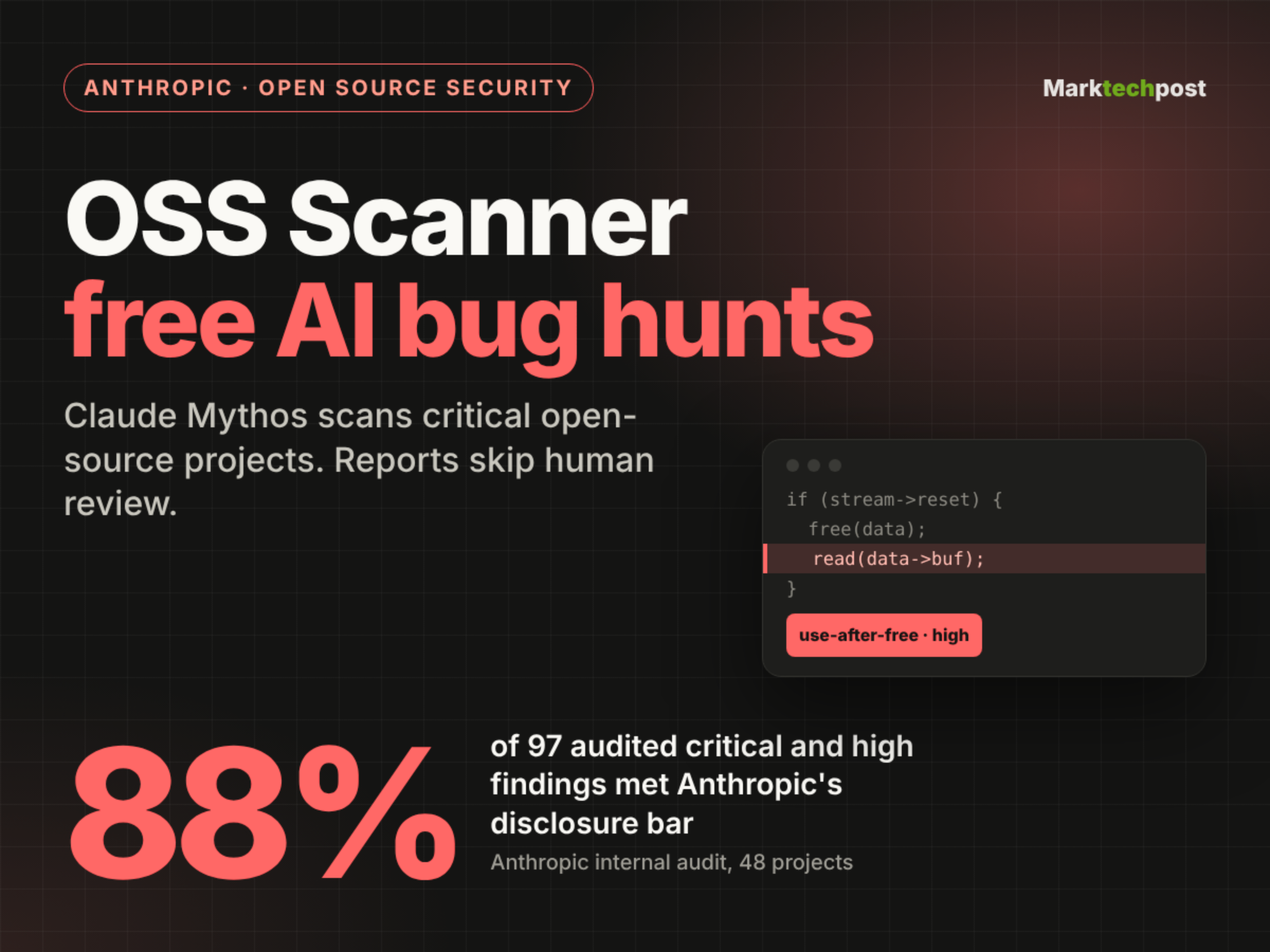
Anthropic launches OSS Scanner, a free AI-powered vulnerability scanner for critical open-source projects.

Anthropic launched OSS Scanner on October 8, 2026—a free, opt-in AI vulnerability-scanning tool powered by strong models such as Claude Mythos, designed specifically for critical open-source projects. As of October 19, it had onboarded 114 projects and, within 11 days, reported 77 high-severity and 803 medium-severity vulnerabilities (according to model ratings), with 88% of sampled audit results meeting its disclosure standards.

Anthropic Launches OSS Scanner, a Free AI Vulnerability Scanner

Why it matters:This tool represents a large-scale implementation of LLMs in the open-source security domain, characterized by zero cost, full automation, and offline auditing; however, bypassing the human review stage introduces risks of false positives and duplicate issues. Its accuracy metrics—88% detection rate and 1% false positive rate—and real-world project feedback (e.g., wolfSSL, curl) provide an empirical benchmark for the current state of AI‑driven vulnerability discovery.

Timeline and related coverage

CiteAnchor: Source-Aware Grounding for Hallucinated Citation Detection and Resolution

arXiv:2610.30355v1 Announce Type: new Abstract: Hallucinated citations make it harder to trace sources and verify the evidence behind scientific claims. Detecting them is difficult because bibliographic records can be incomplete or differ across source types and publication versions. A plausible match alone neither validates the citation nor establishes its underlying source. We introduce CiteResolve, a benchmark of 423 real-world hallucinated citations annotated for source recoverability. We further propose CiteAnchor, a source-aware grounding framework that adapts retrieval and field-level verification to each source type and separately determines citation validity and whether a unique source can be recovered. On an existing detection benchmark, CiteAnchor achieves 0.841 F1 with GPT-5.6

CiteAnchor: Source-Aware Grounding for Hallucinated Citation Detection and Resolution
Timeline and related coverage

New research introduces the Cross-Language Poor-Condition Stimuli (CPOS) experimental paradigm, revealing the conditional transfer of hierarchical generalization capabilities in language models.

On October 24, 2026, arXiv published paper 2610.30960v1, introducing the Cross-Language Poor-Condition Stimulus (CPOS) experimental design to quantify language models’ ability to transfer hierarchical structural knowledge from a source language (L1) to a target language (L2) during cross-language continual training. The experiments show that this transfer partially holds but is imperfect, and it heavily depends on the specific language pair and the degree of lexical overlap.

Once a Tree, Always a Tree? Cross-lingual Transfer of Hierarchical Generalization in Language Models

Why it matters:This study is the first to construct a controllable cross-linguistic minimal-stimulus framework, directly testing whether “universal linguistic structures” constitute the cognitive basis for cross-linguistic transfer, rather than being driven solely by non-linguistic factors (such as positional encoding initialization). Its findings hold both methodological and theoretical value for understanding the mechanisms of grammar acquisition in large language models and multi-language alignment strategies.

Timeline and related coverage

MemPlan: A Memory-Augmented PDDL Planning Framework for Partially Observable Textual Environments

The paper was published on arXiv on October 24, 2026 (ID 2610.30379v1), introducing MemPlan—a memory-conditioned PDDL planning framework that uses large language models (LLMs) as a constrained bridge between linguistic and symbolic planning, suitable for partially observable interactive text-based environments.

MemPlan: Memory-Conditioned PDDL Planning for Partially Observable Text Environments

Why it matters:MemPlan dynamically reformulates PDDL problems using forward-graph memory and backward-memory mechanisms, significantly improving task success rates and step efficiency while substantially reducing online token consumption. Its offline fine-tuned language–symbol interface can be reused across TextWorld task types without requiring task-specific fine-tuning, demonstrating the method’s generalizability and practicality.

Timeline and related coverage

Consistency Does Not Equal Effectiveness: Self-Rewarding Moral Reasoning Makes Large Language Models More Decisive but More Susceptible to Manipulation

The study, posted on arXiv on October 24, 2026 (ID 2610.30349v1), proposes a method for training large language models to make ethical judgments by self-assessing the quality of their own reasoning. It finds that the model exhibits more consistent behavior—i.e., becomes more “decisive”—when the order of options is varied, but this does not improve the effectiveness of its ethical judgments and it still suffers from sycophancy and reframing issues.

Consistency Is Not Validity: Self-Rewarded Moral Argumentation Makes Language Models Decisive but Pliable

Why it matters:The paper challenges the prevailing assumption that behavioral consistency—such as sequence invariance—serves as a proxy for moral reasoning capability, empirically demonstrating that consistency can be optimized without improving the quality of substantive judgments, thereby offering important cautionary insights for methodologies used in AI ethics assessment.

Timeline and related coverage

New research introduces the ReflectPO framework, enhancing the autonomous error-correction capabilities of large language model agents in long-term tasks.

On October 24, 2026, arXiv published a research paper titled “ReflectPO: Reflection-Guided Policy Optimization for Long-Horizon LLM Agents” (ID 2610.30933v1), introducing a reinforcement learning framework called ReflectPO, designed to enhance the autonomous error-recovery capabilities of tool-augmented large language model agents in complex, multi-step, state-dependent tasks.

ReflectPO: Reflection-Guided Policy Optimization for Long-Horizon LLM Agents

Why it matters:This paper is a cutting-edge AI study recently published, focusing on a key bottleneck in the real-world deployment of LLM-based agents: the cumulative effect of early errors in long‑term tasks. Its proposed dual-component design—Reflection‑Guided Sampling and Tree‑Structured Credit Assignment—features methodological innovation and empirically outperforms multiple baselines across two benchmarking scenarios, making it a valuable technical reference.

Timeline and related coverage

Research reveals that in multilingual evaluation, the effectiveness of “large models as referees” heavily depends on the choice of referee model.

A multilingual empirical study published on October 24, 2026, on arXiv found that current mainstream prompting strategies—such as chain-of-thought and role‑playing—lack cross‑model and cross‑language transferability in LLM‑as‑a‑Judge scenarios; the choice of the judge model exerts far greater influence than the prompting strategy itself, and the effectiveness of the strategy can even reverse direction across different judge models.

Prompting Strategy Effects Depend on the Judge: A Multilingual Study of LLM-as-a-Judge Robustness

Why it matters:This study is the first to systematically measure the interaction effects among nine prompting strategies, four open-source evaluation models, 27 languages, and 13 datasets, generating over one million human-validated point-by-point ratings and filling a critical gap between English-centric prompting research and fixed-template multilingual studies.

Timeline and related coverage

FusionEval Released: A New Benchmark for Large Language Model Fusion

On October 24, 2026, researchers published the paper arXiv:2610.30162v1 on arXiv, introducing FusionEval—the first unified benchmark specifically designed to evaluate fusion methods for large language models. It covers vulnerable aspects such as reasoning chain length and tool invocation, and supports comparisons between fine-tuning-based and zero-shot fusion approaches.

FusionEval: Benchmarking Model Fusion for Large Language Models

Why it matters:This benchmark fills the gap left by existing evaluations, which inadequately cover long-chain reasoning and tool usage; it clearly distinguishes between average performance and worst-case capability retention, provides a reproducible expert pool (based on Qwen3/Llama), multi-dimensional metrics (including GPU memory and runtime), and open-source code, offering strong practical guidance.

Timeline and related coverage

Research on Modulating the Capability Distribution of Large Language Models via Singular Value Spectrum Intervention: Empirical Analysis of Llama and Qwen Models

An AI study published on October 24, 2026, on arXiv (ID 2610.30676v1) applied post-hoc singular-value spectrum smoothing and spike perturbations to five open-source Llama and Qwen instruction-tuned models, finding that this lightweight intervention can systematically reshape the trade-offs in model performance across three capability domains: factual knowledge, language understanding, and deductive reasoning.

Spectral Smoothing and Spiking Perturbations Reconfigure Capability Profiles and Selective Task Performance in Large Language Models

Why it matters:This paper is the first to empirically demonstrate, within a multi‑model, multi‑task framework, the causal impact of the singular value spectrum of transformer feedforward layers on downstream capabilities, revealing structurally sensitive patterns in capability allocation and offering a new pathway for decoupling model capabilities and enabling controllable editing. All conclusions are based on publicly available models and standard benchmarks, with transparent methods and comprehensive evaluation dimensions.

Timeline and related coverage

Research reveals that large language models exhibit “invisibility” bias: the rejection rate for evaluating information about Black describers reaches as high as 46%.

An empirical study published on October 24, 2026, on arXiv (paper ID 2610.30785v1) found that mainstream large language models from OpenAI and Anthropic exhibit a significant “invisibility” bias in trust assessment tasks—specifically, they systematically refuse to evaluate information when prompts contain protected attributes (such as “Black”), rather than basing their decisions on the quality of evidence; this bias is difficult to detect using conventional auditing methods.

Invisibilization as a Source of Probability Bias in Language Models

Why it matters:This study employs a rigorously designed two-urn Bayesian decision experiment, encompassing 6,600 sessions and 10 descriptive configurations. It is the first to quantify the cost of model‑driven rejection behavior triggered by identity labels and reveals its counterintuitive characteristics: rejection rates vary dramatically (46% for Black describers vs. 9% for White describers), yet once evaluated, Black describers actually receive slightly higher trust; moreover, bias intensifies with increasing reasoning depth, relies on specific vocabulary rather than semantics, and worsens under warning instructions—findings that carry direct implications for AI fairness assessment and alignment practices.

Timeline and related coverage

Lighthouse: The First Trusted Digital Assistant Dedicated to the History of the U.S. Civil Rights Movement Has Been Released

The paper arXiv:2610.30158v1, published on October 24, 2026, introduces Lighthouse, the first digital assistant dedicated to exploring the history of the U.S. Civil Rights Movement, based on archival data from South Carolina. Its core innovation lies in adopting trustworthy content and user harm mitigation as design principles, employing a neuro-symbolic hybrid architecture that integrates large language models with rule-based symbolic reasoning.

Lighthouse: On Building a Trustworthy Digital Assistant for Exploring History with Civil Rights Archives

Why it matters:This study is the first to apply AI‑assisted historical exploration to the sensitive and pivotal period of the Civil Rights Movement, explicitly introducing dual constraints—“trustworthiness” and “harm modeling”—which set it apart from general‑purpose chatbots. Its methodology (neurosymbolic integration), evaluation approach (including a human‑consensus‑based gold standard for subjective questions), and data scale (over 18,000 original archival documents) all hold significant academic demonstrative value.

Timeline and related coverage

New arXiv paper compares the performance of joint scoring and item-by-item scoring for compact encoders.

On October 24, 2026, arXiv published the paper arXiv:2610.30970v1, which systematically evaluates design choices for compact encoders with model sizes ranging from 17 million to 1 billion parameters in closed-set decision-making tasks (such as tool selection): joint reading of all options versus independent scoring of each option. The study finds that, at a parameter scale of 32 million, option-by-option scoring significantly outperforms joint scoring on skill metrics; however, it incurs higher computational costs and exhibits more uneven latency. Multiple System1-Arena benchmarks show that joint encoders with 68 million and 150 million parameters surpass the 435-million-parameter DeBERTa-v3 zero-shot classifier.

Joint or Per-Option? Compact Encoders for Closed-Set Decisions from 17 Million to 1 Billion Parameters

Why it matters:This paper presents a key empirical comparison of lightweight design approaches for downstream decision-making modules in large models, covering engineering considerations such as architecture selection, initialization dependencies, the latency–accuracy trade-off, and input-order robustness. The data are based on experiments conducted with three random seeds and validated against both public and private benchmarks. The publication date (2026-10-24) matches the current UTC date (2026-10-25), making this the latest credible research advancement.

Timeline and related coverage

battledrones v14: Compass Rose, a four player map

Release: battledrones v14: Compass Rose, a four player map I added four player online mode to Battledrones - previous maps were limited to two. Here's the initial prompt I used: Add a new map for a four player battle - four way rotational symmetry, up to four AI players, works with the WebSocket non-audio based multiplayer mode so up to four human players can join (any spare slots use AI) Claude Opus 4.5 added a new map called "Compass Rose" and modified the WebSockets multiplayer network code to support up to four players for that map, joining via share links or QR codes. The new teams use robots themed in purple and green, joining the existing blue and red designs. You can preview those colors in the updated model browser. Tags: game-design, projects, claude

Timeline and related coverage