
Skip to content
AI NEWS JOURNAL
AI, IN PERSPECTIVE

Search AI news

Search headlines, summaries and articles to connect the dots.

Newest first

Anthropic launches OSS Scanner, a free AI-powered vulnerability scanner for critical open-source projects.

Anthropic launched OSS Scanner on October 8, 2026—a free, opt-in AI vulnerability-scanning tool powered by strong models such as Claude Mythos, designed specifically for critical open-source projects. As of October 19, it had onboarded 114 projects and, within 11 days, reported 77 high-severity and 803 medium-severity vulnerabilities (according to model ratings), with 88% of sampled audit results meeting its disclosure standards.
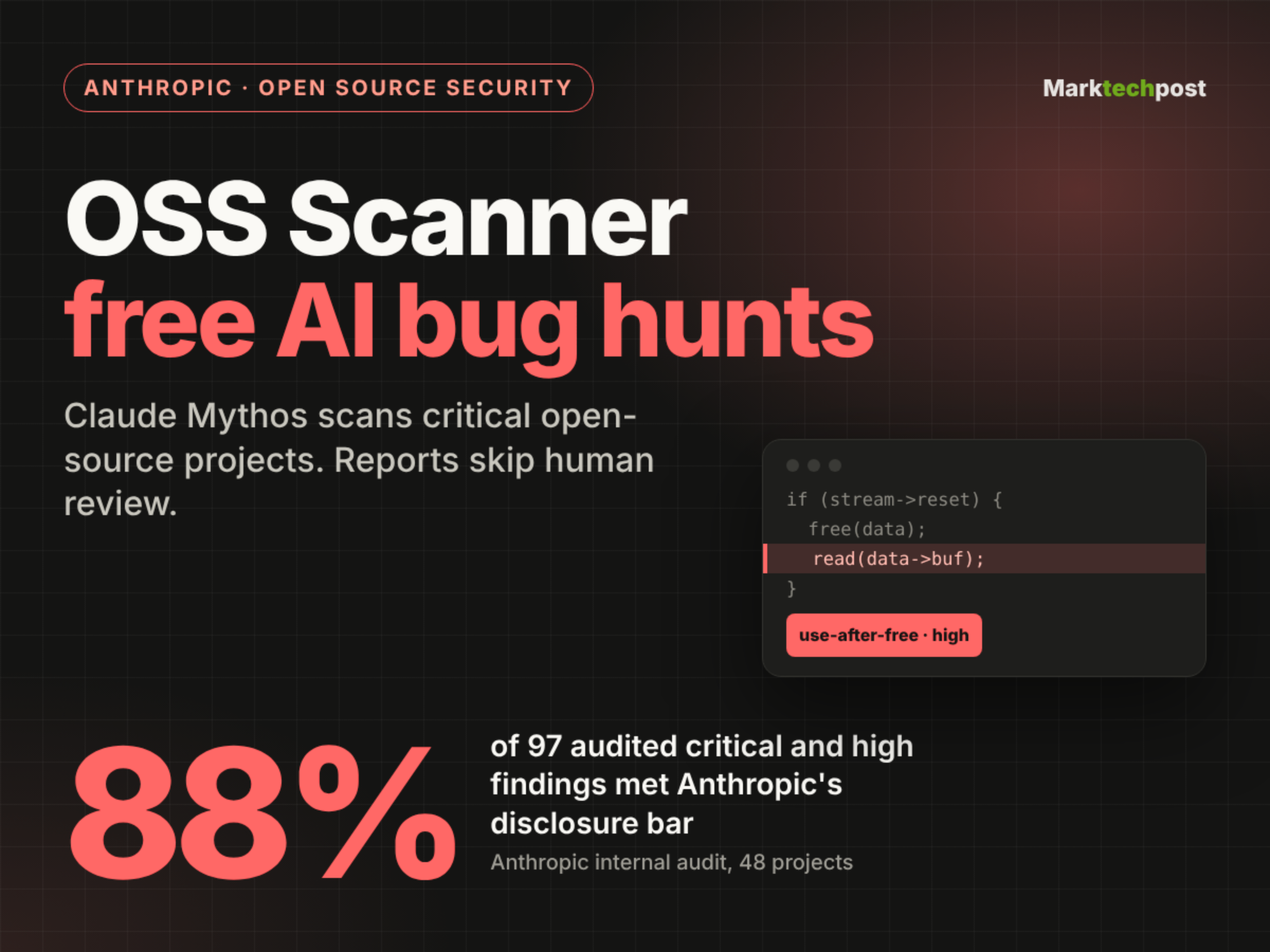
Anthropic Launches OSS Scanner, a Free AI Vulnerability Scanner

Why it matters:This tool represents a large-scale implementation of LLMs in the open-source security domain, characterized by zero cost, full automation, and offline auditing; however, bypassing the human review stage introduces risks of false positives and duplicate issues. Its accuracy metrics—88% detection rate and 1% false positive rate—and real-world project feedback (e.g., wolfSSL, curl) provide an empirical benchmark for the current state of AI‑driven vulnerability discovery.

Timeline and related coverage

MemPlan: A Memory-Augmented PDDL Planning Framework for Partially Observable Textual Environments

The paper was published on arXiv on October 24, 2026 (ID 2610.30379v1), introducing MemPlan—a memory-conditioned PDDL planning framework that uses large language models (LLMs) as a constrained bridge between linguistic and symbolic planning, suitable for partially observable interactive text-based environments.

MemPlan: Memory-Conditioned PDDL Planning for Partially Observable Text Environments

Why it matters:MemPlan dynamically reformulates PDDL problems using forward-graph memory and backward-memory mechanisms, significantly improving task success rates and step efficiency while substantially reducing online token consumption. Its offline fine-tuned language–symbol interface can be reused across TextWorld task types without requiring task-specific fine-tuning, demonstrating the method’s generalizability and practicality.

Timeline and related coverage

IFC-MCQ: A Method for Automatically Generating Multiple-Choice Question Benchmarks for LLM Agents in Building Information Modeling

On October 24, 2026, researchers published the IFC-MCQ method on arXiv, aiming to automatically generate a multi-choice question benchmark with precise scoring for Industry Foundation Classes (IFC) data retrieval systems based on large language models (LLMs) in the architecture, engineering, and construction (AEC) sector.

IFC-MCQ: Automatically Generating Multiple-Choice Benchmarks for Evaluating LLM Agents on IFC Data Retrieval

Why it matters:This work directly addresses the pain points of LLMs—namely, the difficulty and high cost of evaluating them on specialized structured data such as IFC—by proposing the first automated multiple-choice question-generation framework for IFC files. It covers 15 categories and 36 subcategories, supporting reproducible and scalable evaluations of agent capabilities.

Timeline and related coverage