
1. GPT-6.1 Terra, better suited for workers, has launched, with API prices cut in half and faster computer performance.
On October 26, OpenAI released GPT-6.1 Terra, focusing on enhancing visual understanding, computer operations, factual accuracy, and programming capabilities for everyday office use and high-frequency agent tasks. The model can handle tasks such as processing technical drawings, filling out forms, and editing videos, and it supports developers through API calls.
In terms of performance, OpenAI’s published tests show that GPT-6.1 Terra achieved a 15-percentage-point improvement over the previous-generation GPT-5.6 Terra on the computer-operation benchmark Agents’ Last Exam, with task costs reduced to about one-third; in the Terminal-Bench 4.0 programming test, the task success rate at maximum reasoning intensity reached 50.3%, more than double the figure reported for the previous generation. OpenAI also stated that, in certain internal factual-accuracy tests, the model’s error rate at low reasoning intensity dropped from 53.6% to 16.7%.
Pricing is a major highlight of this upgrade. GPT-6.1 Terra’s standard API pricing has been reduced by 50% compared to the previous generation, with a charge of $1 per million input tokens and $5 per million output tokens. The new model is now available to eligible ChatGPT Work and Codex users.
2. Ant Lingguang 2.0 has launched, upgrading from a chat assistant to a capable personal AI assistant.
On October 27, Ant Group’s Lingguang app launched version 2.0, repositioning itself as a “personal AI assistant that gets things done” and enhancing its capabilities in managing complex tasks, providing ongoing follow-ups, and supporting everyday life. The new version can handle scenarios such as bill reconciliation, subscription management, product price comparison, parenting reminders, pet care, and travel planning. Users can issue natural-language commands to enable the AI to continuously manage routine tasks that require multiple rounds of follow-up.
In terms of security, Lingguang 2.0 integrates with Ant APASS, incorporating identity authentication, intent-based security, and privacy protection into the agent’s execution workflow. Users can view, modify, or revoke permissions at any time, ensuring that the agent operates strictly within its authorized scope. This upgrade marks a significant evolution for Ant Lingguang, shifting its capabilities from “answering questions and generating content” to “proactive follow-up and task management.”
3. Anthropic files for an IPO, with revenue of $16.3 billion in the first half of the year.
On October 26, Anthropic publicly filed its IPO registration documents with the U.S. Securities and Exchange Commission (SEC), planning to list on Nasdaq under the ticker symbol “ANT.” The prospectus indicates that the company’s revenue for the first half of 2026 is expected to reach $16.286 billion, roughly 3.5 times its full-year revenue in 2025, with Claude Code and enterprise-level AI services serving as key growth drivers.
However, rapid growth has also come with massive investments. In the first half of the year, Anthropic reported a net loss of $80.748 billion, of which approximately $72.4 billion was attributable to changes in the fair value of financial instruments. During the same period, its operating loss was about $693 million (the net loss figure encompasses a broader scope, including not only regular operating losses but also fair-value adjustments—for example, when Investor A finances Company B by borrowing funds, the liability associated with that debt rises proportionally as Company B’s valuation increases; by contrast, the operating loss refers solely to losses generated by core business operations).
In terms of computing power investment, the prospectus pledges over $430 billion in future cloud computing expenditures, with total infrastructure spending obligations exceeding $600 billion.
Another noteworthy figure in the prospectus is that approximately 5% to 7% of Anthropic’s revenue comes from users who violated terms and had their accounts suspended or limited; some of these users had already paid for the service before being banned, without receiving refunds. According to media estimates, this segment generated roughly $1.6 billion to $2.3 billion in the first nine months of 2026. Anthropic also stated that from August to September, it intensified its efforts to identify and suspend violating accounts; as account suspensions decline going forward, related revenue will correspondingly decrease, potentially impacting overall revenue growth.
Additionally, Anthropic acknowledged that some of its planned data centers will rely on on-site natural gas–fired power generation, and that climate change could slow down its expansion. The prospectus also cautions that advanced AI could be used for cyberattacks, the development of biological weapons, or even to cause catastrophic damage exceeding the insurance industry’s capacity to cover.
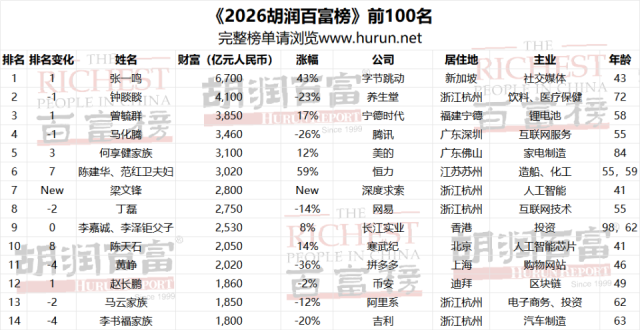
4. The Hurun Rich List has been released, with the top ten entrepreneurs accounting for more than half of the growth, primarily driven by the AI and semiconductor sectors.
In October, the “2026 Hurun Rich List” was released, with AI emerging as a key driver of wealth growth among China’s richest individuals this year. Zhang Yiming, founder of ByteDance, saw his fortune increase by RMB 200 billion, reaching RMB 670 billion and reclaiming the top spot on the list, setting a new record for the highest net worth of any Chinese billionaire. According to Hurun, advances in ByteDance’s AI business have fueled the company’s rising valuation.
AI upstarts are also making a splash. DeepSeek founder Liang Wenfeng, making his debut on the list, ranks seventh with a fortune of 280 billion yuan; Zhipu founders Liu Debing and Tang Jie make the list with 39.5 billion and 27.5 billion yuan, respectively, while MiniMax founder Yan Junjie joins at 22.5 billion yuan. Large AI models are becoming a major source of wealth for a new wave of billionaires.
Looking at the overall ranking, this year a total of 1,529 entrepreneurs made the list, with combined wealth reaching RMB 32 trillion, up 7% year over year. According to Hu Run, the top ten entrepreneurs with the largest wealth gains accounted for 56% of the entire list’s increase in total wealth, primarily driven by the AI and semiconductor sectors.
5. Tencent Hunyuan has open-sourced a large-scale simultaneous interpretation model, with real-world performance surpassing that of some commercial APIs.
On October 26, Tencent Hunyuan officially launched and open-sourced the simultaneous interpretation large model Hy-SimulMT, which supports bidirectional real-time speech translation between Chinese and English. It enables listening and translating simultaneously, with synchronized output of translated speech, and also supports real-time voice cloning to closely replicate the speaker’s voice and tone. The model has been first released on Tencent’s Hy Translation App, offering a free trial experience.
In terms of performance, Tencent’s empirical tests show that Hy-SimulMT has a response latency of approximately 3 seconds, whereas human simultaneous interpretation typically takes 4–5 seconds. Evaluations indicate that its translation quality outperforms mainstream open-source simultaneous‑interpretation models and surpasses most commercial translation APIs. Tencent also conducted comparative tests with six professional simultaneous interpreters, reporting that the model’s translation quality matches that of human experts, while delivering lower latency and faster speed.
During the November APEC meeting, Tencent Hy Translation, a new AI-powered translation tool supporting mutual translation among 33 languages, will serve as the official AI translation app, providing support to volunteers and frontline service personnel.
6. Kuaishou launches the “Interactive Content World,” where AI-generated mini-games can be played instantly upon opening.
On October 26, the Kuaishou app officially launched the “Kuaishou Interactive Content World,” providing a dedicated entry point for interactive storytelling, simulation management, and casual mini-games. Most of the content on the platform is created using Vibe Coding: creators simply describe their ideas in natural language, and AI generates code and enables rapid iteration, allowing them to publish interactive works for users to experience.
Currently, the platform has launched works across various categories, including the interactive narrative “Odyssey: Choices,” the casual game “Marble Challenge,” and the fishing simulation game “Anglers Never Run Out of Air.” Users can experience these games directly on the platform, with their play history being recorded; each game displays the creator’s personal ID and view statistics.
Kuaishou is not the only player in this space. Douyin, Bilibili, Xiaohongshu, and Hongguo Short Drama have also previously invested in interactive content, exploring areas such as recommendation and distribution, community‑driven creation, note‑based integration, and branching storylines. As AI lowers the barrier to developing interactive products, content platforms are striving to shift users from “consuming content” to “engaging with content,” vying for more of their time.
7. Tsinghua University, NVIDIA, and others have jointly launched StreamEval, with 38 AI real-time video models undergoing evaluation.
Tsinghua University, NVIDIA, Carnegie Mellon University, the University of California, Berkeley, Princeton University, the National University of Singapore, and other institutions have jointly launched StreamEval, a new benchmark for evaluating models that generate AI-powered real-time interactive videos. The project covers five task categories—digital human dialogue, virtual human performance, world generation, instruction editing, and reference editing—and has already evaluated 38 models, publicly releasing leaderboards, code, and datasets to enable developers to reproduce and test their results.
Unlike traditional evaluations that focus primarily on the quality of a single video generation, StreamEval places greater emphasis on whether a model can promptly respond to new instructions during continuous video generation while maintaining consistency in character identity, scene elements, and existing content. The evaluation results show that visual quality, instruction execution, and long-term continuity do not always improve in tandem; some models, though delivering stable visuals and good audio‑video synchronization, still struggle to accurately perform actions or meet editing requirements when faced with successive commands.
Currently, StreamEval has made its GitHub code and Hugging Face and ModelScope datasets publicly available, and it allows developers to submit models for evaluation.
8. Meta plans to raise $95 billion, stepping up investment in AI infrastructure.
On October 26, Meta announced the launch of a roughly $35 billion stock issuance plan and plans to introduce a follow-on public offering worth about $60 billion in the first quarter of 2027. Combined, these two initiatives could raise up to $95 billion. The proceeds will primarily support the company’s ongoing investments in AI infrastructure, computing power, and personal superintelligence. Notably, NVIDIA, AMD, and Broadcom have expressed interest in participating, with the three companies collectively seeking to subscribe for up to $5 billion; however, these expressions of intent do not yet constitute binding investment commitments.
Meta expects its capital expenditures to reach between $135 billion and $145 billion by 2026, and stated that AI investments have already begun to improve platform user engagement and advertising performance. This round of financing will further broaden the company’s funding sources to support data center expansion and AI product development. However, such large-scale investment also entails higher capital requirements, and it remains to be seen whether Meta can translate its computing power investments into sustained commercial returns.
Feel free to share, like, and recommend.
Let's explore AI together.