Skip to content
AI NEWS JOURNAL
AI, IN PERSPECTIVE

Search AI news

Search headlines, summaries and articles to connect the dots.

Newest first

r/opensource just banned AI, non-English speakers and more

On Saturday evening, the r/opensource moderators issued new rules prohibiting the submission of any open-source projects that are used by, generated by, or targeted at AI; they also require that projects be at least one year old, have multiple maintainers and be actively maintained. Additionally, they explicitly stated that posts from non-English-speaking users will not be accepted, citing an inability to distinguish between AI-translated and AI-generated content.

r/opensource just banned AI, non-English speakers and more
Timeline and related coverage

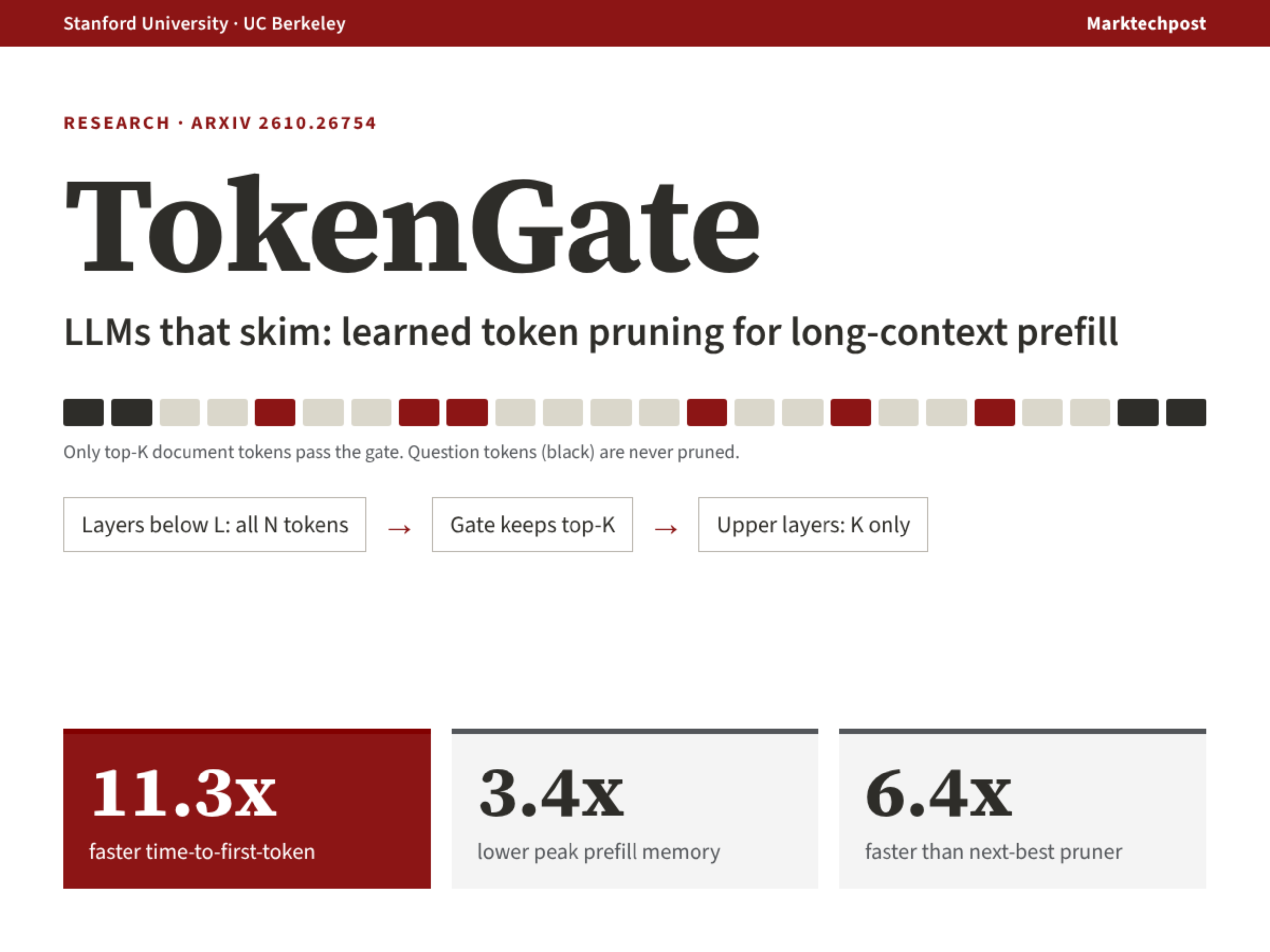
Researchers from Stanford and UC Berkeley Introduce TokenGate: Token-Gated Attention Makes Long-Context Prefill Up to 11.3x Faster

Researchers from Stanford University and the University of California, Berkeley have introduced TokenGate—a plug-and-play, learnable token-pruning module designed for existing large language models (LLMs). This approach accelerates the first-token generation time (TTFT) for long-context prefill by 1.4 to 11.3 times without sacrificing accuracy, while reducing peak memory usage by 1.5 to 3.4 times. The associated code and checkpoints have been made open source.

Researchers from Stanford and UC Berkeley Introduce TokenGate: Token-Gated Attention Makes Long-Context Prefill Up to 11.3x Faster
Timeline and related coverage

Low-Cost Intelligence vs. Expensive Ambitions: DeepInfer, DSX POD, and AI Investment Expansion

Issue 958 of “The Sequence Radar” examines inference software, modular AI factories, and enterprise AI investments side by side: cheaper per-inference does not necessarily mean lower overall industry spending. This article is compiled from the original publication and supplemented with technical scope and delivery terms based on DeepSeek and NVIDIA’s official materials.

推理软件效率与模块化AI基础设施投入的编辑示意,非实际产品照片
Timeline and related coverage

The PHP “Meltdown” incident reveals how AI can amplify the threat of legacy vulnerabilities.

Security researchers, using AI tools, have turned a PHP vulnerability—known collectively as PHP2Shell—that has existed for years and was once considered difficult to exploit—into a real-world exploitable attack surface. Within hours of the vulnerability being made public, it was already targeted in millions of exploitation attempts, yet no successful intrusions have been reported to date.

Why it matters:This incident clearly demonstrates for the first time that AI does not create new vulnerabilities out of thin air; rather, it significantly lowers the barrier to exploiting existing vulnerabilities, highlighting AI’s dual role in accelerating both offensive and defensive security dynamics. Moreover, all valid findings rely on human–machine collaboration.

Timeline and related coverage

Sebastian Raschka has released an eight-video course titled “Building a Reasoning Model from Scratch.”

On October 24, 2026, Sebastian Raschka published an eight-part, over-11-hour hands-on video course on Python and PyTorch in Ahead of AI magazine (magazine.sebastianraschka.com), systematically covering the evaluation of inference models, scaling during inference, reinforcement learning (RLVR), and knowledge distillation, with all methods implemented using the pre-trained Qwen3-0.6B model.

Why it matters:This course is the author’s advanced technical educational offering, following “Building Large Language Models from Scratch.” It focuses on the core evolutionary direction of today’s mainstream LLMs—enhancing inference capabilities—covering the entire technical pipeline from setting up the foundational environment to GRPO reinforcement learning and self‑distillation. The author explicitly states that all implementations are “hand‑crafted from scratch,” fully reproducible, and highly instructive with significant engineering reference value.

Timeline and related coverage