
Skip to content
AI NEWS JOURNAL
AI, IN PERSPECTIVE

Search AI news

Search headlines, summaries and articles to connect the dots.

Newest first

Sebastian Raschka has released an eight-video course titled “Building a Reasoning Model from Scratch.”

On October 24, 2026, Sebastian Raschka published an eight-part, over-11-hour hands-on video course on Python and PyTorch in Ahead of AI magazine (magazine.sebastianraschka.com), systematically covering the evaluation of inference models, scaling during inference, reinforcement learning (RLVR), and knowledge distillation, with all methods implemented using the pre-trained Qwen3-0.6B model.

Why it matters:This course is the author’s advanced technical educational offering, following “Building Large Language Models from Scratch.” It focuses on the core evolutionary direction of today’s mainstream LLMs—enhancing inference capabilities—covering the entire technical pipeline from setting up the foundational environment to GRPO reinforcement learning and self‑distillation. The author explicitly states that all implementations are “hand‑crafted from scratch,” fully reproducible, and highly instructive with significant engineering reference value.
Timeline and related coverage

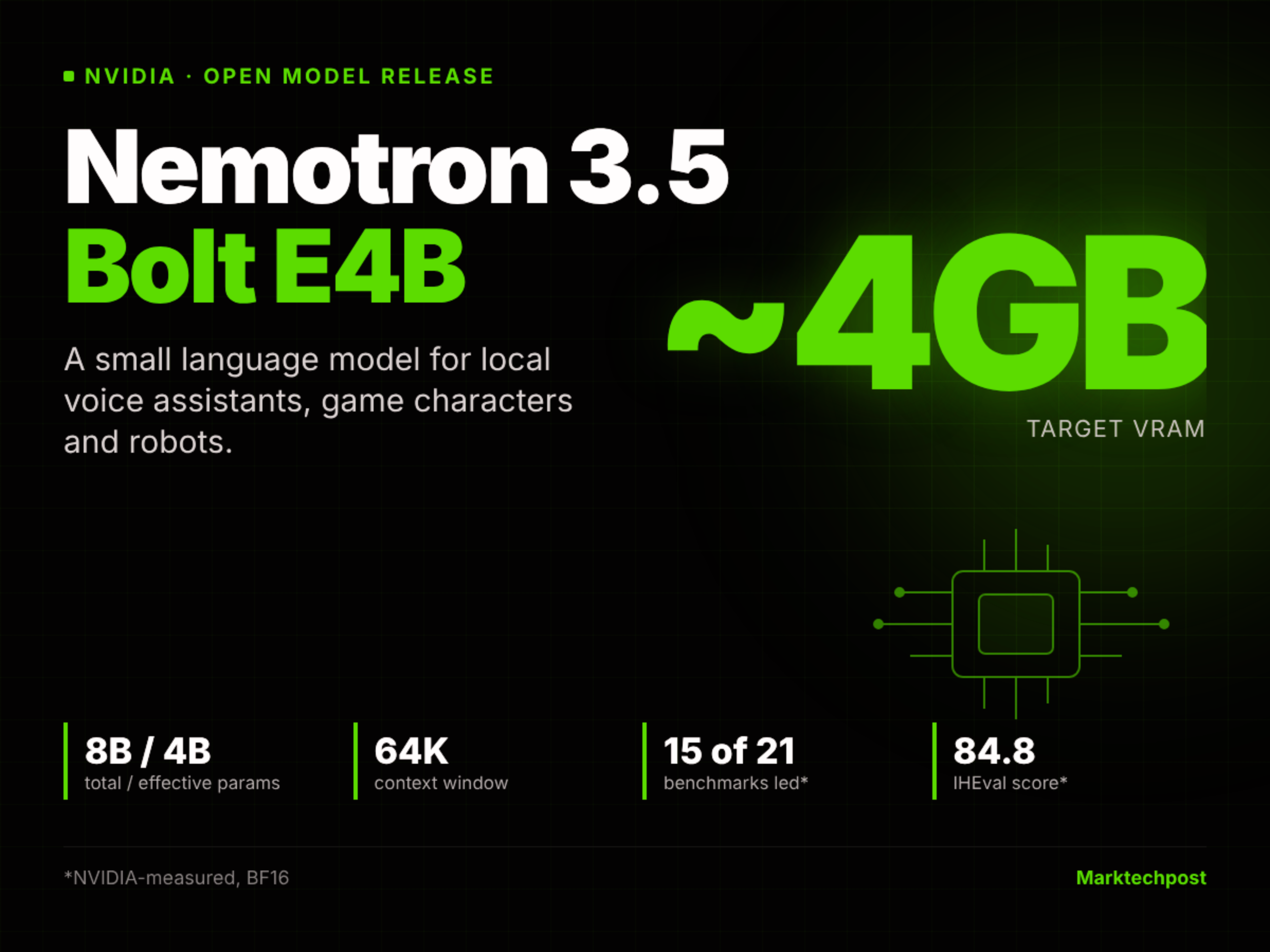
NVIDIA has released the open-source small language model Nemotron 3.5 Bolt E4B 4GB, optimized for on-device voice assistants, game NPCs, and robots.

NVIDIA, leveraging Google’s Gemma 4 E4B model and employing only reinforcement learning (RL) for post-training, has launched Nemotron 3.5 Bolt E4B 4GB—a small open-source language model with 8B total parameters, 4B effective parameters, and a 64K context window. It is designed to run on edge devices such as RTX and Jetson with approximately 4GB of VRAM, supporting multi-turn tool calls and low-latency voice interaction.

NVIDIA Releases Nemotron 3.5 Bolt E4B 4GB: An Open Small Language Model for Local Voice Agents, Game Characters and Robots
Timeline and related coverage

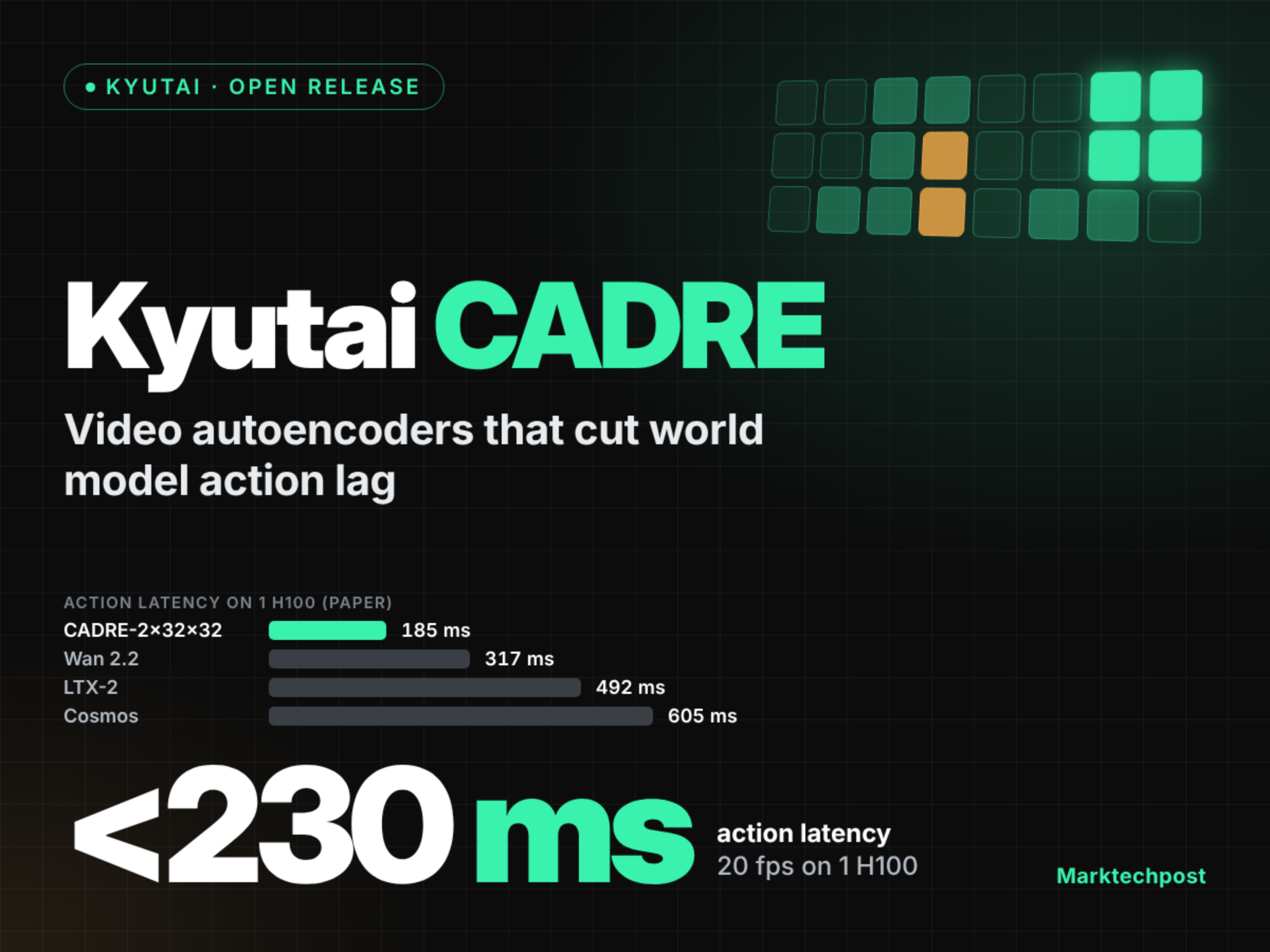
Kyutai releases the CADRE video autoencoder family: designed for interactive world models, with end-to-end action latency reduced to below 230 milliseconds.

On October 23, 2026, Kyutai unveiled CADRE—a family of seven open-source causal diffusion-based video autoencoders designed to reduce action latency in world models. On a single H100 GPU, measured response latency was as low as 185 ms, with inference throughput reaching 23.4 fps, and the scene FVD metric dropping to 162.6 (compared to 599.7 for Wan 2.2). However, in robotic manipulation tasks, its action following rate (ARR) lagged behind both Wan 2.2 and Cosmos.

Kyutai CADRE: Video Autoencoders That Cut World Model Lag Below 230 ms
Timeline and related coverage

Amazon SageMaker AI has launched a Multi-Step Reinforcement Learning (MTRL) framework, supporting end-to-end training of agents to accomplish multi-step tasks.

AWS has launched the Multi-Turn Reinforcement Learning (MTRL) feature, enabling users to train large‑model agents on SageMaker AI using full task trajectories and final outcome feedback, without requiring step‑level annotations. A end-to-end demonstration is provided using Wordle as an example, covering AgentCore deployment, data preparation, GRPO training, reward design, and cost analysis.

Timeline and related coverage

Amazon QuickSight’s layered maps now support GeoJSON point and line features, enabling the visualization of locations and routes together.

Amazon QuickSight’s layered maps now support the GeoJSON formats for Point and LineString geometries, enabling users to overlay store locations, delivery routes, or flight trajectories on the same map. This capability requires no third-party services, but it does demand that GeoJSON files adhere to the proper structure, with matching keys and static updates.

Timeline and related coverage

Black October: A Comprehensive Overview of the AI-Driven Cybersecurity Crisis—From Its Peak to Defensive Response

Around October 21–22, 2026, over a span of approximately 48 hours, more than a dozen high‑severity AI‑related vulnerabilities and intrusion incidents were reported worldwide, including PHP2Shell, GitLab RCE (CVSS 10), NGINX/HTTP/3 DoS, LiteLLM password theft, eMudhra CA key leakage, and Quest Diagnostics medical data exposure. State actors such as Storm‑0940 leveraged open‑source intelligent penetration‑testing frameworks like ARTEX to launch large‑scale attacks. Concurrently, AI security defense systems were rapidly being developed, encompassing formal verification, open‑source patching agents, standardization of agent capabilities, and hardware‑level optimizations.

Timeline and related coverage

Microsoft’s MAI-DxO system achieves 83% accuracy in diagnosing complex cases, but most of the improvement stems from the underlying large model.

According to research published in Science, Microsoft’s AI diagnostic system MAI-DxO achieved an accuracy of 83% in simulating the diagnosis of complex cases, significantly outperforming general practitioners at 36%; however, analysis indicates that this performance improvement stems primarily from the advanced foundation models it leverages—such as GPT-5.5—while the marginal gains attributable to its proprietary DxO orchestration architecture are limited, and no clear advantages were observed in routine settings like emergency departments.

Timeline and related coverage

Amazon Quick has obtained HIPAA qualification, but compliance responsibility still rests with the customer.

Amazon Quick is an HIPAA‑compliant service offered by AWS that enables healthcare organizations to process Protected Health Information (PHI) upon signing a Business Associate Agreement (BAA); however, compliance with HIPAA does not equate to full regulatory compliance. Customers must rigorously manage its PHI processing workflows, encryption mechanisms, logging policies, and irreversible configuration requirements.

Timeline and related coverage

Rescale leverages the AWS AI-DLC framework and Strands Agents to rapidly build an AI test traffic-splitting proxy.

Rescale, in collaboration with AWS engineers and leveraging the AI-Driven Development Lifecycle (AI-DLC) methodology, the Strands Agents framework, and Amazon Bedrock (Claude Opus 4.8), completed within five days a production-ready AI test-routing agent designed to automatically classify and route nighttime end-to-end test failures, and rolled out this human-AI collaborative development paradigm across the organization.

Timeline and related coverage

Several leading financial institutions in Europe have adopted open-source large models to build proprietary intelligent systems.

At the GTC Berlin conference, European financial institutions including Revolut, Starling Bank, Lloyds, and Santander announced that they are building production‑grade AI capabilities based on NVIDIA’s accelerated computing platform and open‑source weight models—such as PRAGMA, the Nemotron series, and the Kumo family—covering core use cases like trading analytics, speech recognition, fraud detection, and data pipeline acceleration, while emphasizing data sovereignty, cost control, and compliant deployment.

Timeline and related coverage

NVIDIA Cosmos Platform Upgrade: New Toolchain for Training, Evaluating, and Deploying World Models

NVIDIA has expanded the Cosmos platform by introducing the Cosmos Data Factory blueprint, the Cosmos Framework training optimization tool, and the Cosmos 3 NIM microservice, supporting multimodal data generation, adaptation to open-source world models (such as GR00T and QWEN), and low-latency inference; real-world applications have already been deployed by Porsche, ANYbotics, Ultralytics, ADNOC, and others.

Timeline and related coverage

NVIDIA’s open-source models are helping to bring AI projects in the public sector to fruition across multiple European countries.

NVIDIA, in collaboration with governments and technology partners across multiple European countries, is advancing sovereign, controllable AI applications—leveraging open-source large models such as Nemotron and synthetic persona datasets—in Germany, Poland, the United Kingdom, France, Greece, and other nations. These efforts span areas including medical image analysis, employment services, digital government assistants, classified information processing, and localized language modeling.

Timeline and related coverage

Google I/O 2026 unveiled AI research and health tools such as Gemini for Science, WeatherNext, and Antigravity 2.0.

At the I/O 2026 conference, Google’s research team unveiled a series of AI systems aimed at scientific discovery, climate forecasting, healthcare, and edge computing, including the multimodal research assistant Gemini for Science, WeatherNext for hurricane early warning, the self‑building operating system platform Antigravity 2.0, and the open‑source quantum chip Willow, among others. All these developments are experimental demonstrations, with no independent validation or regulatory approval yet.

Timeline and related coverage