
Skip to content
AI NEWS JOURNAL
AI, IN PERSPECTIVE

Search AI news

Search headlines, summaries and articles to connect the dots.

Newest first

NVIDIA has released the open-source small language model Nemotron 3.5 Bolt E4B 4GB, optimized for on-device voice assistants, game NPCs, and robots.

NVIDIA, leveraging Google’s Gemma 4 E4B model and employing only reinforcement learning (RL) for post-training, has launched Nemotron 3.5 Bolt E4B 4GB—a small open-source language model with 8B total parameters, 4B effective parameters, and a 64K context window. It is designed to run on edge devices such as RTX and Jetson with approximately 4GB of VRAM, supporting multi-turn tool calls and low-latency voice interaction.
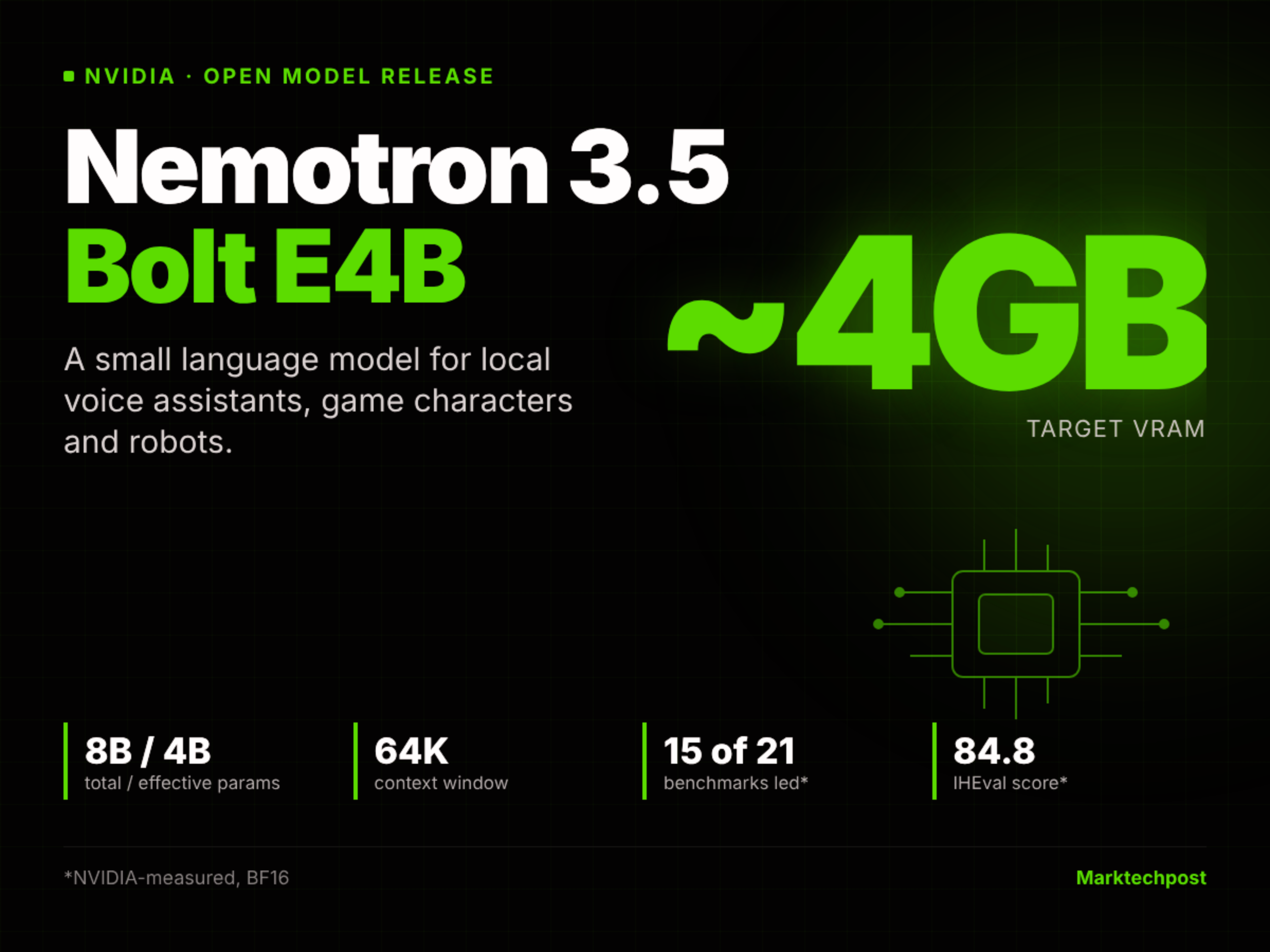
NVIDIA Releases Nemotron 3.5 Bolt E4B 4GB: An Open Small Language Model for Local Voice Agents, Game Characters and Robots
Timeline and related coverage

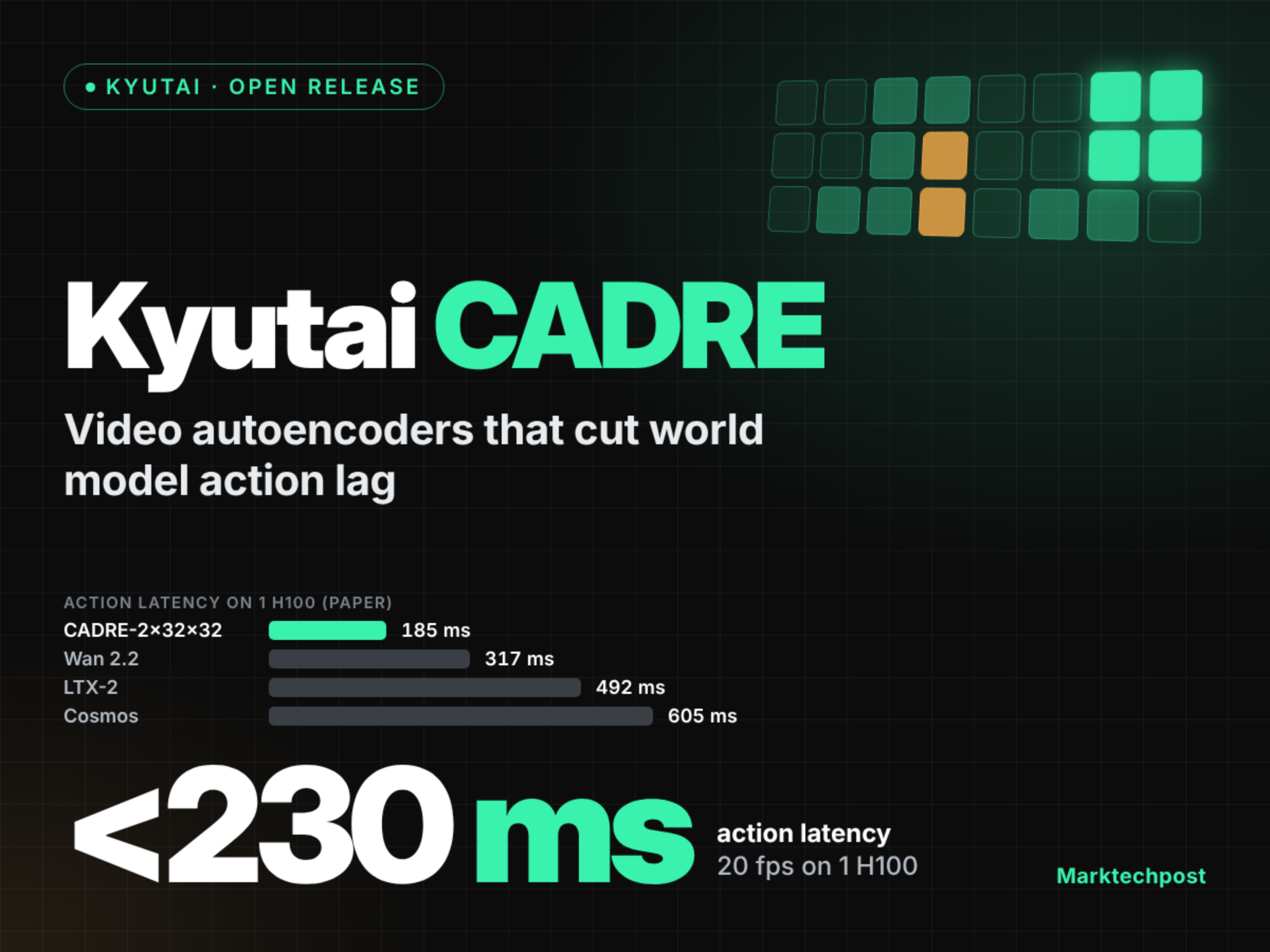
Kyutai releases the CADRE video autoencoder family: designed for interactive world models, with end-to-end action latency reduced to below 230 milliseconds.

On October 23, 2026, Kyutai unveiled CADRE—a family of seven open-source causal diffusion-based video autoencoders designed to reduce action latency in world models. On a single H100 GPU, measured response latency was as low as 185 ms, with inference throughput reaching 23.4 fps, and the scene FVD metric dropping to 162.6 (compared to 599.7 for Wan 2.2). However, in robotic manipulation tasks, its action following rate (ARR) lagged behind both Wan 2.2 and Cosmos.

Kyutai CADRE: Video Autoencoders That Cut World Model Lag Below 230 ms
Timeline and related coverage

inDrive, in partnership with Pony.ai and NVIDIA, plans to launch autonomous taxi trials in Astana, the capital of Kazakhstan, in the first half of 2027.

Ride-hailing platform inDrive has signed memorandums of understanding with Pony.ai and NVIDIA, planning to launch Gen-7 autonomous taxi trials in Astana, the capital of Kazakhstan, in the first half of 2027. Initially, these vehicles will be equipped with safety drivers, with the ultimate goal of achieving fully driverless operation; NVIDIA will provide AI technology support, including the Hyperion platform and the Halos safety system.

Timeline and related coverage

GTC Berlin 2026: Jensen Huang’s keynote comprehensively unveils the AI factory, security agents, and Europe’s AI ecosystem strategy.

At the GTC Berlin 2026 conference held at Berlin’s Tempodrom, NVIDIA CEO Jensen Huang unveiled several key advancements: the DSX POD modular AI factory, the Vera Rubin full-stack AI agent platform, the OpenShell security architecture, the Agent Knowledge Foundation knowledge layer, and the Agile ONE SN humanoid robot reference platform. He also announced a European AI investment commitment exceeding €10 billion, spanning more than 12,000 partners, while emphasizing that Europe is accelerating the development of an independent, controllable AI economic infrastructure.

Timeline and related coverage

NVIDIA launches SimReady Central: an open-source, simulation-ready 3D asset library for robotics and AI factories.

NVIDIA, in collaboration with Hugging Face, has launched SimReady Central, a free and open-source simulation-ready (SimReady) 3D asset library built on OpenUSD. The initial release includes over 2,000 validated industrial-grade assets, covering robot bodies, end-effectors, AI factory infrastructure, and more, enabling developers to rapidly build physics-based AI training environments and digital twin scenarios.

Timeline and related coverage