Skip to content
AI NEWS JOURNAL
AI, IN PERSPECTIVE

Search AI news

Search headlines, summaries and articles to connect the dots.

Newest first

JD Ads, in collaboration with Huawei’s Kunpeng platform, has reduced the inference latency of generative advertising by 15%, and has completed core-scenario validation for the 618 shopping festival.

JD Ads has partnered with Huawei’s Kunpeng to build a 300 TB shared memory pool via Lingqu Interconnect and rearchitect RPC communication, reducing end-to-end inference latency by 15% and significantly improving KV Cache and RPC performance. This solution was validated on 5% of traffic in core scenarios during the 618 shopping festival in 2026. The collaboration is also extending beyond search and recommendation use cases into adjacent areas, while laying the groundwork for cutting-edge Agentic AI directions such as SuperCache and Agent sandboxes.

Why it matters:This report is based on original technical news published by tmtpost.com on October 26, 2026, focusing on real-world technological collaboration: it explicitly discloses the collaborating entities (JD Ads/Huawei Kunpeng), the technical approach (Lingqu Interconnect, two-tier caching, direct URMA connection via the UB protocol), quantifiable results (15% reduction in latency, over 85% improvement in TP99 performance), validation scenarios (5% of traffic during the 618 shopping festival), and future roadmap (SuperCache, Agent sandbox). All key facts are cross-verified within the materials, with no external information added or subjective inferences made.

Timeline and related coverage

Tsinghua University and The Chinese University of Hong Kong jointly open-source AKV: an engineering service system for KV caching tailored to LLM agents.

On October 26, 2026, researchers from Tsinghua University and the Chinese University of Hong Kong open-sourced AKV—a KV cache engineering server built on SGLang and specifically designed for large language model (LLM) agents. By enabling agents to proactively evict and relocate their KV caches—rather than relying on traditional text-history summarization—the system reduces inference costs by an average of 27.7% across four agent benchmarks and improves task scores by 1.7 points on average. The code is licensed under the Apache-2.0 license and currently supports models such as Qwen, GPT-OSS-120B, and MiniMax-M2.7.
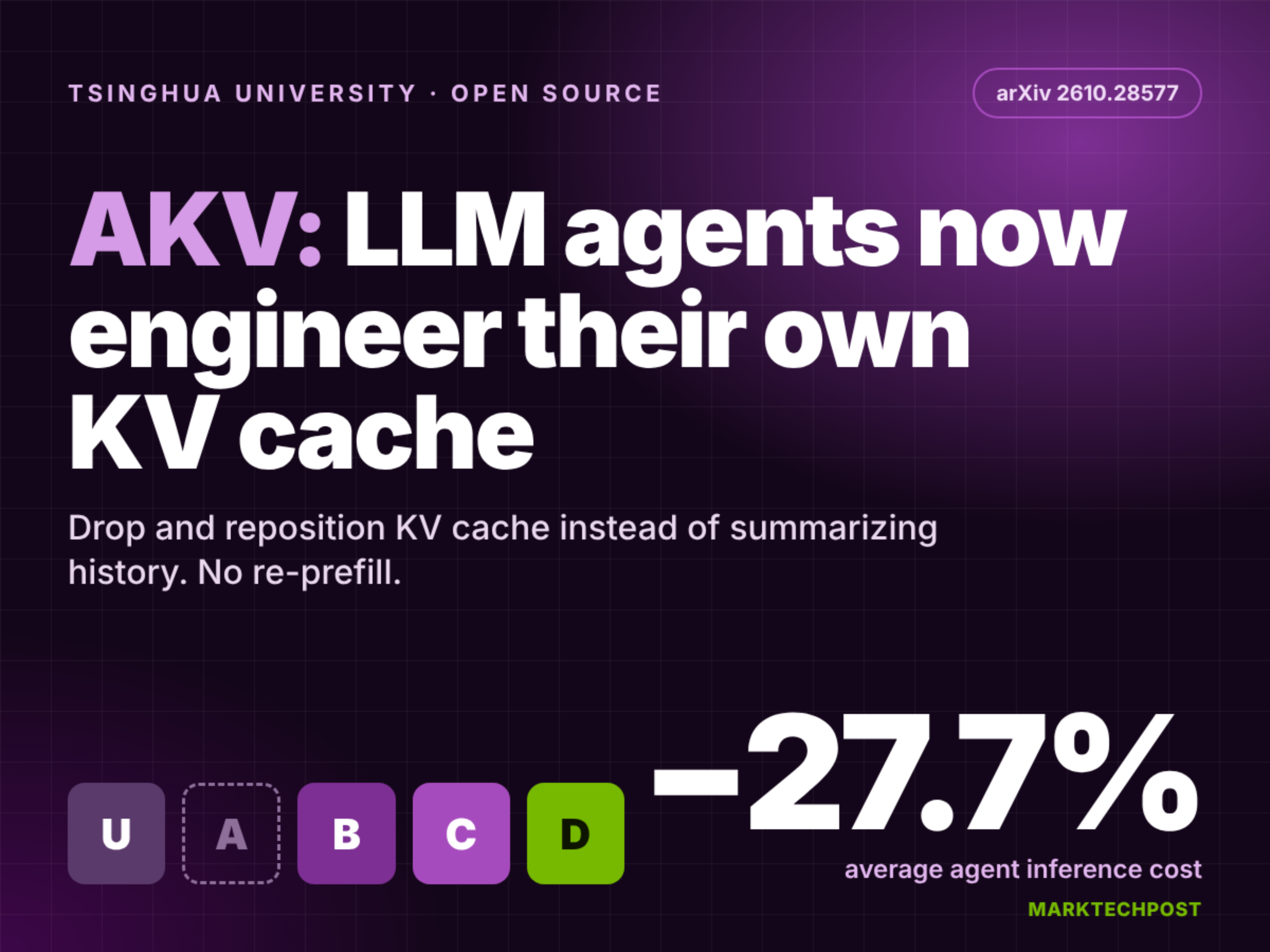
Tsinghua AI Open-Sources AKV, a Cache Engineering Server for LLM Agents on SGLang

Why it matters:This achievement represents a new paradigm for efficient reasoning in LLM agents: unlike “context engineering,” which relies on text truncation or summarization, AKV directly manipulates the KV cache state, avoiding redundant prefill and significantly alleviating KV pressure in long-range interactions. Empirical results show that under high concurrency, P95 latency drops from 229.9 seconds to 30.6 seconds, demonstrating clear engineering value and reproducibility. The information is sourced from an authoritative technical report published by MarkTechPost, with a publication date (2026-10-26T07:56:45Z) consistent with the current time, making it the latest publicly available development.

Timeline and related coverage

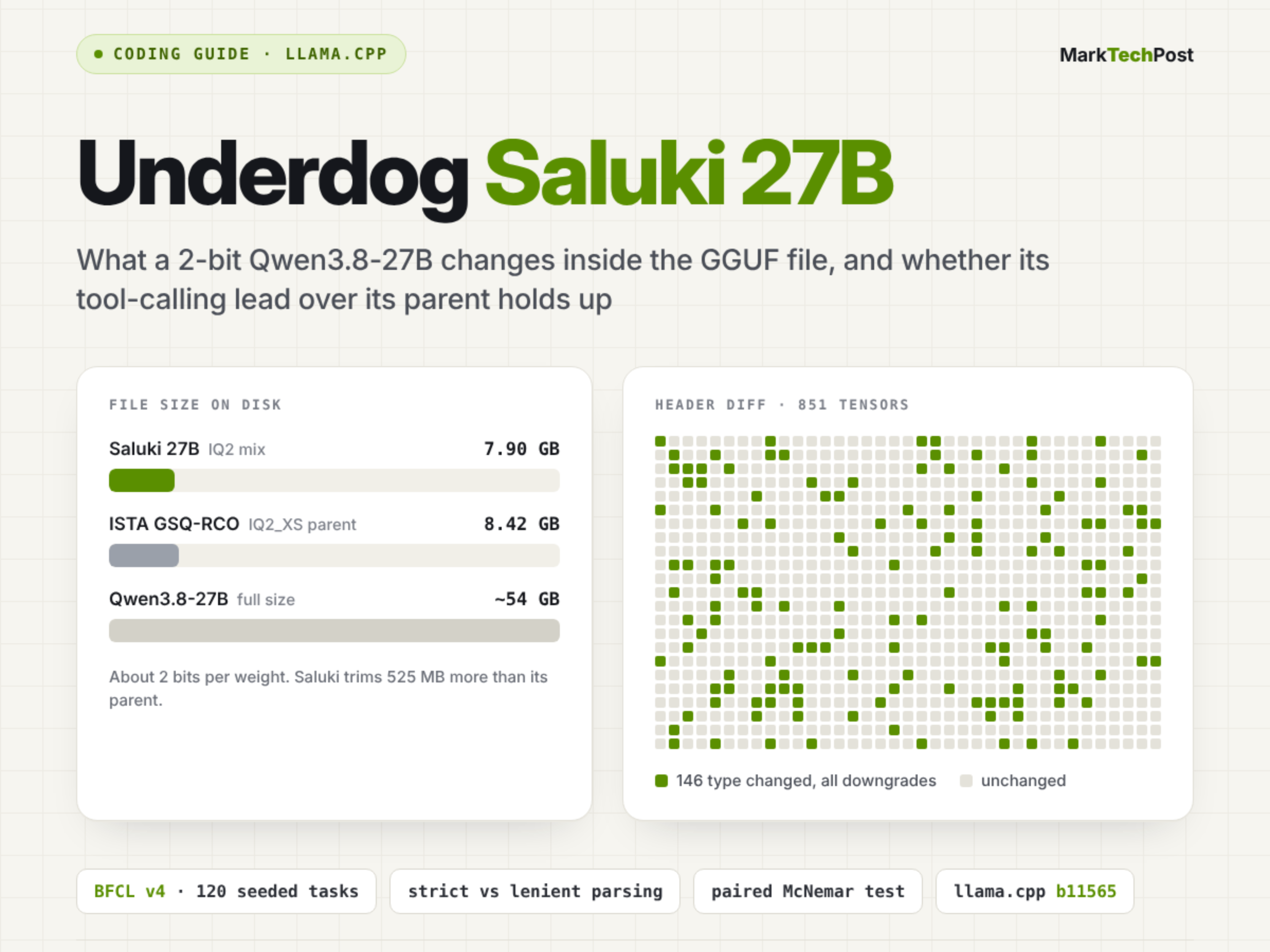
Underdog Saluki 27B: Technical Analysis of the 2-bit Qwen3.8-27B Tool-Calling Model Based on GSQ-RCO

This article introduces Saluki 27B, a model released by Underdog—a 7.9 GB, 2-bit quantized variant of Qwen3.8-27B—built using the GSQ-RCO method from ISTA-DASLab. It claims to outperform the original 54 GB full-precision model on the BFCL v4 benchmark across 120 tasks; however, all performance conclusions are based solely on the developers’ assertions and have not been independently verified.

How to Run Underdog Saluki 27B: 2-Bit Qwen3.8-27B Tool-Calling Guide
Timeline and related coverage

AnyLanguageModel 1.0 released: a unified Swift interface supporting both local and hosted models, compatible with the entire Apple platform family of operating systems 27

Hugging Face has officially released AnyLanguageModel 1.0, an open-source Swift framework fully compatible with the Apple Foundation Models API. It supports seamless switching between local models (MLX, llama.cpp, Core ML) and hosted models (OpenAI, Anthropic, Gemini, Hugging Face Inference Providers, etc.), and introduces new features such as image input, tool invocation, guided generation, and automatic adaptation of inference chunks.

Timeline and related coverage