
Skip to content
AI NEWS JOURNAL
AI, IN PERSPECTIVE

Search AI news

Search headlines, summaries and articles to connect the dots.

Newest first

b11877

vulkan: Add a larger tile size for conv3d (coopmat2 only) (#29920) * vulkan: Add a larger tile size for conv3d (coopmat2 only) This adds a larger tile size, in practice it is only for coopmat2 where we don't need shared memory to store the output (would use more than 64KB). Add some additional representative backend tests. At least, this is what codex came up with from looking at sd.cpp Wan VAE. * only apply large tile size for newer driver versions **Website:** - **Attestations:** - **macOS/iOS:** - [macOS Apple Silicon (arm64)](https://github.com/ggml-org/llama.cpp/releases/download/b11877/llama-b11877-bin-macos-arm64.tar.gz) - macOS Apple Silicon (arm64, KleidiAI enabled) [DISABLED](https://github.com/ggml-org/llama.cpp/pull/23780) - [macOS Intel (x64)](https://github.com/ggml-org/llama

Timeline and related coverage

Panel manufacturers are collectively raising prices to cope with upstream cost pressures driven by AI, but downstream acceptance remains low, putting pressure on end-product quality control.

Starting in September 2026, panel manufacturers such as TCL CSOT, BOE, and HKC have issued price‑increase notices one after another. The primary reason is the rapid growth of AI large models, which has led to a sharp surge in demand for HBM, squeezing capacity for mature‑process chips and driving up the prices of key components like driver ICs, PCBs, and glass substrates. Upstream suppliers, including Corning, have also raised their prices in tandem. Despite clear cost pressures, downstream TV and monitor brands have yet to broadly increase purchase prices, while end users continue to report frequent quality‑control issues such as overheating and black spots. As a result, these price hikes have not yet translated into actual sales or improved user experiences.

AI大模型狂飙,面板行业也扛不住了

Why it matters:The materials system reveals the cross‑chain transmission mechanism through which the AI industry impacts indirectly related hardware sectors—rather than driving panel demand directly, it triggers a full‑chain cost repricing via the reallocation of wafer‑fabrication capacity. At the same time, it highlights a significant gap between price‑increase behavior and actual market feedback (price rigidity, declining shipments, and user complaints), underscoring the deep‑seated contradiction between industry bargaining power and product competitiveness.

Timeline and related coverage

Global Experiences That the U.S. Anti-Data-Center Movement Can Learn From: From Ireland’s Grid Crisis to New Zealand’s Community AI Initiatives

In his book “Hyper-Scale,” Paris Marx traces the history of resistance within global data centers, noting that Ireland imposed a ban due to grid capacity saturation, prompting companies to build their own gas-fired power plants; meanwhile, New Zealand is exploring a non-exploitative AI pathway by leveraging local cloud services to support Māori-language speech recognition; and the wave of opposition currently sweeping the United States is, in fact, a reenactment of long‑foreseen global tensions.

Timeline and related coverage

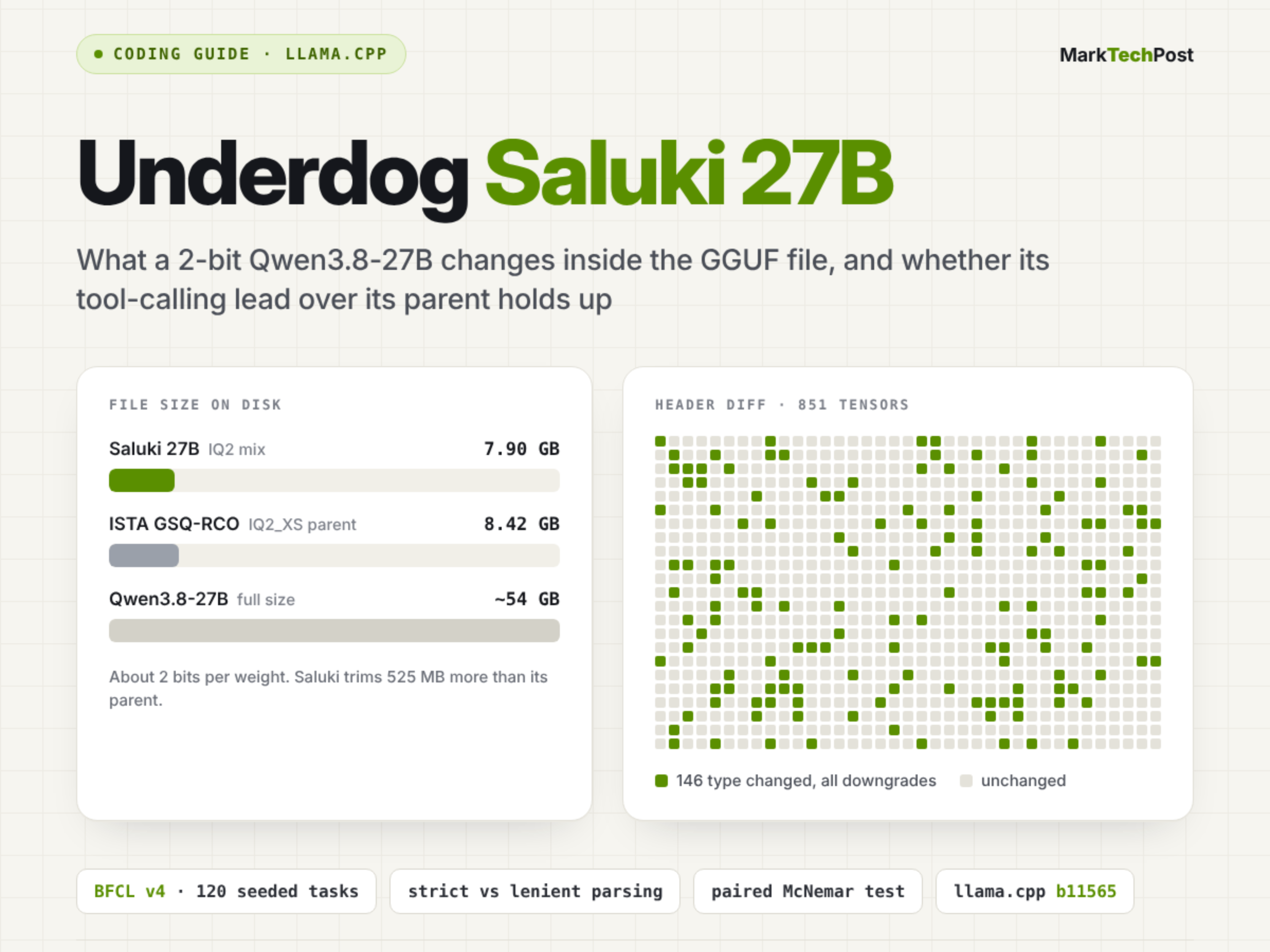
Underdog Saluki 27B: Technical Analysis of the 2-bit Qwen3.8-27B Tool-Calling Model Based on GSQ-RCO

This article introduces Saluki 27B, a model released by Underdog—a 7.9 GB, 2-bit quantized variant of Qwen3.8-27B—built using the GSQ-RCO method from ISTA-DASLab. It claims to outperform the original 54 GB full-precision model on the BFCL v4 benchmark across 120 tasks; however, all performance conclusions are based solely on the developers’ assertions and have not been independently verified.

How to Run Underdog Saluki 27B: 2-Bit Qwen3.8-27B Tool-Calling Guide
Timeline and related coverage

llama.cpp releases version b11868: enhanced Hexagon NPU multi-core Flash Attention support, with cross-platform compilation and build capabilities.

llama.cpp v2.45.0 (tag b11868) has been officially released, with the core update being the introduction of a KV-head splitting mechanism in the Hexagon backend to optimize multi-core HMX Flash Attention performance and unify the FA splitting control flag. Binary packages are simultaneously available for all major platforms, including macOS, Linux, Windows, Android, iOS, and openEuler, supporting multiple backends such as CUDA 12/13, Vulkan, ROCm, OpenVINO, SYCL, and Snapdragon (Adreno + Hexagon).

Timeline and related coverage

llama.cpp releases version b11867: server-side entry point refactored, with full support for multiple platforms and heterogeneous acceleration backends.

llama.cpp has officially released version b11867 on GitHub. Key changes include a refactored server entry point (PR #31113) and the addition of the server_role mechanism. Additionally, more than 40 precompiled binaries are now available, covering macOS, Linux, Windows, Android, iOS, and openEuler, with support for diverse hardware backends such as CPU, CUDA (12.4/12.8/13.4), Vulkan, ROCm 10.0, OpenVINO, SYCL (FP16/FP32), and Snapdragon (Adreno + Hexagon).

Timeline and related coverage

llama.cpp releases version b11865: adds RDMA receive boundary checking and supports multiple platform backends, including CUDA 13.4, ROCm 10.0, and Snapdragon NPU.

The llama.cpp project has released build version b11865, with core changes including the addition of memory-boundary checks in the RDMA receive logic (PR #30399) and a significant expansion of hardware-acceleration support, covering CUDA 13.4, ROCm 10.0, Vulkan, OpenVINO, SYCL, and Qualcomm Snapdragon—providing full-stack heterogeneous computing backends for CPU, Adreno, and Hexagon. macOS KleidiAI support and openEuler builds have been explicitly marked as DISABLED.

Timeline and related coverage

llama.cpp releases version b11861: fixes an inference exception caused by the minimax-m3 model’s quantized scaling tensor not being propagated.

llama.cpp v.b11861 fixes the weight distortion issue in the minimax-m3 model that occurred under NVFP4/MXFP8 quantization due to the scale tensor not being injected into the computation graph, thereby preventing “token soup” and residual vanishing; it also provides multi-platform binary builds covering macOS, Linux, Windows, Android, iOS, and openEuler.

Timeline and related coverage

Intel has received an exemption from the U.S. FCC’s ban on foreign-made robots, in order to ensure automated logistics at its chip fabs.

On October 22, 2026, the U.S. Federal Communications Commission (FCC) granted Intel a one-year exemption, allowing it to continue using certain foreign‑made automated guided vehicles (AGVs) at its U.S. semiconductor fabs, as the original ban’s vague wording could inadvertently affect critical semiconductor manufacturing equipment.

Timeline and related coverage

Kazakhstan is accelerating the development of its AI computing infrastructure, and Firebird has obtained U.S. export approval to deploy 45,000 NVIDIA Grace Blackwell GPUs.

Kazakhstan’s AI ecosystem is transitioning from the planning phase to large-scale deployment. Firebird has obtained U.S. export licenses to build an AI factory in Kazakhstan, with the first phase deploying 45,000 NVIDIA Grace Blackwell GPUs. Kazakhtelecom has already brought online more than 1,000 H200/B300 GPUs and plans to add over 2,000 Vera Rubin and other GPUs by 2025. Multiple stakeholders are collaborating to advance computing power supply, developer access, and the local implementation of AI applications.

Timeline and related coverage

Amazon SageMaker AI has launched GPU-free managed model training sessions, now generally available.

AWS has announced that SageMaker AI’s serverless model customization feature now includes “Training Sessions,” which are fully available starting today. Users can independently define post-training logic—such as custom loss functions, reward signals, or multi‑round reinforcement learning—while the platform automatically handles GPU allocation, distributed execution, fault tolerance, and checkpoint storage.

Timeline and related coverage

Amazon SageMaker launches the Training Session API: users can write custom training loops for large models without managing GPUs.

Amazon SageMaker has released the Training Sessions API, enabling users to implement custom large-model training workflows—such as SFT, RLHF, GRPO, and KTO—using pure Python scripts. GPU resource scheduling, fault tolerance, distributed execution, and checkpoint management are all handled by the service.

Timeline and related coverage

NVIDIA drives the transformation of Europe’s retail sector: Open models and physical intelligence are being implemented in e-commerce, warehousing, and virtual try-on.

European retailers are leveraging NVIDIA-accelerated open large models and physics‑AI technologies to achieve large‑scale deployment across scenarios such as digital product discovery, intelligent warehouse simulation, virtual try‑on, and accelerated R&D. Companies including Shopify, Zooplus, L’Oréal, and the Otto Group have used tools like the Nemotron series of models, Omniverse digital twins, and ALCHEMI molecular simulations to significantly reduce inference costs, improve search accuracy, shorten R&D cycles, and validate improvements in conversion rates and sales growth.

Timeline and related coverage

Jas Kaira, Head of AI Business at Blackstone: Concerns about AI infrastructure debt are exaggerated.

Jas Kaira, head of Blackstone’s AI business, stated at the TechCrunch Disrupt conference that market panic over massive debt in the AI infrastructure sector has been overly amplified. His key argument is that this debt is largely backed by long-term contracts with high‑credit‑rating clients—such as Microsoft and Meta—and that the underlying assets (e.g., GPUs) possess strong collateral value, meaning the risk profile differs fundamentally from that of the 2008 banking system.

Timeline and related coverage

VocabX: Reduces the inference cost of domain-specific small language models by 77% through cost-weighted vocabulary specialization.

Dharma-AI has introduced the VocabX method, which reconfigures the vocabulary of language models for specific tasks—such as automated scoring of Portuguese essays—by optimizing for cost rather than word frequency. Without modifying the model architecture, parameters, or training pipeline, empirical results show a 77% reduction in inference costs, while the evaluation score (bench score) improved from 0.703 to 0.810.

Timeline and related coverage

TorchNeuron System-Level Performance Analysis (Part 1): End-to-End Profiling Based on the AWS Trainium Chip

This article is the first in a series of technical blog posts jointly published by Hugging Face and Amazon, systematically introducing how to use TorchNeuron on AWS Trainium AI accelerator chips for PyTorch model inference performance analysis. It covers the principles of Neuron backend integration, methods for configuring torch.profiler, the use of NeuronConfig and NeuronProfiler tools, and visualized tracing with Neuron Explorer. Additionally, using RMSNorm as an example, it compares the device‑time differences among three implementations: plain PyTorch, the built-in torch.rms_norm fusion, and torch.compile’s automatic fusion.

Timeline and related coverage