Skip to content
AI NEWS JOURNAL
AI, IN PERSPECTIVE

Search AI news

Search headlines, summaries and articles to connect the dots.

Newest first

DraMaze: A Multi-Agent Pipeline with Future-Aware Memory for Diverse Microdrama Script Generation

arXiv:2610.32002v1 Announce Type: new Abstract: The rapid growth of microdramas has increased demand for high-quality script production. Long-form microdrama script generation with LLMs requires both diverse plot progression and long-range narrative coherence. Our observations reveal that candidate continuations increasingly concentrate on fewer narrative mechanisms as generation progresses, while conventional retrieval may reinforce trope reuse and overlook historical information essential to future plots. To address these challenges, we propose DraMaze, a multi-agent pipeline that explores diverse causal paths through trope memory-guided evolutionary tree search and mutation. It further constructs a Backward Narrative Dependency Tree to organize, retain, and retrieve historical memories

Timeline and related coverage

Permission to Retry: A Study of Authorization and Recovery in AI Agent Workflows

arXiv:2610.31916v1 Announce Type: new Abstract: A durable agent can resume a consequential action while its authority changes and the action's external outcome remains uncertain. We study execution-time reliability of tool-using AI agents, isolating recovery decisions from language-model behavior. Checkpoint state, permission to dispatch, evidence of an external effect and permission to reconcile are distinct obligations. We present a finite conformance study that checks these obligations through histories scored against a provider effect ledger hidden from the recovering application. A prospectively frozen campaign executes 336 histories on native LangGraph and Temporal hosts, crossing 14 schedules, three provider contracts and four matched application policies. All 168 paired host cells

Permission to Retry: A Study of Authorization and Recovery in AI Agent Workflows
Timeline and related coverage

Understanding Communication Failures in Multi-Agent LLM Systems

arXiv:2610.32060v1 Announce Type: new Abstract: Multi-agent LLM systems aim to improve reasoning through debate, evidence sharing, and mutual correction, but interaction can also introduce failures that final accuracy alone cannot explain. Agents may converge too early, ignore dissent, suppress correct minority answers, or preserve a wrong framing across rounds. We present a corpus-grounded taxonomy of communication failures, built from 3,211 failed multi-round trajectories across medical QA, coding, finance, multi-hop reasoning, ethics, and embodied text tasks. Using this taxonomy, we analyze failure distributions across datasets and system designs, round-level error dynamics, recovery hardness, majority transitions, minority-signal suppression, and self-reported confidence. We find that

Timeline and related coverage

LangChain releases the five core components of its “Enterprise-Level Agent Framework”

On October 25, 2026, LangChain published a blog post systematically outlining the five universal architectural principles it has distilled from deploying AI agents (GTM Agent, OpenSWE, Content Studio) within its marketing, sales, and engineering teams: native integration with the work environment (Slack), a dynamic identity model (OBO + fixed credentials), a two-tiered memory mechanism (global/user-level), sandboxed code execution, and a high proportion of scheduled operations (not manually triggered). All agents are built on the Managed Deep Agents platform.

Why it matters:This information originates from the official LangChain blog, published on 2026-10-25T18:06:32.000Z—earlier than the current system time of 2026-10-25T23:01:18.857Z. The content focuses on implemented internal agent practices, with specific details such as Slack thread isolation, GitHub account attribution logic, and tiered permissions for Notion/Twitter, without including unverified predictions or external claims, thus meeting requirements for timeliness and factual accuracy.

Timeline and related coverage

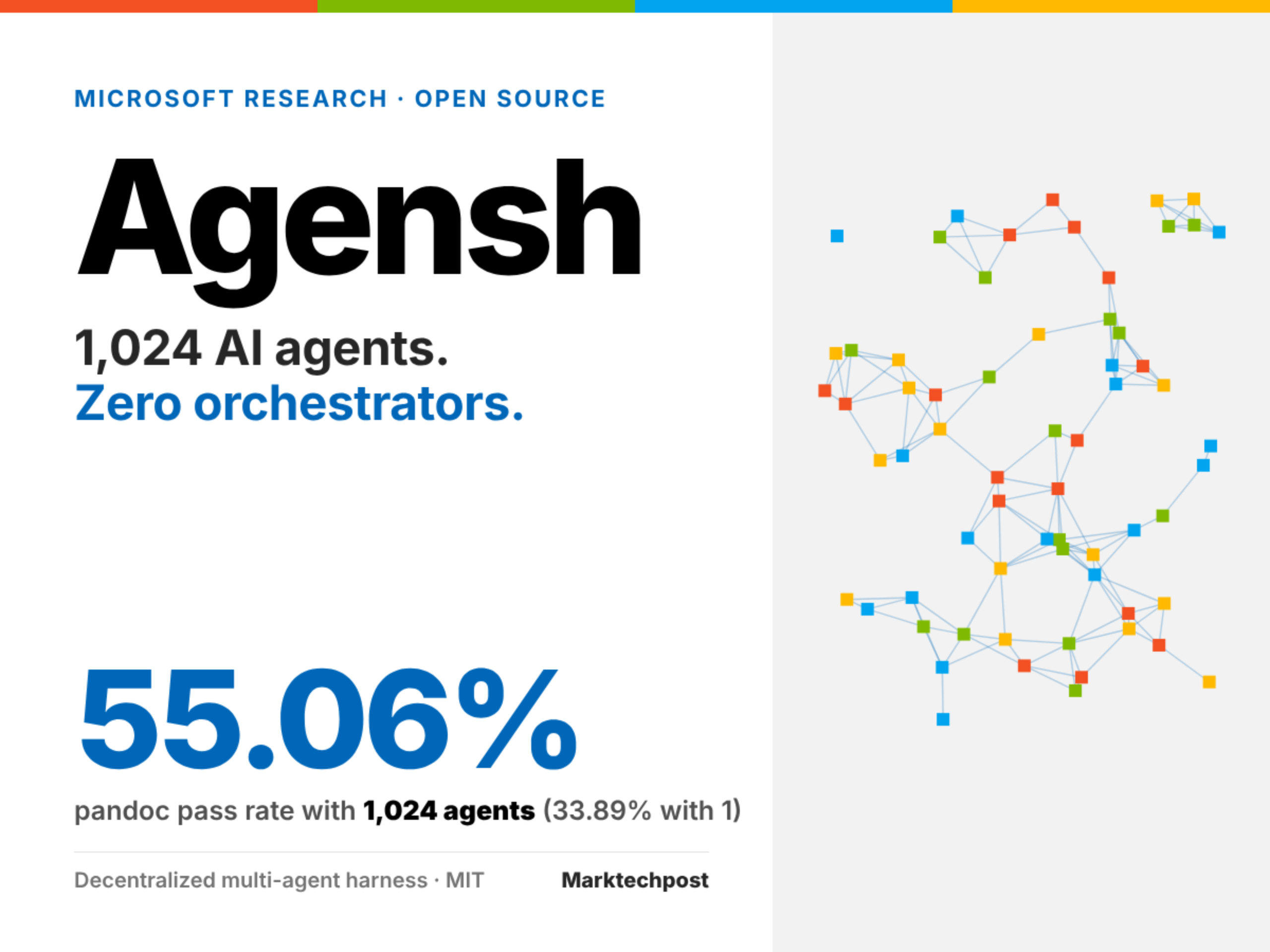
Microsoft open-sources Agensh: a decentralized framework that supports 1024 autonomous, collaboratively operating AI coding agents.

On October 25, 2026, Microsoft Research open-sourced Agensh, a multi-agent runtime framework that operates without a central coordinator, enabling 1 to 1,024 LLM-powered coding agents to self-organize and collaborate on ProgramBench. The system achieves decentralized coordination through shared dashboards inspired by Gitea, Mattermost, and DeLM, with all agents following the same prompt-driven five-step loop; its scalability has been validated in a Linux + Docker environment.

Microsoft Open-Sources Agensh: A Multi-Agent Harness for 1,024 Agents

Why it matters:This achievement represents a significant evolution in multi-agent system architectures—abandoning the traditional “master‑agent” paradigm and enabling large‑scale self‑organization through prompt engineering and lightweight service composition. Empirical results on ProgramBench (e.g., 128 agents achieving a 49% improvement in task load balancing across five tasks) establish a new benchmark for distributed AI engineering. Released under the MIT License and compatible with mainstream single‑agent tools such as Copilot CLI, it offers valuable guidance for practical development.

Timeline and related coverage

Bayer Crop Science has built the multi-agent decision-making engine ADE based on Amazon Bedrock AgentCore.

Bayer Crop Science has built the Agentic Decision Engine (ADE) on Amazon Bedrock AgentCore—a natural-language multi-agent platform for breeding experts, analysts, and researchers—as an enhancement layer rather than a replacement for its existing Connected Decision Engine (CDE). The system is now live in production, serving over 100 R&D users and enabling approximately 80% of issues to be resolved independently through 22 domain-specific agents and about 20 API tools.

Timeline and related coverage

Deep Insight: How AWS’s Open-Source Multi-Agent System Addresses Five Major Production-Grade Challenges

AWS Solutions Architecture Team has launched Deep Insight, an open-source multi-agent system designed for automated CSV data analysis and natural-language report generation. It systematically addresses five common challenges in production environments—agent orchestration, role-based model selection, stable operation, secure code execution, and observability—and has been validated in real-world scenarios such as LG Electronics and the re:Invent 2025 TechRecon.

Timeline and related coverage

AWS releases the Adaptive Agent Framework (AAIF): a hierarchical AI task scheduling solution that enables edge-cloud collaboration based on Strands Agents.

AWS has introduced the Adaptive Agentic Intelligence Framework (AAIF), which leverages Strands Agents to build a hierarchical agent architecture. It dynamically routes tasks via local small language models (SLMs): routine IoT telemetry and visual analytics are executed at the edge, while complex reasoning is offloaded to Amazon Bedrock’s large cloud-based models. The framework supports hybrid deployment, keeps costs under control, and incorporates responsible AI governance recommendations; however, it currently exists as a proof-of-concept implementation and does not yet provide third-party validation or commercial deployment data.

Timeline and related coverage