Skip to content
AI NEWS JOURNAL
AI, IN PERSPECTIVE

All AI updates

Explore the complete news stream by source, topic and date.

Newest first

Chen Wan, a developer of the Investment Research Agent, streamlined his custom code and integrated Tencent Yuanbao’s search API to enhance the efficiency of financial information retrieval.

On October 26, 2026, Chen Wan, the creator of the paid research briefings for the new energy industry chain, deleted the two-year‑maintained cleaner.py (web‑page cleaning script) and sites.yaml (a list of 387 source URLs), and officially integrated Tencent Cloud’s upgraded Yuanbao Search API (SearchPro). Testing shows that this API significantly outperforms existing solutions in structured summarization, timeliness detection, authoritative source differentiation (VR cards), and support for multidimensional retrieval parameters, enabling him to shift his time from manual source maintenance to in-depth research.

Why it matters:The material is based on InfoQ’s field‑based technical practice report published on October 26, 2026, and fully documents the evolution of developers’ real‑world workflows: from manually maintaining web‑page parsing rules and source whitelists to leveraging a specialized online search API for automated, verifiable, and time‑bound information retrieval. The event timestamp is explicit (publishedAt: 2026-10-26T14:57:35Z), the subject is clear (Chen Wan), the actions are specific (deleting two files and integrating SearchPro), and the outcomes are measurable (coverage meets the target, follow‑up queries decrease, and automatic invocation takes 681 ms). Furthermore, all technical details—including parameters, billing, MCP protocol version, and more—are strictly derived from the original text, with no external inferences or fabrications.

Timeline and related coverage

GHARP: Real-Time Gaussian Head Animation from Large-Scale Reconstruction Prior

We present GHARP (Real-time Gaussian Head Animation from Large-scale Reconstruction Prior), a method that animates 3D human heads in real time from a few input images of a subject and a driving expression signal. We decouple the problem into an identity stage that builds a representation of the subject’s geometry and appearance offline, and an animation stage that predicts expression-dependent residuals on top of it at runtime. This separation offers a favorable trade-off with respect to fidelity, quality and runtime: the identity stage can be expensive while the animation stage runs a…

Timeline and related coverage

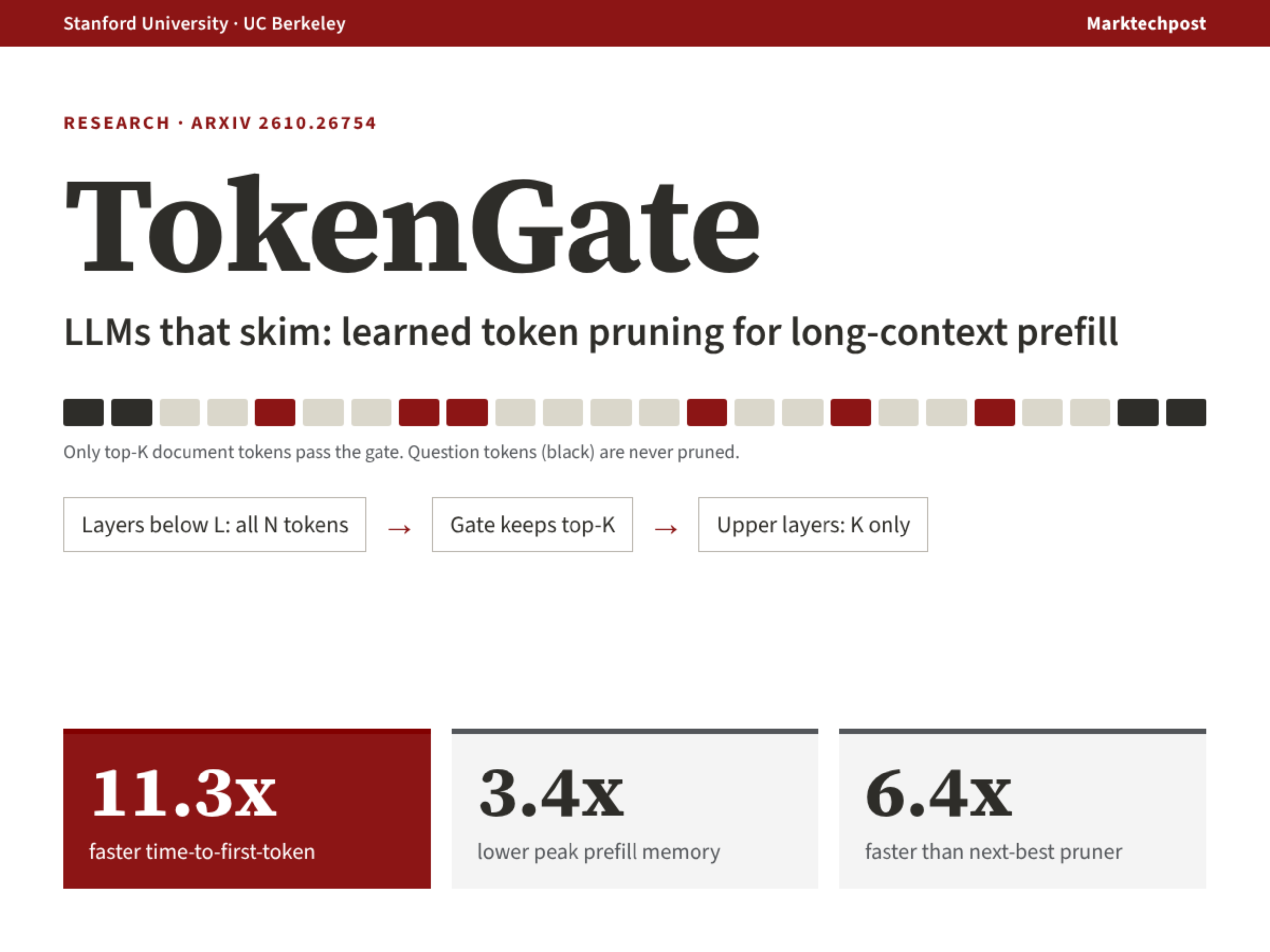
Researchers from Stanford and UC Berkeley Introduce TokenGate: Token-Gated Attention Makes Long-Context Prefill Up to 11.3x Faster

Researchers from Stanford University and the University of California, Berkeley have introduced TokenGate—a plug-and-play, learnable token-pruning module designed for existing large language models (LLMs). This approach accelerates the first-token generation time (TTFT) for long-context prefill by 1.4 to 11.3 times without sacrificing accuracy, while reducing peak memory usage by 1.5 to 3.4 times. The associated code and checkpoints have been made open source.

Researchers from Stanford and UC Berkeley Introduce TokenGate: Token-Gated Attention Makes Long-Context Prefill Up to 11.3x Faster
Timeline and related coverage

Google’s AI search feature deals a severe blow to the online publishing industry: traffic plummets, lawsuits abound, and compensation mechanisms are only just being explored.

In 2024, Google launched AI Overviews, and in May 2025 it rolled out AI Mode, causing a significant drop in search traffic from Google across several major media outlets—The New York Times saw its share of search traffic fall from 44% to 35.5% over three years. Among DCN members, 19 experienced traffic losses ranging from 1% to 25% in May–June 2025, with DMG Media reporting a peak decline of 89% in click-through rates. Publishers filed multiple lawsuits, but all were dismissed by U.S. judges; Google subsequently introduced an opt-out option, enhanced source attribution, and launched a news AI pilot involving 400 media organizations, along with a content‑paying test program.

Google’s AI search changes upended online publishing

Why it matters:The report systematically examines the structural impact of Google’s AI-powered search feature on the publishing ecosystem, covering a timeline (2024–2025), empirical data (from third-party institutions), responses from multiple stakeholders (publishers, regulators, courts, and nonprofit organizations), and recent countermeasures (opt-out mechanisms, source optimization, and licensing and paid-access pilots). The content is information-dense, timely, and policy-relevant.

Timeline and related coverage

Sebastian Raschka has released an eight-video course titled “Building a Reasoning Model from Scratch.”

On October 24, 2026, Sebastian Raschka published an eight-part, over-11-hour hands-on video course on Python and PyTorch in Ahead of AI magazine (magazine.sebastianraschka.com), systematically covering the evaluation of inference models, scaling during inference, reinforcement learning (RLVR), and knowledge distillation, with all methods implemented using the pre-trained Qwen3-0.6B model.

Why it matters:This course is the author’s advanced technical educational offering, following “Building Large Language Models from Scratch.” It focuses on the core evolutionary direction of today’s mainstream LLMs—enhancing inference capabilities—covering the entire technical pipeline from setting up the foundational environment to GRPO reinforcement learning and self‑distillation. The author explicitly states that all implementations are “hand‑crafted from scratch,” fully reproducible, and highly instructive with significant engineering reference value.

Timeline and related coverage

Amazon SageMaker AI has launched a Multi-Step Reinforcement Learning (MTRL) framework, supporting end-to-end training of agents to accomplish multi-step tasks.

AWS has launched the Multi-Turn Reinforcement Learning (MTRL) feature, enabling users to train large‑model agents on SageMaker AI using full task trajectories and final outcome feedback, without requiring step‑level annotations. A end-to-end demonstration is provided using Wordle as an example, covering AgentCore deployment, data preparation, GRPO training, reward design, and cost analysis.

Timeline and related coverage

IskayPet builds a multilingual enterprise knowledge assistant based on the Amazon Bedrock-hosted knowledge base.

Spanish pet-care company IskayPet leveraged Amazon Bedrock Managed Knowledge Bases to build an enterprise-grade knowledge assistant—covering Spain, Portugal, and France, and supporting four languages (Spanish, Portuguese, French, and English)—without needing to develop its own RAG infrastructure. The assistant supports business scenarios such as retail, veterinary care, onboarding, and procurement.

Timeline and related coverage

Flint-interactive: An interactive data visualization programming language for AI agents

Microsoft Research has unveiled Flint-interactive, a domain-specific language for building highly expressive, semantically rich interactive data visualizations. Its compiler automatically maps user interactions—such as clicks and brush selections—to semantic events and uses high-level operators to drive coordinated updates across multiple elements, including charts, tables, and text, significantly reducing the cost and development complexity of creating reliable interactive visualizations with AI agents.

Timeline and related coverage

IBM releases the Granite time-series integration forecasting model: a four-model, zero‑fine‑tuning ensemble that delivers a robust default forecasting solution.

IBM Research has released the open-source Granite Timeseries Ensemble (v1), which integrates four types of pre-trained architectures—PatchTST-FM-r1/r2, FlowState, and Tiny Time Mixers—and supports probabilistic ensemble forecasting with zero fine-tuning. By default, it employs equal-weight probabilistic pooling (Probabilistic Ensemble), while also offering an IQR-based adaptive weighting scheme (IQR Ensemble). On the GIFT-Eval benchmark (as of the October 20, 2026 snapshot), its point forecast error (MASE = 0.683) slightly outperforms that of the best single model, with significantly improved overall robustness.

Timeline and related coverage

OlmoEarth v1.3 Released: A High-Performance Open-Source Satellite Embedding Model for the Global Surface

The Allen Institute for AI has released OlmoEarth v1.3, offering planet-wide satellite embedding vectors at 10-meter resolution in both 64-dimensional and 128-dimensional formats, along with the interactive exploration tool Embeddings Explorer. It supports zero-code change detection, similar-region retrieval, and lightweight classification modeling.

Timeline and related coverage

AI-assisted “blind-scan” ultrasound technology supports maternal and child health care at the grassroots level: A multi-center, prospective study validates its cross-regional generalizability.

Google’s research team, in collaboration with clinical institutions, conducted a prospective multicenter study that demonstrated an AI‑driven “blind‑scan” ultrasound protocol—using low‑cost, portable probes operated by non‑ultrasound specialists—achieved gestational age assessment accuracy comparable to expert‑level ultrasonic biometry in both Chicago and Nairobi (mean absolute error of 4.18 days vs. 4.48 days), without requiring local data fine‑tuning. This offers a viable pathway to expand prenatal ultrasound coverage in resource‑limited settings.

Timeline and related coverage

A 31-year-old unsolved problem in mathematics, the KLS conjecture, has been proven: a fundamental breakthrough has been achieved in high-dimensional geometry and the theory of randomized algorithms.

On October 4, 2026, Zhang Xinzhi, a researcher at Microsoft Research, together with his collaborators, completed a rigorous proof of the Kannan–Lovász–Simonovits (KLS) conjecture, thereby resolving a long-standing central problem that had remained open since its formulation in 1995. This achievement establishes a dimension-independent constant bound for the “plane‑cut bottleneck” in high-dimensional log-concave distributions, providing an unconditional theoretical foundation for random sampling, convex optimization, and theoretical computer science.

Timeline and related coverage

Google Cloud and NVIDIA have announced the official commercial availability of the NVIDIA Vera Rubin infrastructure: A5X instances are now live, focusing on large-scale reinforcement learning and agent reasoning.

Google Cloud and NVIDIA have announced that the A5X instances, built on the Vera Rubin architecture, will officially go commercial starting next month, initially available in the United States and later expanding to Europe. The platform integrates NVL72 GPUs, ConnectX-9 SuperNICs, the Virgo network, and fourth-generation liquid cooling technology, and is specifically designed for high-density computing workloads such as large-scale reinforcement learning and generative agent inference.

Timeline and related coverage