Skip to content
AI NEWS JOURNAL
AI, IN PERSPECTIVE

All AI updates

Explore the complete news stream by source, topic and date.

Newest first

Manus has just quietly unveiled its 2.0 manifesto.

On October 26, Zhang Tao (online alias HideCloud), co-founder and product partner at Manus, recently published a lengthy article on his WeChat official account “Qianyun Sisi,” titled “Transforming Manus with Manus.” The piece opens with an image that left a deep impression on him. He had submitted several requirements and bug reports to an engineer; when he checked back a while later, he found that the engineer’s computer had multiple Codex and Manus sessions running side by side. Clicking on any one of them, he typed in what he had just been working on...
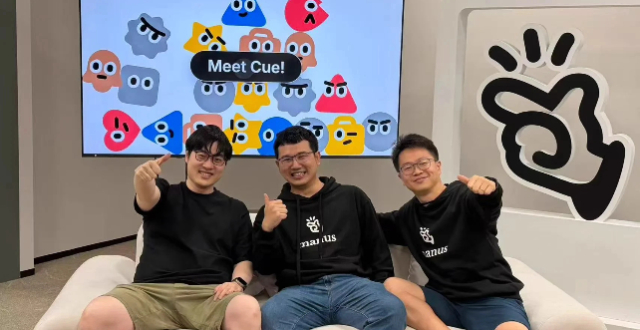
Manus,刚刚悄悄发布了自己的2.0宣言
Timeline and related coverage

GPT-6.1 Terra in GitHub Copilot

GPT-6.1 Terra, OpenAI’s newest model, is now generally available in GitHub Copilot. It is designed for everyday agentic coding and terminal work at a lower cost than GPT-6.1 Sol. In… The post GPT-6.1 Terra in GitHub Copilot appeared first on The GitHub Blog.

Timeline and related coverage

Microsoft offers buyouts to 60,000 employees

Microsoft is offering voluntary buyouts to up to 60,000 employees across the US, UK, Canada, and India. In a message to employees, Microsoft chief people officer Amy Coleman writes that this gives staff members "the opportunity to leave Microsoft with financial support and career planning resources" as the company looks to trim staff without another […]

Microsoft offers buyouts to 60,000 employees
Timeline and related coverage

TACS-RF: Tool-driven Agentic Circuit Synthesis of RF and mmWave Modules

arXiv:2610.31882v1 Announce Type: new Abstract: We present the framework of TACS-RF - a Tool-driven Agentic Circuit Synthesis of RF and mmWave modules. In this framework, a large-language-model (LLM) coding agent (Claude Opus 4.8) directly drives industry-standard electronic-design-automation (EDA) tools such as Cadence Virtuoso/Spectre, Calibre, Cadence EMX, and Ansys HFSS to design RF and mmWave modules. We validate the framework through the agentic design of a 240-251 GHz sub-THz transmitter in a 90 nm SiGe BiCMOS process. The agent semi-autonomously designed the sub-blocks including a 60 GHz push-push Colpitts VCO with second-harmonic extraction, multistage differential cascode power drivers, a push-push frequency doubler, a differential bowtie antenna, and all the interstage matching

TACS-RF: Tool-driven Agentic Circuit Synthesis of RF and mmWave Modules
Timeline and related coverage

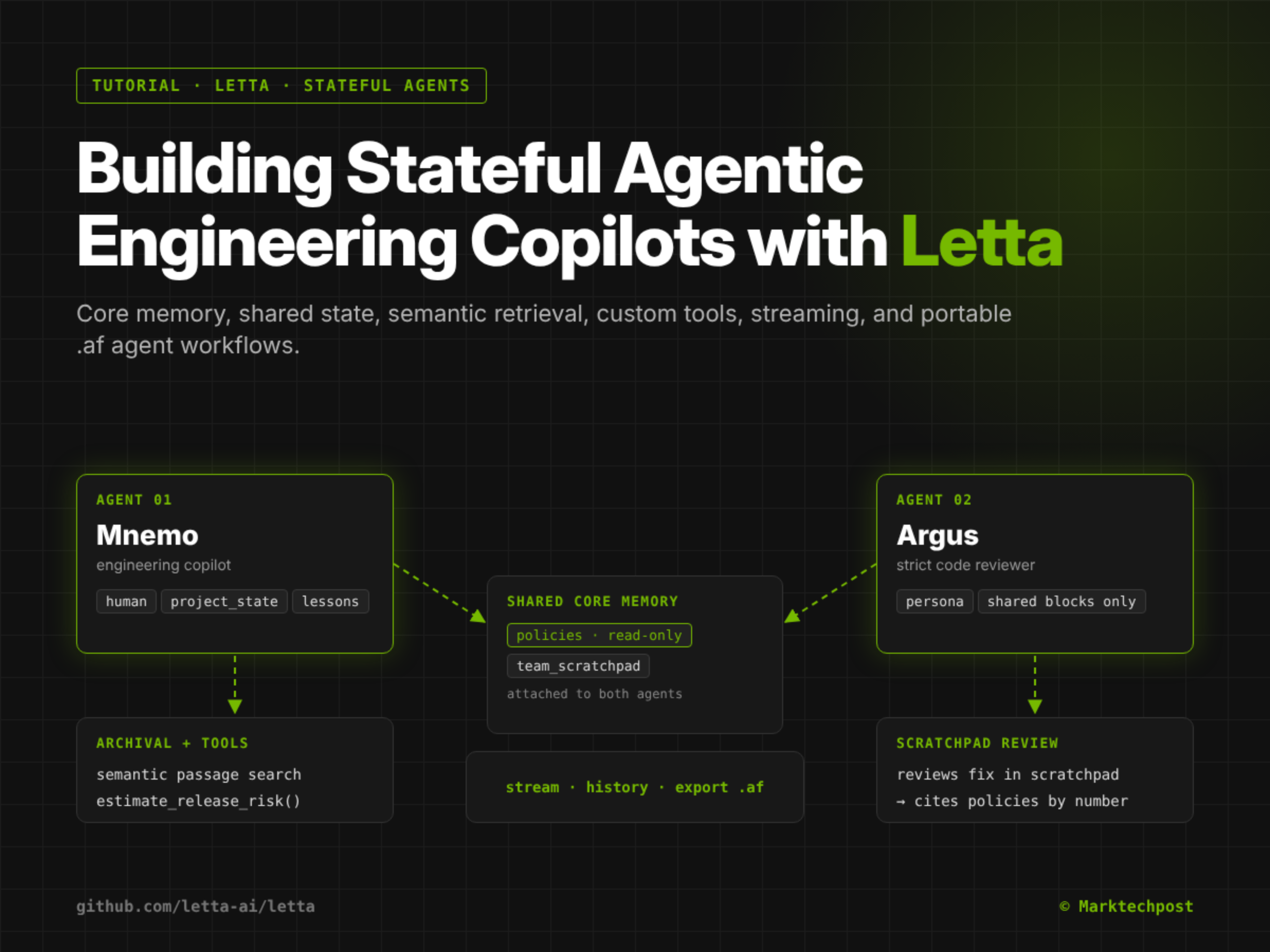
Letta platform releases a tutorial on building stateful engineering collaborators: supporting core memory, shared state, and portable workflows.

MarkTechPost published a tutorial on October 24, 2026, detailing how to build an agentic copilot with persistent state using the Letta framework. The guide covers capabilities such as verifiable core memory, multi-agent shared memory, semantic retrieval of archived knowledge, custom Python tool integration, streaming responses, and .agent format (.af) export. The content serves as a technical practice guide and does not provide performance metrics, security audits, or production‑environment validation.

Stateful Agentic Engineering Copilots with Letta: Core Memory, Shared State, Semantic Retrieval, Custom Tools, Streaming, and Portable Agent Workflows
Timeline and related coverage

How Three Java Champions Leverage GitHub Copilot to Boost Development Efficiency: Focusing on Human-AI Collaboration and Shared Responsibility

Vlad Mihalcea, Patrick Baumgartner, and Frank Delporte, three seasoned Java Champions, shared their experiences using GitHub Copilot in production environments and open-source projects, emphasizing human-led problem definition, context anchoring, iterative validation, and ultimate accountability—rather than relying on AI to automatically generate code.

Timeline and related coverage

How to seamlessly resume a GitHub Copilot session in VS Code

GitHub’s official tutorial explains how to import an entire Copilot session—complete with generated code changes, conversation context, and the working tree—into Visual Studio Code with a single click, enabling an end-to-end collaboration workflow that requires no branch rebase, preserves all context, and allows you to review/edit/test directly before pushing to the associated pull request.

Timeline and related coverage

Quoting Addy Osmani, Morgan Westlee Lunt, and Qing Wang

We think "did a human read the code?" is an imprecise proxy for "what could go wrong with this change, and which check—automated or human—is the right one to catch it?" Asking that question also changed when review happens. Before, review was a gate at the end of the road: write the code, open a PR, wait for your colleague. Now, review runs continuously, more like spellcheck while you write. Most changes have been reviewed and fixed by Claude at least once before a human is asked to look. This catches most routine mistakes, and saves team attention for higher-level questions and scrutiny. — Addy Osmani, Morgan Westlee Lunt, and Qing Wang, How the Claude Code team does code review Tags: anthropic, claude, ai, claude-code, llms, addy-osmani, coding-agents, generative-ai, agentic-engineering,

Timeline and related coverage

sparqlite: SPARQL 1.1 inside SQLite, written in Rust

Research: sparqlite: SPARQL 1.1 inside SQLite, written in Rust This research task is really an experiment in running Claude Code for web in "Ultracode" mode, as described in Orchestrate subagents at scale with dynamic workflows in the Claude Code documentation. With Ultracode turned on, Claude Code makes aggressive use of dynamic workflows - it generates JavaScript that defines and coordinates a network of subagents to take on complex problems. My initial prompt was this - I meant "hit the rows directly", the word "delete" was an accidental typo on my phone: Write a SQLite extension in Rust that implants SPARQL and runs really fast because it can hit the delete rows directly This caused Claude Code for web to churn for over 12 hours. I checked in on its progress the next day and sent a sin

Timeline and related coverage

Chirp Pong

Tool: Chirp Pong Another game experiment - I wanted to see if it was feasible to have a two player game on two separate phones running in static HTML where the networking code uses chirps sent via the microphone. It seems to work! Build a two player competitive pong like game where two players use their phones close to each other and the game state is sent via audio noises which the web microphone API can interpret - but add graphical and gameplay twists to make it a lot more fun and intertwine than pong Claude Opus 5.5 Extra in Claude Code. Tags: game-design, ai, generative-ai, llms, claude-code

Timeline and related coverage

LaTeX renderer

Tool: LaTeX renderer Inspired by Paul Ford and Aboard Foundary's new web app Tiny Little Office, which provides a suite of web app content editors (a Word Processor, Outliner, Presentation Builder, Spreadsheet, Calculator, Drawing Tool, Diagram Maker, Animator, Calendar, and Trip Planner). Tiny Little Office's signature trick is to store all of the document data in the #fragment section of the URL, so every document created using it becomes a bookmarkable and shareable link. It also has an llms.txt file telling agents how to construct URLs that will render as documents. Claude used that file to generate this link to a deck that explains how the URL format works: Tiny Little Office inspired me to have Claude Code (Opus 5.5 Extra) build a similar tool that works with LaTeX. Here's the sequen

Timeline and related coverage

Tree Appreciator

Tool: Tree Appreciator Another game experiment with Claude. This one used the default Claude iPhone app (chat mode, not Claude Code mode), where I prompted Claude Opus 5.5 Max with: Build a three js game called "Tree appreciator" - it shows you two algorithmically generated trees and the game mechanics is about appreciating the differences between them. Think hard about how to make sure it is both fun and beautiful. Somewhat embarrassingly given my recent talk, I've found that telling Opus 5.5 "make sure it is fun" works uncomfortably well. In this case Claude crunched for 3 hours and 7 minutes before retuning a cosy little spot-the-difference game with music and animation and achievements that's quite compelling to play. Tags: game-design, javascript, ai, generative-ai, llms, claude, vibe

Timeline and related coverage